On This Page
Business Automation Trends to Watch in 2027
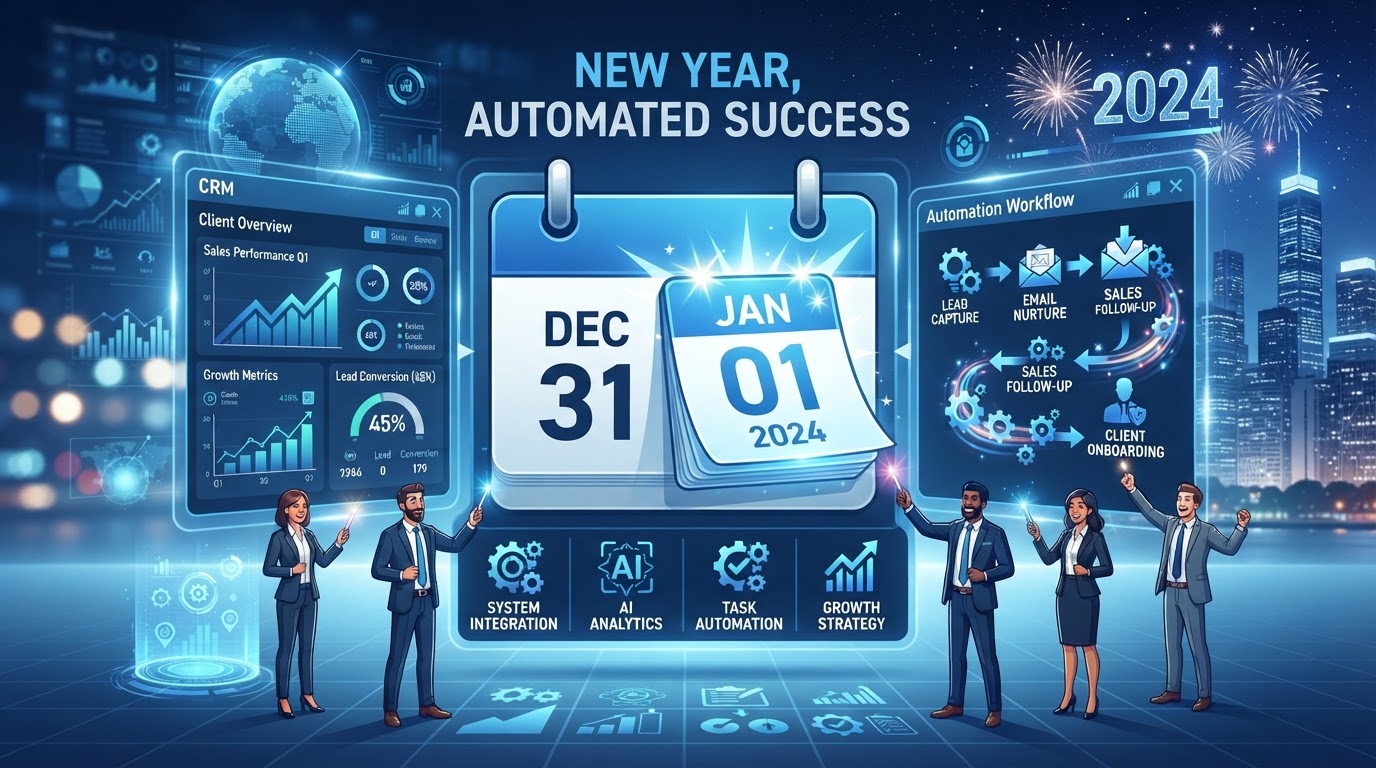
Every new year brings a fresh wave of automation trends, and 2027 is no exception. The shifts underway — from rigid scripts to reasoning agents, from text-only bots to multimodal voice, from reactive reporting to predictive CRM — are reshaping what service businesses can automate and how. But not every trend matters for every business, and the hype cycle can lead to investments in flashy technology that doesn't move the needle. This guide covers the automation trends actually worth watching in 2027, with practical adoption guidance for service businesses — separating the transformative from the trendy. You can also see our live [New Year promotion page](/promotions/new-year) for current offers.
01Trend 1: Agentic Workflows Replace Rigid Scripts
The most significant automation shift in 2027 is the transition from deterministic, rule-based workflows to agentic workflows — automations powered by AI agents that can reason, plan, and adapt. Instead of mapping every branch and handling every edge case manually, you give the agent a goal, a set of tools, and guardrails, and it determines the sequence.
Why this matters for service businesses: the long tail of edge cases is where most automation budgets vanish. A traditional workflow handling 90% of cases cleanly still leaves 10% requiring human cleanup. Agents close that gap by reasoning about unexpected inputs instead of failing on them. According to McKinsey's State of AI report, companies deploying agentic workflows saw a 40% reduction in exception handling compared to rule-based automation.
Adoption guidance: start with a contained, well-defined use case — lead qualification, appointment scheduling, customer support triage. Give the agent a limited toolset (3–5 tools), clear success criteria, and guardrails that prevent it from taking actions outside its scope. Don't deploy an agent with broad, vague goals — constrain it tightly and expand gradually. Our AI chatbots and voice assistants service ships agent-backed bots by default, and our AI agent vs chatbot guide covers the distinction in detail.
02Trend 2: Voice AI Crosses the Customer-Facing Threshold
Voice AI has been 'almost ready' for years. In 2027, it crosses the threshold for production customer-facing use — sub-800ms latency, reliable interruption handling, and natural-enough voices that callers rarely realize they're talking to a machine. This opens up a new category of automation: AI front-desk agents that book appointments, answer FAQs, and triage calls 24/7.
Why this matters for service businesses: phone calls are still the primary contact method for most service businesses — clinics, contractors, law firms, auto shops. An AI voice agent that handles calls 24/7 captures every inquiry, books appointments directly into the calendar, and escalates complex matters to humans. This eliminates the missed-call revenue leak (where unanswered calls go to the next business on Google) and provides after-hours coverage that no human team can match.
Adoption guidance: deploy voice AI as the front line, with human escalation for anything complex or high-value. The entire conversation should be logged to the CRM with a summary and sentiment score. Start with after-hours coverage (where you currently have voicemail) before replacing daytime call handling. Our AI chatbots and voice assistants service builds these voice agents, and our chatbot human handoff guide covers the escalation framework.
03Trend 3: Predictive CRM Goes Native
Lead scoring and predictive analytics used to require a data science team and months of iteration. In 2027, modern CRMs ship with predictive models trained on your historical data out of the box — scoring leads, predicting churn, forecasting revenue, and recommending next actions, all in real time.
Why this matters for service businesses: predictive scoring, wired into routing rules, means hot leads route to sales the instant their score crosses a threshold — no manual review, no delay. A lead that visits your pricing page twice and downloads a case study gets routed to a rep in under a minute, while a cold lead stays in an automated drip. This single capability typically lifts conversion 20–30%.
Adoption guidance: if you're using a modern CRM, predictive scoring is likely already available and just not turned on. Start by enabling it, configuring the routing thresholds, and instrumenting the funnel so you can see which score bands convert. Don't build a custom predictive model unless you have the data science resources — the native models are good enough for 90% of service businesses. Our CRM and pipeline automation service includes a scoring audit as standard.
04Trend 4: Compliance Automation Becomes Essential
As AI and automation touch more customer data and communication channels, compliance requirements are tightening — TCPA for SMS, HIPAA for health data, GDPR and state privacy laws for customer data. In 2027, compliance isn't a separate concern from automation; it's a built-in requirement, and the automation platforms that handle compliance natively have a significant advantage.
Why this matters for service businesses: every SMS campaign, every AI chatbot that touches customer data, every automated workflow that processes personal information must comply with applicable regulations. Non-compliance isn't just a legal risk — it's a business risk, as penalties, lawsuits, and reputational damage can be catastrophic. According to the Federal Communications Commission's TCPA enforcement data, SMS compliance violations have resulted in millions in penalties.
Adoption guidance: build compliance into your automation from the start, not as an afterthought. For SMS: ensure explicit opt-in consent, clear opt-out mechanisms, and respect for quiet hours — our TCPA and AI texting compliance guide covers the requirements. For health data: ensure HIPAA-compliant tools and processes — our HIPAA-conscious patient intake guide covers the specifics. For customer data: ensure proper consent, retention policies, and deletion capabilities — our AI CRM security checklist covers the data protection layer.
05Trend 5: Multimodal AI and Unified Customer Views
AI is becoming multimodal — able to process text, voice, images, and video together. For customer-facing automation, this means a chatbot that can see a photo a customer uploads (a photo of a damaged roof for a contractor, a photo of a skin condition for a dermatologist) and reason about it in context. Combined with unified CRM data, this creates a richer, more helpful customer interaction.
Why this matters for service businesses: many service inquiries involve visual information — 'look at this damage,' 'is this normal,' 'can you fix this?' A multimodal AI that can process images alongside text provides instant, context-aware responses that a text-only bot cannot. For a contractor, a customer uploads a photo of water damage and the AI assesses urgency and routes accordingly. For a clinic, a patient uploads a photo of a rash and the AI triages the appointment priority.
Adoption guidance: multimodal AI is emerging but not yet mature for all use cases. Monitor the capability, and adopt it first for use cases where visual information is central to the inquiry (contractors, clinics, real estate, automotive). Ensure the AI is scoped to assess and route, not to diagnose or prescribe — human review is still required for consequential decisions. Our AI chatbots and voice assistants service tracks these capabilities as they mature.
06Trends to Be Cautious About
Not every trend deserves adoption. Here are the ones to approach with caution:
Fully autonomous AI agents with no human oversight. The hype suggests AI agents will soon run entire businesses autonomously. The reality: autonomous agents are reliable for narrow, well-defined tasks but risky for broad, consequential decisions. Always maintain human oversight for anything that affects customers, revenue, or compliance. Our why business automations fail guide covers the failure modes of over-autonomous systems.
Blockchain for business automation. Despite years of hype, blockchain adds complexity and cost without clear benefit for most service business automation. Unless you have a specific, verified use case (supply chain provenance, multi-party trust), skip it. The automation ROI is in AI and integrations, not distributed ledgers.
Over-customization. The temptation with new automation capabilities is to build highly custom, complex workflows. But custom workflows are harder to maintain, more prone to breaking, and more expensive to update. Prefer standard, well-supported automation patterns over custom builds — the maintainability is worth more than the customization. Our automation monitoring best practices guide covers why simple, standard automations outperform complex custom ones over time.
07How to Evaluate Which Trends Matter for Your Business
Not every trend matters for every business. Use this framework to evaluate which to adopt:
| Question | If Yes | If No |
|---|---|---|
| Does it address a real pain point? | Evaluate further | Skip |
| Is the technology mature enough for production? | Evaluate further | Monitor, don't adopt |
| Can you deploy it with your current team/budget? | Plan adoption | Wait for costs to drop |
| Does the ROI justify the investment? | Adopt | Skip |
| Can you maintain it long-term? | Adopt | Skip or partner |
The framework prevents trend-chasing. A trend that doesn't address a real pain point, isn't mature enough for production, or can't be maintained long-term is a distraction, not an opportunity. Focus on the trends that pass all five questions — those are the ones that will actually move your business forward. Our automation audit and consulting service helps businesses evaluate which trends and technologies are worth adopting for their specific context.
08An Anonymized Example from Our Work
A dental clinic was evaluating several 2027 automation trends: agentic workflows, voice AI, and predictive CRM. Through the evaluation framework, we determined: agentic workflows were premature for their needs (their use cases were well-served by rule-based automation), voice AI was a strong fit (after-hours call handling was a major pain point), and predictive CRM was already available in their platform but not enabled. They adopted voice AI for after-hours coverage (capturing calls that previously went to voicemail) and enabled predictive lead scoring (routing high-score leads to the front desk immediately). They skipped agentic workflows and multimodal AI as not yet mature for their context. The result: after-hours call capture increased 100% (from voicemail to AI booking), and lead routing improved response time from hours to minutes. The disciplined evaluation — adopting what fit, skipping what didn't — produced a higher ROI than adopting every trend would have.
09Adopting Trends with Discipline
The automation trends of 2027 are genuinely transformative — agentic workflows, voice AI, predictive CRM, and compliance automation are reshaping what service businesses can achieve. But transformation requires discipline: adopt the trends that address your real pain points, are mature enough for production, and can be maintained long-term. Skip the rest. The framework above ensures your automation investment goes to the trends that will actually move your business forward. If you're ready to evaluate which trends fit your business, the automation audit and consulting service provides a tailored assessment. And for new-year offers, visit our promotion page. Because the best automation strategy for 2027 isn't adopting every trend — it's adopting the right ones, for the right reasons, at the right time.
Key Takeaways
- Agentic workflows replace rigid scripts — AI agents reason about edge cases instead of failing on them, reducing exception handling by 40%.
- Voice AI crosses the customer-facing threshold in 2027 — sub-800ms latency and natural voices enable 24/7 AI front-desk agents.
- Predictive CRM goes native — lead scoring, churn prediction, and revenue forecasting are built into modern CRMs, often just not enabled.
- Compliance automation becomes essential — TCPA, HIPAA, and privacy requirements must be built into automation from the start.
- Evaluate trends with discipline: adopt only those that address real pain points, are production-mature, and can be maintained long-term.

Written by Moise
Founder & Lead Automation ArchitectMoise is the founder and lead automation architect at Wootomatic. With over a decade of hands-on experience designing, implementing, and maintaining high-throughput business automations, CRM pipelines, and custom AI agents, he has architected mission-critical workflows for hundreds of appointment-based and field-service businesses. His focus is on resilient, monitored systems that produce measurable ROI without fragile software bloat.
Ready to Put This Into Action?
Tell us about your workflow and we'll scope a custom automation within 24 hours.