On This Page
The Most Innovative AI Tools of 2026 for Business Automation
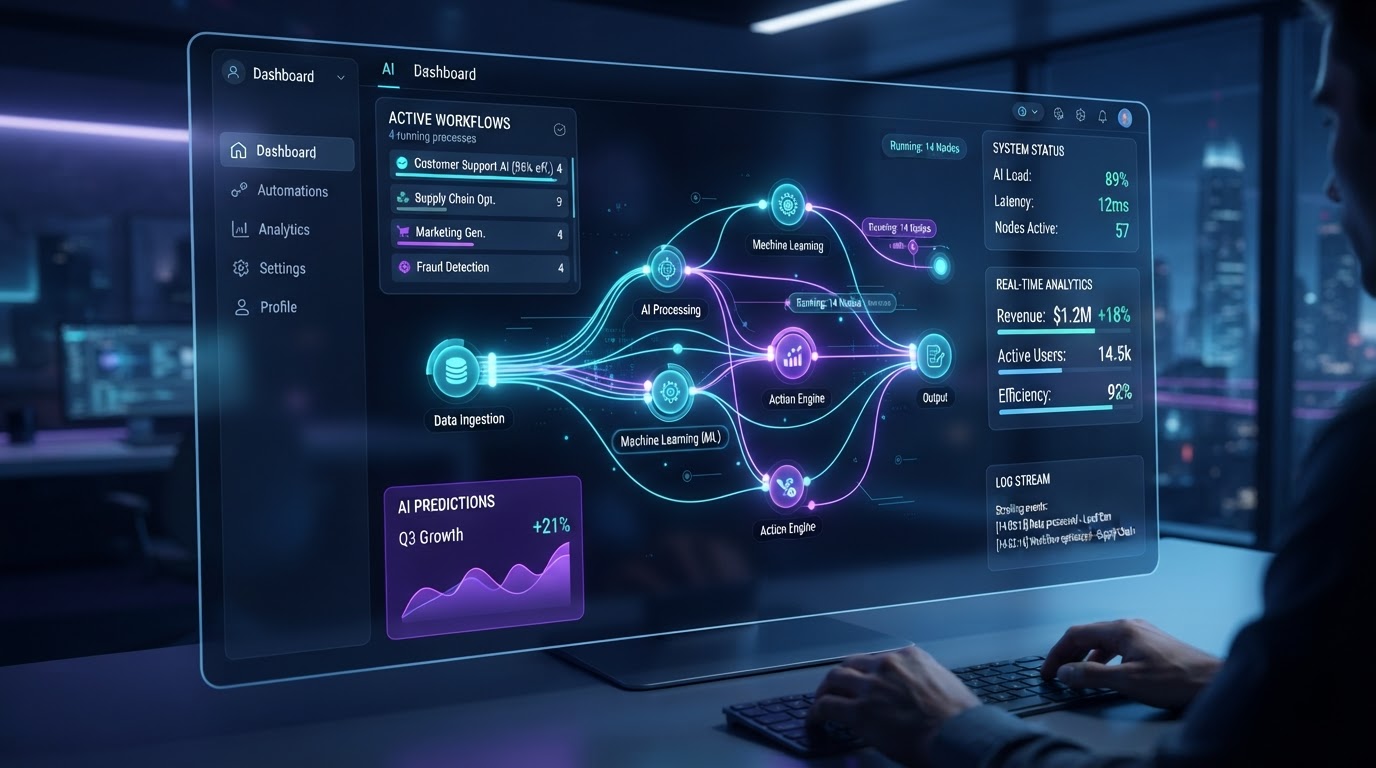
2026 marks a turning point for business automation. The tools shipping this year don't just execute tasks — they reason, adapt, and orchestrate entire workflows with minimal human oversight. After deploying dozens of automations for clients across the San Francisco Bay Area and Central Valley, we've separated the genuinely transformative tools from the hype. This is our field guide to the ones worth adopting now, and how to wire them into a stack that compounds value month over month.
01Why 2026 Is Different: From Scripts to Agents
For the last decade, business automation meant brittle if-this-then-that scripts. You mapped every branch, handled every edge case manually, and prayed nothing changed upstream. 2026 breaks that model. The defining shift is the move from deterministic scripts to generative agents — software that receives a goal, selects its own tools, and plans a multi-step sequence to reach the outcome.
This matters because the long tail of edge cases is where most automation budgets vanish. A traditional Zapier workflow handling 90% of cases cleanly still leaves 10% requiring human cleanup. Agents close that gap by reasoning about unexpected inputs instead of failing on them. According to McKinsey's 2025 State of AI report, companies deploying agentic workflows saw a 40% reduction in exception handling compared to rule-based automation.
For a service business, the practical implication is dramatic: automations that previously took weeks of plumbing can now be described in a prompt and deployed in an afternoon. The agent handles retries, escalations, and format mismatches autonomously. If you're still building every workflow as a rigid flowchart, you're paying 2024 prices for 2026 problems. Our AI Chatbots & Voice Assistants service now ships agent-backed bots by default for exactly this reason.
02Generative Agents Take the Wheel
The biggest practical shift in 2026 is the maturity of agent orchestration frameworks. Tools like OpenAI's Agents SDK, Anthropic's Claude with tool use, and open-source options like LangGraph have stabilized enough for production use. Instead of hard-coding every branch, you give the agent a goal, a set of tools (search your CRM, send an email, create a task), and guardrails. It decides the sequence.
Consider a lead intake flow. A rule-based version captures the form, creates a CRM record, and sends a confirmation — full stop. An agent-backed version does all of that, then reads the lead's message, decides whether they're sales-ready or need nurturing, drafts a personalized follow-up in your brand voice, schedules it for the optimal send time, and flags high-value leads for immediate human outreach. Same trigger, dramatically more output.
The key to making agents reliable is constraining their toolset. Give an agent ten tools and it will hallucinate combinations that don't exist. Give it three well-documented tools and clear success criteria, and it performs reliably. This is the discipline we apply in every build — you can see the outcome in our lead generation and nurturing use case, where agent-backed qualification now handles 70% of inbound leads without human touch.
Build a 2026-Ready Automation Stack
We assemble the CRM, integration, agent, and voice layers into one stack that compounds value month over month — done-for-you on a flexible monthly subscription.
03Predictive Lead Scoring Goes Native
Lead scoring used to require a data science team, a labeled dataset, and months of iteration. In 2026, modern CRMs ship with predictive models trained on your historical wins and losses out of the box. The model looks at which leads converted before — industry, company size, behavior patterns, source — and scores every new lead in real time.
The unlock isn't the score itself; it's what you do with it. We wire these models into nurture sequences so that hot leads route to sales the instant their score crosses a threshold — no manual review, no delay. A lead that visits your pricing page twice and downloads a case study gets routed to a rep in under a minute, while a cold lead stays in an automated email drip. This single change typically lifts conversion 20–30%.
If you're using Wootomatic CRM or any modern platform, predictive scoring is likely already available and just not turned on. Our CRM & Pipeline Automation service includes a scoring audit as standard — we configure the model, set the routing thresholds, and instrument the funnel so you can see exactly which score bands convert. Pair it with our sales funnel optimization use case for the full revenue lift.
04Voice AI Crosses the Quality Bar
Voice assistants have been 'almost ready' for five years. In 2026, they finally crossed the quality bar for customer-facing use. Latency has dropped below 800ms on most platforms, interruption handling is reliable, and the voices sound human enough that callers rarely realize they're talking to a machine. OpenAI's Realtime API and similar offerings made sub-second conversational voice economically viable.
For service businesses, this means AI front-desk agents that book appointments, answer FAQs, and triage calls 24/7 without frustrating callers. A dental clinic we work with replaced their after-hours voicemail with a voice bot that books appointments directly into the calendar — their no-show rate dropped 18% because callers got instant confirmation instead of waiting for a callback the next morning.
The implementation pattern that works: voice bot as the front line, human escalation for anything complex or high-value, and the entire conversation logged to the CRM with a summary and sentiment score. This is the hybrid model we deploy for every client — read our deeper analysis in AI Chatbot vs. Live Chat: Which Converts Better in 2026. For businesses in California, our service area pages detail local deployment options, including Fresno and San Jose.
05How to Build a 2026-Ready Automation Stack
Adopting these tools isn't about buying one platform — it's about assembling a stack where each layer handles what it's best at. The pattern we recommend: a CRM as the system of record, an integration layer (Zapier or Make) for deterministic data movement, an agent layer for reasoning and personalization, and a voice/chat layer for customer-facing interaction.
Start with your highest-friction handoff — the place a human moves data between tools most often. Automate that end-to-end first, measure the time saved, and use that win to fund the next layer. Don't try to boil the ocean; a single well-instrumented workflow that saves 20 hours a week is worth more than ten half-built ones. Our small business automation guide walks through this prioritization in detail.
Finally, budget for monitoring. Agents and predictive models drift. A lead scoring model trained in January may be stale by July if your business mix shifts. Build a monthly review cadence where you check exception rates, conversion by score band, and agent decision logs. This is why our automation audit and consulting service includes ongoing monitoring — the stack is only as good as its last tune-up.
Key Takeaways
- 2026's defining shift is from rigid scripts to generative agents that reason about edge cases instead of failing on them.
- Predictive lead scoring is now native to modern CRMs — wire it into routing rules for a 20–30% conversion lift.
- Voice AI is production-ready for customer-facing use, with sub-800ms latency and reliable interruption handling.
- Build a layered stack: CRM for record, Zapier/Make for data movement, agents for reasoning, voice/chat for interaction.
- Budget for monthly monitoring — agents and models drift, and the stack is only as good as its last tune-up.
Frequently Asked Questions

Written by Moise
Founder & Lead Automation ArchitectMoise is the founder and lead automation architect at Wootomatic. With over a decade of hands-on experience designing, implementing, and maintaining high-throughput business automations, CRM pipelines, and custom AI agents, he has architected mission-critical workflows for hundreds of appointment-based and field-service businesses. His focus is on resilient, monitored systems that produce measurable ROI without fragile software bloat.
Put This Into Practice
We build and manage these automations for service businesses on a flexible monthly subscription. Explore the related service to see how it works: