On This Page
Auto Repair Shop Appointment Automation: Booking, Reminders, Estimates, and Reviews
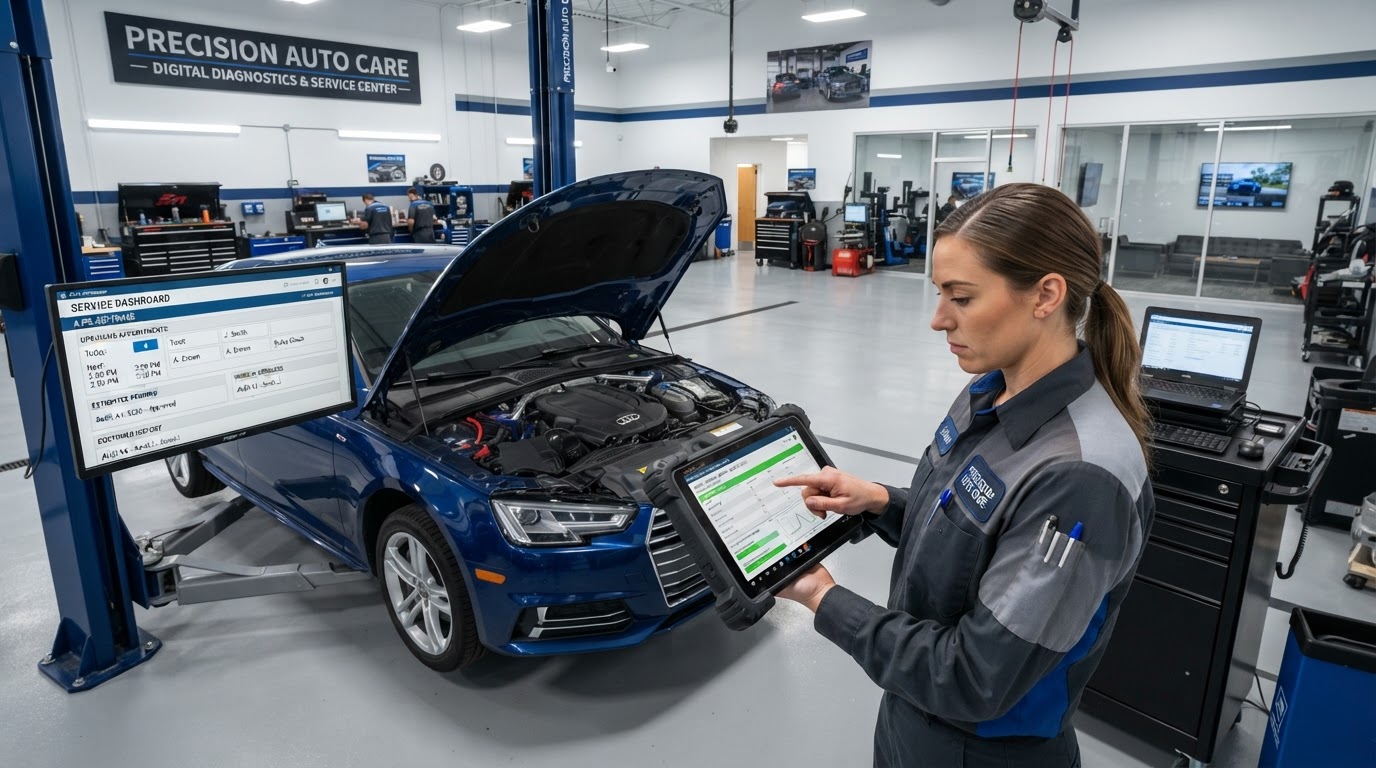
Auto repair shops operate on a simple equation: empty bays mean lost revenue, and every no-show or unbooked hour is $80–$200 in labor that's gone forever. Yet most shops still book appointments by phone — the customer calls, the service advisor is with another customer, the call goes to voicemail, and the customer books at the shop down the street. The same shop that can't answer the phone also can't follow up on estimates, remind customers about pending repairs, or collect reviews after service — because the service advisor is too busy writing repair orders to do any of it. After automating appointment and follow-up workflows for auto repair shops, the pattern is clear: the shops that automate booking, reminders, and follow-up consistently run fuller bays, have higher customer retention, and generate more reviews than those that don't. This guide covers the specific workflows that fill the schedule and keep it full.
01The Auto Repair Booking Problem
Auto repair is a business of bays and hours. A shop with 4 bays operating 10 hours/day has 40 bookable hours per day — and every empty hour is $80–$200 in lost labor revenue. The challenge is that most shops still book by phone, and phone booking is a fragile process: the customer calls when they think about it (often during the shop's busiest hours), the service advisor is with another customer, the call goes to voicemail, and the customer — who was ready to book — calls the next shop on Google. An estimated 20–30% of inbound calls to auto repair shops go unanswered during business hours, according to RepairPal's auto repair industry data.
The solution is online booking automation — but not just a static form. The booking system must show real bay and technician availability, let the customer pick a time that works for them, automatically book the appointment, and send a confirmation — all without a phone call. This captures the customer who was ready to book but couldn't reach the shop, and it frees the service advisor from the phone-tag that interrupts their day. The appointment and calendar automation service builds these booking systems with real-time availability.
The booking system should also capture the vehicle and service information at booking time: year, make, model, mileage, and the service requested (oil change, brake job, diagnostic, etc.). This lets the service advisor prepare for the appointment — pulling parts, allocating the right technician, estimating the time — before the customer arrives, rather than discovering the scope at check-in. This single workflow change typically reduces the check-in time from 15 minutes to 5 and improves the customer experience dramatically.
02Service Reminders and No-Show Reduction
Once the appointment is booked, the reminder sequence is what prevents no-shows — and auto repair no-shows are expensive. Each no-show is an empty bay that could have been filled by another customer, and the lost revenue compounds when the no-show was a $400 brake job instead of a $40 oil change. The reminder sequence: SMS 48 hours before ('Hi [name], confirming your appointment at [shop] on [date] at [time] for your [vehicle]. Reply Y to confirm or call us to reschedule.'), SMS 24 hours before, and SMS 2 hours before. This sequence typically reduces no-shows from 25% to 10–12%.
The reminders should include the specific details — date, time, vehicle, and service — so the customer can confirm the details are correct. A reminder that says 'You have an appointment' is less effective than 'You have an appointment on Tuesday at 2pm for your 2019 Honda Civic's brake inspection.' The specificity reassures the customer that the shop has their information correct and reduces the 'I thought it was Wednesday' no-shows. The med spa automation guide covers the same reminder sequence pattern — the principles are identical for any appointment-based business.
The no-show recovery sequence triggers if the customer doesn't show up: within 30 minutes of the missed appointment, an SMS goes out: 'Hi [name], we missed you at your appointment today. Would you like to reschedule? Here's a link to our calendar.' This typically recovers 40–60% of no-shows — customers who genuinely forgot (not customers who deliberately skipped) appreciate the easy reschedule option and rebook immediately. The missed-call text-back automation framework covers the recovery pattern that applies equally to missed appointments.
03Automated Estimates and Approvals
The estimate is where auto repair shops lose customers — not because the price is wrong, but because the communication is slow. A customer drops off their car, the technician finds additional work needed, the service advisor writes the estimate, and the customer waits hours for a phone call to approve. In the meantime, the customer is anxious, the bay is occupied, and the shop is losing throughput. Automated estimate delivery changes this: the estimate is generated in the shop management system, automatically texted to the customer with a link to approve digitally, and the approval flows back to the shop in real time.
The estimate SMS should include a clear summary: 'Your [vehicle] needs [services] for $[total]. Here's the detailed breakdown: [link]. Tap to approve or call us with questions.' The link opens a mobile-friendly estimate page with line items, parts and labor breakdown, and a single-tap approval button. When the customer approves, the shop is notified instantly and the work proceeds — no phone tag, no delays, no anxious waiting. This single automation typically reduces estimate approval time from 2–4 hours to 20–40 minutes, which means more cars through the bay per day.
The decline path matters too. If the customer declines the estimate, the automation should capture the decline reason (too expensive, not urgent, wants a second opinion) and route it to the service advisor for follow-up. A customer who declines because 'it's too expensive' might be open to a phased approach (do the critical repairs now, the rest later); a customer who 'wants a second opinion' might be retained with a more detailed explanation. The follow-up — not the initial estimate — is what recovers the declined work. The lead response time automation framework's follow-up pattern applies directly to estimate follow-up.
04Post-Service Follow-Up and Reviews
After the service is complete, the follow-up sequence is what drives retention and reviews — and most shops do neither. The customer picks up their car, drives away, and the shop never follows up — no satisfaction check, no review request, no reminder that the brake pads will need replacing in 6 months. Automated post-service follow-up changes this: within 24 hours of service completion, an SMS goes out: 'Hi [name], thanks for choosing [shop]! How did we do? Reply with any feedback.' If the response is positive, a review request follows: 'Glad to hear it! We'd love a Google review — here's the link: [URL].'
The review request is the highest-ROI follow-up for auto repair shops — reviews drive local SEO, and the shop with the most recent, highest-rated reviews wins the most new customers. Automated review requests typically generate 3–5x more reviews than manual requests, and the 24-hour timing captures the customer while the positive experience is fresh. The reputation and reviews AI service builds these post-service review sequences with intelligent timing.
The negative feedback interception is the reputation-protecting variant: before the public review request, send a private satisfaction check-in. If the customer rates below 4 stars, suppress the public review request and route the feedback to the shop manager for immediate follow-up. This catches dissatisfied customers before they post a negative review and gives the shop a chance to resolve the issue — a follow-up call, a goodwill discount, a corrected repair. The contractor lead automation guide covers the same interception pattern for any service business.
05Service Cycle Reminders and Recurring Revenue
Auto repair is not a one-time transaction — it's a recurring relationship based on the vehicle's maintenance cycle. Oil changes every 5,000 miles, tire rotations every 10,000, brake inspections every 20,000, timing belts at 60,000–100,000. A shop that tracks each customer's vehicle mileage and service history can automate reminders at the right intervals: 'Hi [name], your 2019 Civic is due for an oil change based on your mileage. Here's a link to book — mention this text for $10 off.' These reminders drive recurring revenue and position the shop as the trusted maintenance partner, not just the place to go when something breaks.
The reminder should be based on mileage, not just time — a customer who drives 20,000 miles/year needs oil changes more often than one who drives 5,000. If the shop doesn't have the current mileage, the reminder can ask: 'Hi [name], it's been 5 months since your last visit — what's your current mileage? We'll let you know what service is due.' This interactive reminder captures the mileage data and drives the booking in one workflow. The property management maintenance automation guide covers the same lifecycle-based reminder pattern — for auto repair, the vehicle's maintenance cycle is the trigger.
The seasonal automation is another high-ROI pattern. Before winter: 'Time for winter prep — battery check, antifreeze, tire inspection. Book now for $XX.' Before summer: 'AC check and cooling system inspection — book before the heat hits.' These seasonal touches fill the bays during otherwise slow periods and position the shop as proactive, not reactive. The business processes to automate before hiring framework covers the broader re-engagement pattern — for auto repair, the mileage-based and seasonal triggers are the highest-ROI variants.
06Measuring the Automation's Impact
An auto repair automation system without measurement is a black box. Track these metrics:
- Booking rate — percentage of inbound inquiries that result in a booked appointment (target: above 60%)
- No-show rate — should drop from 25% to under 12% with reminders
- Estimate approval time — should drop from hours to minutes with automated delivery
- Review collection rate — should increase 3–5x with automated requests
- Recurring service booking rate — past customers booking proactively from reminders (target: 30–50%)
The bay utilization rate is the ultimate metric: what percentage of bookable bay-hours are actually filled? A shop with 40 bookable hours/day that fills 30 is at 75% utilization; the automation should push that toward 85–90%. Each 5% increase in utilization at $100/hour average adds $200/day in revenue — $73,000/year from a single metric improvement.
Review the metrics monthly and adjust the reminder timing, estimate follow-up cadence, and review request flow based on what the data shows. The automation ROI calculator framework helps quantify the total impact — for auto repair shops, the combined effect of reduced no-shows, faster estimate approvals, more reviews, and recurring service bookings typically delivers 5–10x ROI within the first year. The CRM migration checklist guide is relevant if you're moving from a legacy shop management system to a modern one that supports these automations — the migration should preserve the customer and vehicle history that the reminders depend on.
Key Takeaways
- 20–30% of calls to auto repair shops go unanswered during business hours — online booking automation captures the customers who can't reach you by phone.
- Automated SMS reminders 48/24/2 hours before appointments reduce no-shows from 25% to under 12%, filling bays that would otherwise sit empty.
- Digital estimate delivery with mobile approval cuts estimate approval time from hours to minutes, increasing bay throughput.
- Automated post-service review requests generate 3–5x more reviews — the lifeblood of local SEO for auto repair shops.
- Mileage-based and seasonal service reminders drive recurring revenue and position the shop as the proactive maintenance partner, not just the break-fix option.

Written by Moise
Founder & Lead Automation ArchitectMoise is the founder and lead automation architect at Wootomatic. With over a decade of hands-on experience designing, implementing, and maintaining high-throughput business automations, CRM pipelines, and custom AI agents, he has architected mission-critical workflows for hundreds of appointment-based and field-service businesses. His focus is on resilient, monitored systems that produce measurable ROI without fragile software bloat.
Ready to Put This Into Action?
Tell us about your workflow and we'll scope a custom automation within 24 hours.
Start Your Automation Project