On This Page
Med Spa Automation: 12 Workflows That Reduce No-Shows and Improve Follow-Up
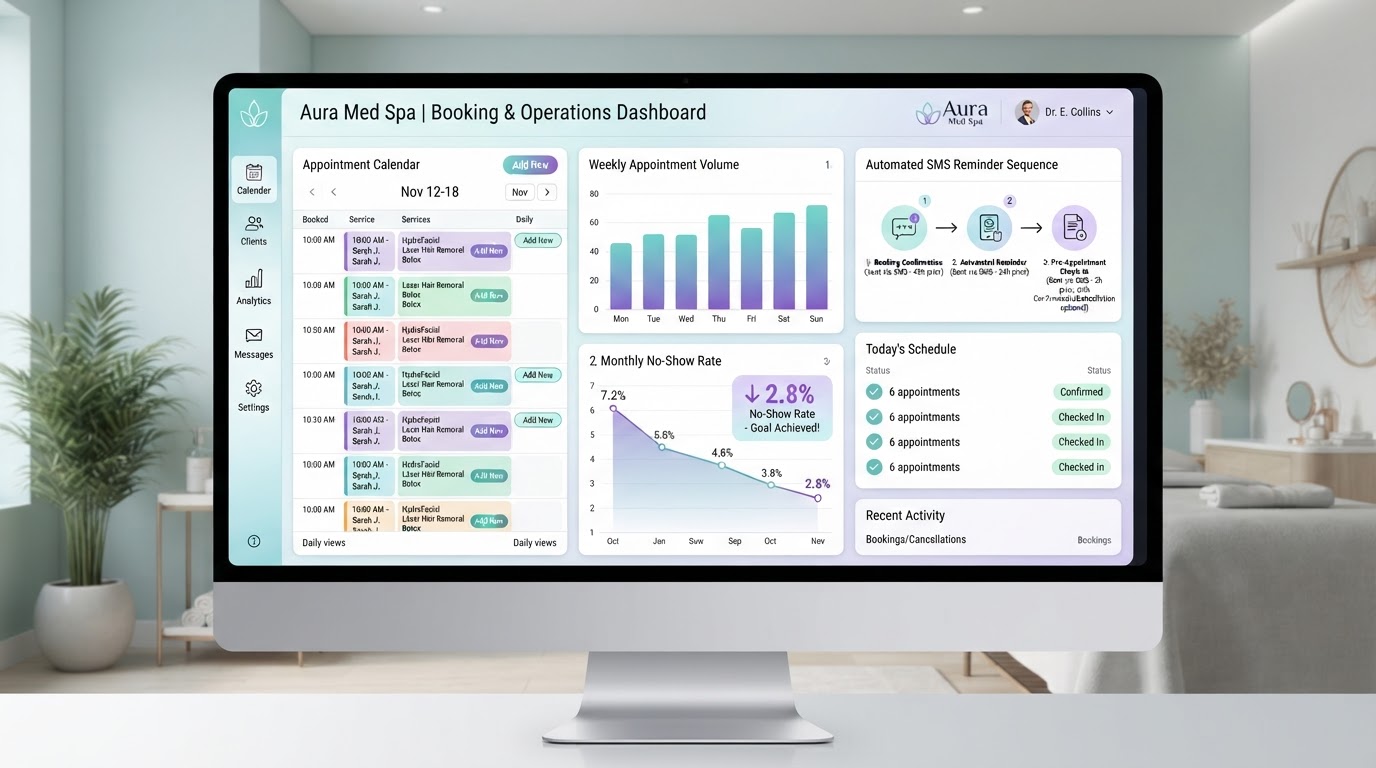
Med spas operate on thin margins and high no-show rates. A single missed appointment — often a $200–$600 service — is revenue that's gone forever, and the industry average no-show rate of 20–30% means med spas are quietly bleeding a quarter of their booking revenue. Automation is the most direct fix, and it's the area where we see the fastest ROI for med spa clients: appointment reminders alone typically cut no-shows by 30–50%, and a full automation stack — covering intake, reminders, post-treatment follow-up, review collection, and membership nurturing — can transform a med spa from a chronically overworked operation into a smoothly running system. This guide covers 12 specific workflows that every med spa should consider, with the measurable impact of each.
01Appointment Reminders and No-Show Recovery (Workflows 1–3)
1. Automated appointment reminders — The single highest-ROI automation for any med spa. Send an SMS reminder 24 hours before and 1 hour before each appointment. This alone typically reduces no-shows from 25% to 12–15%. For a spa doing 200 appointments/month at $300 average, that's recovering 24 appointments/month — $7,200 in recovered revenue from a workflow that costs $200/month in SMS fees. The appointment and calendar automation service builds these reminder sequences as a standard deliverable.
2. No-show recovery sequence — When a patient doesn't show up, trigger an automated SMS within 30 minutes: 'Hi [name], we missed you at your appointment today. Would you like to reschedule? Here's a link to our calendar.' This typically recovers 40–60% of no-shows. Without this automation, a no-show is a permanently lost appointment; with it, more than half are rebooked.
3. Pre-appointment intake automation — Send an automated intake form 48 hours before the appointment. Patients complete their medical history, consent forms, and treatment questions on their phone, and the data flows into the CRM. This eliminates 15–20 minutes of front-desk intake per patient and ensures the provider has the information before the appointment starts — not after.
02Post-Treatment Follow-Up and Care (Workflows 4–6)
4. Post-treatment check-in sequence — After a treatment, send an automated check-in at 24 hours, 72 hours, and 7 days. The 24-hour message asks about pain or concerns; the 72-hour message asks about satisfaction; the 7-day message invites a review and offers a follow-up booking. This sequence improves patient satisfaction (patients feel cared for), catches complications early (the 24-hour check-in surfaces issues before they become emergencies), and drives rebooking (the 7-day message includes a direct booking link).
5. Treatment-specific aftercare automation — Different treatments require different aftercare instructions. A laser treatment needs sun protection reminders; injectables need bruising care; facials need product recommendations. Automate the delivery of treatment-specific aftercare based on the service code in the CRM. This eliminates the front desk's manual task of sending the right instructions and ensures patients always receive accurate care guidance.
6. Rebooking reminders — Many med spa treatments require a series (laser hair removal needs 6–8 sessions; injectables need refreshers every 3–4 months). Automate a rebooking reminder at the optimal interval: 'Hi [name], it's been 3 months since your last Botox treatment. Book your next session to maintain results.' This single automation typically increases repeat-visit revenue by 20–30% because it catches patients at the exact moment they're due, rather than waiting for them to remember and book themselves.
03Reviews and Reputation (Workflows 7–8)
7. Automated review requests — Send a review request via SMS 24 hours after a completed treatment, with a direct link to your Google review page. Timing is critical: 24 hours is long enough for the patient to see results but short enough that the experience is still top of mind. Med spas that automate review requests typically see a 3–5x increase in review volume within the first quarter. The reputation and reviews AI service builds these sequences with intelligent timing based on treatment type.
8. Negative feedback interception — Before sending the public review request, send a private satisfaction survey: 'How was your experience?' If the patient rates below 4 stars, route the feedback to the manager immediately and suppress the public review request. This intercepts dissatisfied patients before they post a public review, giving you the chance to resolve the issue and turn a negative into a positive. This is one of the most reputation-protecting automations a med spa can deploy.
04Membership and Package Nurturing (Workflows 9–10)
9. Membership expiration and renewal automation — If your med spa offers memberships or packages, automate renewal reminders 30 days, 14 days, and 3 days before expiration. Include the remaining unused sessions and a renewal link. This typically recovers 40–60% of lapsed memberships that would otherwise expire silently. The automation also identifies members who haven't used their sessions — a signal to reach out proactively with a 'use it or lose it' reminder that drives engagement.
10. Upsell cross-sell automation — Based on the patient's treatment history, suggest complementary services. A patient who just completed laser hair removal might benefit from a skin treatment for the same area; a patient who gets injectables might be interested in a new treatment line. Automate these suggestions in the post-treatment follow-up, personalized based on the CRM record. This is not pushy upselling — it's informed recommendation based on the patient's actual needs and history.
05Lead Capture and Conversion (Workflows 11–12)
11. New lead instant response — When a prospect submits an inquiry form or calls the med spa, an automated response goes out within 60 seconds acknowledging the inquiry and providing next steps. This is the same lead response time automation framework applied to the med spa context — the 60-second window is where most med spas lose prospects to competitors who respond faster.
12. Consultation booking automation — For aesthetic treatments that require a consultation (most do), automate the consultation booking flow: the prospect picks a time, the system checks the provider's calendar, books the consultation, and sends pre-consultation instructions. This eliminates the phone-tag that typically delays consultations by days and ensures every consultation request is captured — not lost to a missed call or an unread email. The business processes to automate before hiring guide covers the broader intake pattern that this fits into.
06Implementation: Where to Start
Don't deploy all 12 at once — that's the fastest path to overwhelmed staff and a half-configured CRM. Start with the three highest-ROI workflows:
- Appointment reminders — cut no-shows from 25% to 12–15%
- No-show recovery — rebook 40–60% of missed appointments
- Review requests — 3–5x increase in review volume within the first quarter
These three typically deliver 80% of the total impact: reduced no-shows, recovered lost appointments, and increased review volume. Measure the results for 30 days, then use the reclaimed front-desk time to scope and deploy the next batch.
The infrastructure requirement is a CRM with SMS capabilities and calendar integration. Most modern med spa CRMs support this natively; if yours doesn't, the workflow and integration automation service connects your existing tools via integration platforms. The automation ROI calculator framework helps you quantify the impact of each workflow before you build — the ROI on med spa automation is typically so extreme (10x+ on the first three workflows alone) that the investment pays for itself within the first month.
Key Takeaways
- Med spas lose 20–30% of booking revenue to no-shows — automated reminders alone typically cut that rate in half.
- Start with the big three: appointment reminders, no-show recovery, and review requests — they deliver 80% of the total impact.
- Post-treatment follow-up sequences improve patient satisfaction, catch complications early, and drive rebooking at optimal intervals.
- Negative feedback interception catches dissatisfied patients before they post public reviews, protecting your online reputation.
- Membership renewal automation and upsell cross-sell based on treatment history recover lapsed revenue and increase lifetime patient value.

Written by Moise
Founder & Lead Automation ArchitectMoise is the founder and lead automation architect at Wootomatic. With over a decade of hands-on experience designing, implementing, and maintaining high-throughput business automations, CRM pipelines, and custom AI agents, he has architected mission-critical workflows for hundreds of appointment-based and field-service businesses. His focus is on resilient, monitored systems that produce measurable ROI without fragile software bloat.
Ready to Put This Into Action?
Tell us about your workflow and we'll scope a custom automation within 24 hours.
Start Your Automation Project