
On This Page
CRM Migration Checklist: How to Move Contacts, Pipelines, Automations, and Conversations Safely
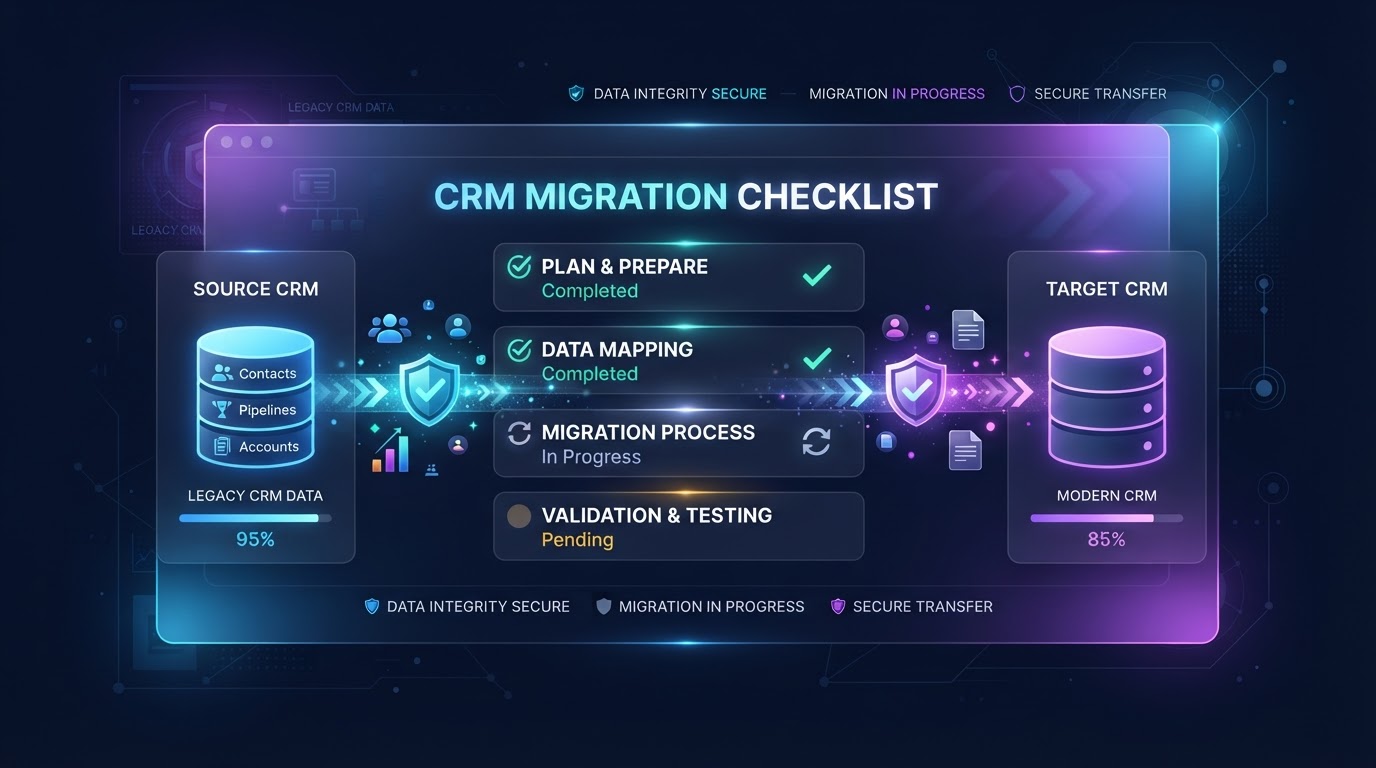
A CRM migration is one of the highest-stakes projects a business can undertake. Get it right and you unlock better automation, cleaner data, and faster growth. Get it wrong and you lose contacts, break active sales pipelines, sever conversation history, and alienate the sales team that depends on the system every day. After migrating dozens of businesses between CRM platforms, we've distilled the process into a checklist that minimizes risk and maximizes data integrity. This guide walks through every step — from pre-migration audit to post-launch stabilization — so you can move your CRM without losing what matters.
01Why CRM Migrations Fail
Most CRM migrations fail not because the technology is hard, but because the planning is thin. The three failure modes are predictable: data loss (contacts or fields don't map correctly and silently disappear), workflow breakage (automations that depended on the old system's structure stop working), and team abandonment (the new system is different enough that the sales team reverts to spreadsheets and email).
Data loss happens when field mapping is treated as an afterthought. Your old CRM has custom fields, tags, and relationship structures that don't exist in the new one. If you map only the standard fields (name, email, phone), you lose the custom data that defines your business — lead source, service type, contract value, referral relationships. A proper migration maps every field, even the ones that seem trivial.
Workflow breakage happens when automations are migrated as configurations rather than re-architected. A workflow that triggered on a specific field value in the old CRM may not have an equivalent trigger in the new one. Copying the logic without understanding the underlying intent leads to automations that fire at the wrong time, or don't fire at all. The workflow and integration automation service covers the re-architecture process in detail.
02Phase 1: Pre-Migration Audit (Weeks 1–2)
Before touching any data, audit what you have. Inventory every contact field, custom field, tag, pipeline stage, automation, template, and integration in your current CRM. Document what each one does, who uses it, and whether it's still active. This inventory becomes your migration map — every item needs a destination in the new system or a deliberate decision to retire it.
Clean your data before migrating, not after. Deduplicate contacts (most CRMs have 10–20% duplicate records), standardize phone number and address formats, fill in missing critical fields, and archive truly dead contacts. Migrating dirty data just moves the mess to a new system — and the mess is harder to clean once it's intermingled with new activity. According to Gartner's data quality research, poor data quality costs organizations an average of $12.9 million annually — don't import that cost into your new CRM.
Map every field explicitly. Create a spreadsheet with columns for: old field name, old field type, sample value, new field name, new field type, transformation needed (e.g., 'concatenate first + last name'), and notes. This mapping document is the single source of truth for the migration. Every field that exists in the old system gets a row — even if the destination is 'retired' — so nothing is silently dropped.
03Phase 2: Pipeline and Automation Architecture (Weeks 2–3)
Pipelines and automations are the heart of your CRM, and they rarely map 1:1 between systems. Re-architect your pipelines for the new system's capabilities, don't just copy the old structure. A pipeline that made sense in your old CRM may have stages that are redundant in the new one, or missing stages that the new system's automation capabilities make valuable. Use the migration as an opportunity to improve, not just replicate.
Document every automation before migrating it: trigger, conditions, actions, and the business intent behind it. Then evaluate whether the new system can replicate it, improve it, or whether it's still needed at all. Many CRMs accumulate automations that are no longer used — a migration is the right time to retire them rather than carrying dead weight into the new system.
Build a dependency map. Automations often depend on each other — one workflow updates a field that another workflow triggers on. Migrating them in the wrong order breaks the chain. Map the dependencies and migrate in dependency order: foundational data first, then field-dependent automations, then notification-based automations last. The CRM and pipeline automation service documents this re-architecture process for businesses moving to a unified platform.
04Phase 3: Data Migration and Testing (Weeks 3–4)
Migrate in a sandbox first, never directly to production. Import your data into a test environment, verify field mapping, check for data loss, and run test automations against the migrated data. This catches mapping errors before they affect your live business. A sandbox migration that reveals 50 missing fields is a success; a production migration that silently drops them is a catastrophe.
Verify data integrity with sampling. Don't trust the import report alone — manually check 50–100 records across different segments (new leads, active deals, closed-won, archived contacts). Confirm that custom fields, tags, notes, and activity history migrated correctly. Pay special attention to relationship data (company-to-contact links, referral relationships) which often breaks in migration.
Test every automation against migrated data. Trigger each workflow manually and confirm it fires correctly with the migrated field values. Test edge cases: empty fields, unusual values, records that were in the middle of a sequence when migrated. An automation that works on fresh data may fail on migrated data if field formats differ subtly. The Zapier vs Make comparison is relevant here — the integration platform you use for migrated automations affects how reliably they handle data format differences.
05Phase 4: Conversation and History Migration
Conversation history — emails, calls, SMS, notes — is what makes a CRM valuable, and it's the hardest data to migrate. Email history often lives in the email provider, not the CRM, and syncing it to the new CRM requires re-connecting the inbox. Call logs may live in a separate telephony system. SMS history may be in a messaging platform. Map every conversation source and plan how each one connects to the new CRM.
Decide what to migrate vs. archive. Migrating 5 years of email history for 10,000 contacts is expensive and often unnecessary. A common approach: migrate the last 12–18 months of conversation history (what's actively relevant) and archive the rest in a searchable backup. This keeps the new CRM fast and focused while preserving access to older history if needed.
Preserve the relationship between conversations and contacts. A migrated email that isn't attached to the right contact record is useless — it's just floating data. Verify that every migrated conversation is correctly linked to its contact, deal, and company records. This is where most migrations lose value silently: the data is technically present but disconnected from the records it belongs to.
06Phase 5: Cutover and Team Enablement (Week 4+)
Plan the cutover for a low-activity period — a weekend, a holiday, or the slowest day of your week. Freeze the old CRM (no new activity), run the final delta migration (anything changed since the sandbox migration), verify, and switch the team to the new system. Have a rollback plan: if something critical breaks, you can revert to the old CRM within hours.
Train the team before cutover, not after. The #1 reason CRM migrations fail is team abandonment — the sales team finds the new system confusing and reverts to spreadsheets. Prevent this with hands-on training on the new system's workflows, not just feature tours. Show each team member exactly how to do their daily tasks in the new CRM, and provide a quick-reference guide for the first two weeks.
Run a hypercare period for 2–4 weeks post-launch. Have a dedicated resource (internal or agency) available to fix issues, answer questions, and tune automations in real-time. The first weeks are when small issues become big frustrations if unaddressed. Monitor adoption metrics: login frequency, records created, automations triggered. If adoption drops, intervene immediately — don't wait for the team to formally complain. The automation audit and consulting engagement includes post-migration stabilization as a standard phase.
07Post-Migration: What to Do in the First 90 Days
The migration isn't done at cutover — the first 90 days are when the new CRM either becomes the team's system of record or becomes shelfware. Week 1–2: daily check-ins with the team, fix issues within hours, monitor automation firing rates. Week 3–4: start optimizing — tune pipelines, refine automations, clean up residual data issues. Month 2–3: build new automations that the old system couldn't support — this is where the migration starts paying for itself.
Measure the migration's ROI. Track: data completeness (are fields more filled than before?), automation reliability (are workflows firing correctly?), team adoption (are logins and records up?), and revenue impact (are deals moving faster through the pipeline?). A successful migration shows improvement in all four within 90 days. If adoption is lagging at day 30, you have a training or usability problem — address it before it becomes permanent.
The goal of a CRM migration isn't to replicate your old system in a new interface — it's to unlock capabilities the old system couldn't provide. Use the first 90 days to deploy automations that were impossible before: AI lead scoring, multi-channel nurture sequences, predictive pipeline forecasting. This is where the migration transforms from an IT project into a revenue driver, and it's the same logic behind the business processes to automate before hiring prioritization framework.
Key Takeaways
- CRM migrations fail from thin planning, not hard technology — data loss, workflow breakage, and team abandonment are the three predictable failure modes.
- Audit and clean your data before migrating — deduplicate, standardize, and map every field explicitly in a spreadsheet before touching the new system.
- Re-architect pipelines and automations for the new system's capabilities; don't just copy the old structure — use the migration as an opportunity to improve.
- Always migrate to a sandbox first, verify with sampling, and test every automation against migrated data before production cutover.
- Train the team before cutover and run a 2–4 week hypercare period — team abandonment in the first weeks is the #1 reason migrations fail.

Written by Moise
Founder & Lead Automation ArchitectMoise is the founder and lead automation architect at Wootomatic. With over a decade of hands-on experience designing, implementing, and maintaining high-throughput business automations, CRM pipelines, and custom AI agents, he has architected mission-critical workflows for hundreds of appointment-based and field-service businesses. His focus is on resilient, monitored systems that produce measurable ROI without fragile software bloat.
Ready to Put This Into Action?
Tell us about your workflow and we'll scope a custom automation within 24 hours.
Start Your Automation Project