On This Page
Missed-Call Text-Back Automation: How It Works and What It Should Include
Every missed call is a lost lead. When a potential customer calls your business and nobody answers, they rarely leave a voicemail — they hang up and dial the next result on Google. The data is brutal: over 80% of callers who reach voicemail hang up without leaving a message, and 60% of those callers contact a competitor within five minutes. Missed-call text-back automation is the single fastest-deploying, highest-ROI automation available for service businesses. This guide explains exactly how it works, what a good system should include, the mistakes that make it feel robotic, and how to measure whether it's actually recovering revenue.
02How Missed-Call Text-Back Works (Step by Step)
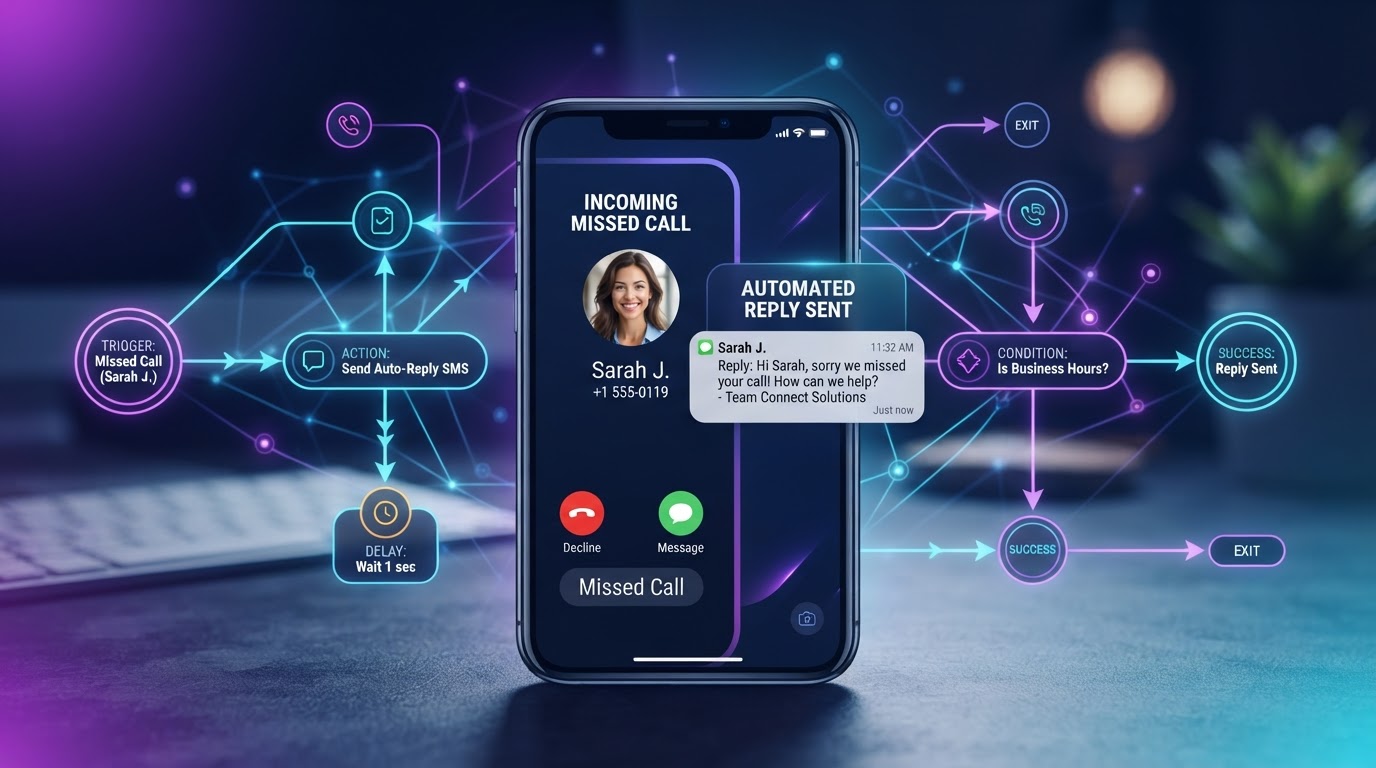
The mechanics are simpler than most business owners expect. The system uses event triggers — think of them as digital tripwires. When an incoming call goes unanswered (the trigger event), the system detects it within seconds and fires an automated SMS to the caller's phone number. The entire process, from missed call to text message delivery, takes 10–30 seconds.
Step 1: A call comes in and rings unanswered (or goes to voicemail after a set number of rings). The phone system or CRM logs the missed call event, capturing the caller's phone number, the timestamp, and whether a voicemail was left.
Step 2: The automation platform detects the missed-call event via webhook or API polling. This is the 'tripwire' — the system recognizes that a specific event occurred and triggers the response sequence.
Step 3: The system sends an automated SMS to the caller. The message is personalized with the business name and includes an open-ended question or offer to help. For example: 'Hi, this is Wootomatic Plumbing — sorry we missed your call! We're on a job right now. How can we help you today?' The message goes out within seconds, while the caller is still holding their phone.
Step 4: The caller's response is logged in the CRM, creating a lead record with the full call and text history attached. If the caller engages, a team member can follow up with full context. If the caller doesn't respond, the system can trigger a follow-up message later that day. Understanding the broader lead generation and nurturing workflow helps you see how each trigger connects to your CRM pipeline.
03What a Good Text-Back System Should Include
A bare-bones text-back system sends a generic message and stops. A well-designed system does much more. First, it should include smart timing — the initial text within 30 seconds, a follow-up if no response within 2 hours, and a final attempt the next morning. This multi-touch approach dramatically increases recovery rates compared to a single message.
Second, the system should capture and log every interaction in the CRM. The missed call, the text exchange, the caller's response — all of it should be attached to a lead record so that when a human follows up, they have full context. A rep calling back should know: 'This caller texted asking about emergency drain cleaning at 2pm.' That context transforms a cold callback into a warm conversation.
Third, the system should include voicemail transcription. If the caller does leave a voicemail, transcribe it with AI and include the transcript in the CRM record and the text-back response. This lets the business respond to the actual question asked, not just acknowledge that a call was missed. The full lead generation and nurturing workflow documents how text-back integrates with capture and nurture sequences.
Fourth, the system should respect business hours and adjust messaging accordingly. A text sent at 11pm should acknowledge the after-hours nature: 'We received your call but our office is closed. We'll reach out first thing in the morning — or reply here and we'll get back to you ASAP.' This sets expectations and prevents the impression that the business is ignoring the caller.
04Common Mistakes That Make Text-Back Feel Robotic
The number one mistake is using a generic, impersonal message. 'We missed your call. Please call back.' is the automation equivalent of a voicemail — it adds no value and feels robotic. A good message is conversational, acknowledges the specific situation, and invites a response with an open question. The tone should match your brand: a law firm's text should sound professional and reassuring; a pizza restaurant's can be casual and warm.
The second mistake is not training the AI on your business context. If the caller texts back asking 'Do you offer payment plans?' or 'What are your hours?', a generic chatbot will either fail to answer or give a wrong answer. The system should be trained on your FAQs, pricing page, service area, and business policies so it can handle common questions naturally. This is the difference between a text-back that feels like a digital employee and one that feels like a vending machine.
The third mistake is over-automating the follow-up. If the caller engages in a text conversation, a human should take over — not an endless AI loop. The system should detect when a conversation requires human judgment (complex questions, complaints, high-value inquiries) and route those to a team member immediately. The automation captures and initiates; the human closes. This hybrid model is what separates a text-back system that converts from one that annoys, and it's the same principle behind effective appointment and calendar automation that pairs text-back with booking workflows.
05TCPA, Consent, and Compliance Guardrails
Automated texting isn't a legal free-for-all. The Telephone Consumer Protection Act (TCPA) and similar regulations govern how businesses can send automated SMS. The safest approach is transactional, one-to-one text-back — replying to a person who called you, in response to that specific call, with informational content. This is generally treated differently from marketing blasts, but the rules are nuanced and depend on your jurisdiction and use case.
Key guardrails to build in: include a clear opt-out mechanism ('Reply STOP to unsubscribe'), never send promotional content in the first text-back message, and log consent evidence in the CRM. If you expand the sequence into marketing follow-ups, you need explicit prior express written consent. The FCC's TCPA guidance is the authoritative reference; review it with legal counsel before launching any multi-touch SMS sequence.
Compliance isn't just about avoiding fines — it protects your deliverability. Carriers filter numbers that generate complaints, and a single flagged campaign can degrade SMS delivery for your entire business. Build compliance in from day one, not as an afterthought.
06Measuring ROI: What to Track
A text-back system without measurement is a black box. Track these metrics from day one:
- Total missed calls per week — your baseline before automation
- Percentage of missed calls that receive a text-back — should be 100%
- Response rate — percentage of text-backs that get a reply
- Recovery rate — percentage of recovered leads that book or purchase
- Revenue recovered — recovery rate × average customer value
A well-functioning system typically achieves a 25–40% response rate on text-backs — meaning 25–40% of callers who would have been permanently lost engage via text. Of those, 30–50% convert to booked appointments. For a business missing 10 calls per week with a $400 average customer value, recovering 3 leads per week at 35% conversion adds $420/week in recovered revenue — over $21,000 annually from a single automation that deploys in days.
Review the metrics monthly and adjust the message copy, timing, and follow-up cadence based on what the data shows. The message that works for a dental clinic won't work for an auto repair shop — testing and iteration are what separate a text-back system that converts from one that annoys. Pairing these metrics with a broader automation ROI calculator framework helps you quantify the total value across every workflow you deploy.
07Choosing the Right Tools and Architecture
There are three common architectures for missed-call text-back. The first is a native CRM workflow — platforms with built-in telephony detect the missed call and send the SMS without any external integration. This is the simplest to maintain but limits you to that platform's telephony features. The second is a Zapier or Make integration that connects your phone system (Twilio, Vonage, or a VoIP provider) to your CRM and messaging tool. This is more flexible but adds a dependency on the automation platform's reliability.
The third is a custom build using a telephony API directly — maximum control, but the most engineering overhead. For most service businesses, the native or integration approach is the right starting point; you can always move to a custom build once volume justifies it. The Zapier vs Make comparison breaks down which integration platform handles telephony triggers more reliably at scale.
Regardless of architecture, the non-negotiables are: sub-30-second delivery, CRM logging of every interaction, business-hours awareness, and an opt-out mechanism. Get those four right and the system will recover revenue; get any one wrong and you'll either lose leads or create compliance risk.
Key Takeaways
- Over 80% of callers who reach voicemail hang up without leaving a message — every missed call is a lead lost to a competitor.
- The system works via event triggers: missed call detected → automated SMS sent within 30 seconds → response logged in CRM → human follows up with context.
- A good system includes multi-touch follow-up, CRM logging, voicemail transcription, and business-hours-aware messaging.
- Train the AI on your business context so it can answer common questions naturally — generic bots feel robotic and lose leads.
- Track response rate, recovery rate, and revenue recovered — a well-tuned system typically recovers 25–40% of missed calls.

Written by Moise
Founder & Lead Automation ArchitectMoise is the founder and lead automation architect at Wootomatic. With over a decade of hands-on experience designing, implementing, and maintaining high-throughput business automations, CRM pipelines, and custom AI agents, he has architected mission-critical workflows for hundreds of appointment-based and field-service businesses. His focus is on resilient, monitored systems that produce measurable ROI without fragile software bloat.
Ready to Put This Into Action?
Tell us about your workflow and we'll scope a custom automation within 24 hours.
Start Your Automation Project