On This Page
Lead Response Time Automation: How to Contact Every New Lead in Under 60 Seconds
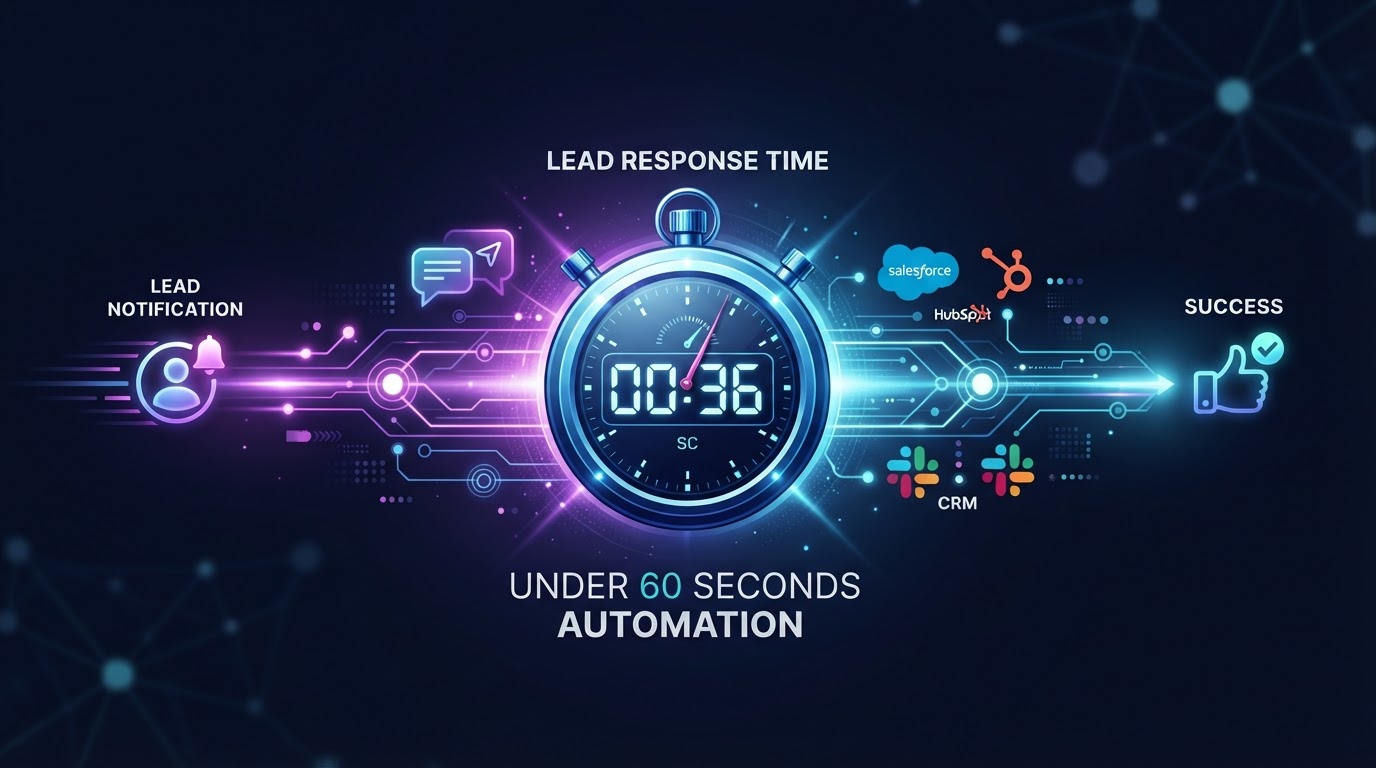
Speed is the single biggest lever in lead conversion, and it's the one humans structurally cannot pull. Research consistently shows that contacting a lead within the first minute makes you dramatically more likely to qualify them than waiting even five minutes. Yet most service businesses take hours — sometimes days — to respond, because a human has to notice the lead, decide what to say, and send it. Lead response time automation is the fix, and it's one of the highest-ROI automations you can deploy. This guide covers the architecture for sub-60-second response, the behavioral nurturing that follows, and how to measure the revenue impact so you know it's working.
01Why Speed Converts (The Data)
The data on lead response time is unambiguous. Harvard Business Review's landmark study found that firms that contacted leads within an hour were 7x more likely to qualify the lead than those that waited an hour or more. But the real insight is in the first minute: InsideSales.com's lead response research showed that responding within 60 seconds makes you 8x more likely to qualify than waiting 5 minutes. The conversion cliff is steep and it starts immediately.
The reason is behavioral, not technical. When a prospect submits a form or calls, they're in a moment of active intent — they're thinking about their problem and evaluating solutions. Within minutes, that intent dissipates: they get distracted, move to another tab, or submit a form to a competitor. The window where your response feels relevant and timely is narrow, and it closes fast.
Most businesses respond in hours because their process is manual: a form submission lands in an inbox, a staff member notices it when they check email, they draft a response, and they send it. Every step adds delay. By the time the response goes out, the prospect has often already moved on. Automation collapses that multi-step, multi-hour process into a single, sub-60-second action.
02The Architecture of Sub-60-Second Response
Achieving sub-60-second response requires three components working together. First, instant capture: the moment a form is submitted, a webhook fires and creates a CRM record — no email round-trip, no manual entry. The lead exists in your system within 1–2 seconds of submission.
Second, instant personalized reply: an automated email or SMS goes out immediately, acknowledging the lead, confirming receipt, and setting expectations. The personalization can be AI-generated based on the lead's message, source, and the specific service they inquired about. A generic 'we received your message' is better than silence, but a personalized 'Hi Sarah, thanks for asking about emergency drain cleaning — we have a technician available this afternoon' is dramatically more effective.
Third, instant team notification: the assigned rep gets a Slack, SMS, or push notification within seconds, with the lead's details and a link to respond. The automation handles the first 60 seconds; the human takes over for the actual conversation. This hybrid model — instant automated acknowledgment plus fast human follow-up — is what converts. The lead generation and nurturing workflow documents the full architecture from capture to close.
03Beyond the First Response: Behavioral Nurturing
The first 60 seconds win the attention; the nurturing sequence wins the deal. Once a lead is captured and acknowledged, an automated nurture sequence keeps them engaged based on their behavior. A lead that clicks a pricing link gets a different next message than one who goes quiet. A lead that visits the booking page but doesn't book gets a nudge within the hour. This behavioral branching is where the real conversion lift happens — it's personalized, timely, and consistent in a way no human team could sustain across every lead.
The sequence should have 3–5 touches over the first 7–14 days, with branches based on engagement. If the lead responds at any point, the sequence pauses and a human takes over. If the lead goes completely cold after 14 days, they move to a long-term nurture cadence (monthly check-ins) rather than being abandoned entirely. The goal is to never lose a lead to inattention — every lead gets a consistent, intelligent follow-up regardless of how busy your team is.
The key is relevance, not volume. A daily generic email will annoy and unsubscribe. A well-timed, behavior-triggered message that addresses what the lead is actually doing feels helpful. This is where AI-generated content shines — it can draft messages that reference the specific page the lead visited, the specific service they asked about, and the specific objection they might have. The sales funnel optimization use case covers the instrumentation layer that makes behavioral nurturing measurable.
04Multi-Channel Response: Email, SMS, and Chat
Different leads prefer different channels, and a single-channel response strategy leaves money on the table. Email is the default for form submissions — it's expected, professional, and allows for rich content. SMS is dramatically higher-open-rate (98% vs 20% for email) and is essential for time-sensitive leads or when the lead provided a phone number. Chat — via an AI chatbot on your site — provides instant, interactive engagement for leads who are still browsing.
The most effective architecture uses all three in coordination: instant email acknowledgment (professional, sets expectations), instant SMS if a phone number was provided (high-visibility, invites a quick reply), and an AI chatbot that engages leads while they're still on the site. The chatbot can qualify, answer FAQs, and even book appointments directly — turning a passive form submission into an active conversation. Our AI chatbots and voice assistants service builds these qualification bots that work alongside the response automation.
The channel choice should match the lead's intent. A lead asking about emergency plumbing needs an SMS, not an email that might not be read for hours. A lead requesting a detailed proposal needs an email with attachments. A lead browsing your pricing page needs a chat invitation, not a form. Mapping channel to intent is what separates a response system that converts from one that just acknowledges.
05Measuring the Revenue Impact
Lead response automation without measurement is a black box. Track these metrics from day one:
- Average response time — should drop from hours to under 60 seconds
- Lead-to-contact rate — percentage of leads that get a human response within 5 minutes
- Qualification rate — percentage of leads that become sales-qualified
- Conversion rate — percentage of leads that close
A well-functioning system typically lifts qualification rate by 20–40% and conversion rate by 15–30%. For a business getting 100 leads/month at $500 average customer value, a 25% conversion lift adds $12,500/month in revenue — from a single automation that costs $3,000–$5,000 to build. The ROI is immediate and obvious. The automation ROI calculator framework helps you plug these numbers into a defensible business case.
The most important metric is response time distribution, not just the average. If your average is 2 minutes but 20% of leads still take 30+ minutes, those 20% are where you're losing revenue. Look at the distribution, find the slow tail, and fix the bottleneck — whether it's a notification that isn't firing, a rep who isn't responding, or a lead source that isn't being routed correctly.
06Common Implementation Mistakes
The first mistake is automating the response but not the routing. An instant email is useless if no human picks up the conversation. The automation must include instant team notification with clear ownership — every lead assigned to a specific rep within seconds, with escalation if the rep doesn't respond within a set time.
The second mistake is over-automating the conversation. The instant reply and nurture sequence are automation's job; the actual sales conversation is a human's job. If a lead responds, a human should take over immediately — not an AI loop that frustrates the prospect. Build in clear handoff triggers: any lead response pauses the sequence and alerts a rep.
The third mistake is not testing the message. The first response email has an outsized impact on conversion — it's the prospect's first impression of your business. A/B test subject lines, tone, and content. A message that feels personal and relevant converts; a generic template doesn't. The funnel conversion checklist covers the full instrumentation you need to measure whether your response sequence is actually working end-to-end.
Key Takeaways
- Responding within 60 seconds makes you 8x more likely to qualify a lead than waiting 5 minutes — speed is the single biggest conversion lever.
- Sub-60-second response requires instant capture, instant personalized reply, and instant team notification — all automated, all within seconds.
- Behavioral nurturing (branching based on what the lead does) is where the real conversion lift happens — relevance beats volume.
- Use multi-channel response (email + SMS + chat) matched to the lead's intent — emergency leads need SMS, detail-seekers need email, browsers need chat.
- Measure response time distribution, not just the average — the slow tail is where you're losing revenue.

Written by Moise
Founder & Lead Automation ArchitectMoise is the founder and lead automation architect at Wootomatic. With over a decade of hands-on experience designing, implementing, and maintaining high-throughput business automations, CRM pipelines, and custom AI agents, he has architected mission-critical workflows for hundreds of appointment-based and field-service businesses. His focus is on resilient, monitored systems that produce measurable ROI without fragile software bloat.
Ready to Put This Into Action?
Tell us about your workflow and we'll scope a custom automation within 24 hours.
Start Your Automation Project