On This Page
How Veteran-Owned Service Businesses Can Automate Lead Follow-Up
In the military, responsiveness saves lives — a delayed response to a situation can mean the difference between success and failure. In business, responsiveness saves leads — a delayed response to an inquiry can mean the difference between a customer and a lost opportunity. Veteran-owned service businesses have a cultural advantage in responsiveness, but manual follow-up can't match the speed and consistency that automation provides. This guide shows how to automate lead follow-up so every inquiry gets an instant, consistent response — translating military responsiveness into civilian conversion. Veterans Day is the right time to build follow-up systems that honor that service through operational excellence.
01The Response Time Reality
Response time is the single biggest predictor of lead conversion. Harvard Business Review found that firms responding to leads within an hour were 7x more likely to qualify them than those that waited longer. InsideSales.com's lead response research found that response within 5 minutes converts 8x better than a 1-hour response. Yet the average small business takes 4–12 hours to reply to an inbound inquiry.
For a veteran-owned service business, this gap is especially painful — because the veteran understands, instinctively, that responsiveness matters. The problem isn't intent; it's capacity. A solo veteran entrepreneur or small team can't maintain sub-5-minute response times manually across every channel (phone, email, web form, chat) while also delivering service. The answer is automation that provides instant response, with human follow-up for the conversations that need it.
This is the model we deploy for every client: automated instant response protects every lead until a human can engage, and the human follow-up happens in the context of an ongoing conversation, not a cold outreach. Our lead response time automation guide covers the full architecture; this guide adapts it to the veteran-owned business context.
02The Automated Follow-Up Stack
Here's the follow-up stack that provides instant, consistent response across every channel:
| Component | Response Time | What It Handles | Monthly Cost |
|---|---|---|---|
| AI chatbot (website) | Under 2 seconds | FAQs, lead capture, booking | $50–$200 |
| Instant email reply | Under 30 seconds | Acknowledgment, next steps | $0–$50 |
| Missed-call text-back | Under 30 seconds | Call recovery | $15–$50 |
| Lead nurturing sequence | Triggered | Ongoing engagement | $30–$100 |
| CRM routing | Instant | Lead assignment, scoring | $0–$50 |
The AI chatbot is the front line. It responds to website visitors in under 2 seconds, answers FAQs, captures lead information, and books appointments — 24/7. For a veteran-owned business, this is the equivalent of a 24-hour watch: no inquiry goes unanswered, regardless of when it arrives. The bot handles the volume; the human handles the value.
Missed-call text-back is the highest-impact single automation. When a call goes unanswered (because you're delivering service, in a meeting, or after hours), an automated SMS fires within seconds: 'Hi, this is [business]. Sorry we missed your call — how can we help? You can also book online at [link].' This recovers 30–50% of missed calls that would otherwise go to a competitor. For a service business where each call might be worth $200–$2,000, this single automation pays for itself many times over. Our missed-call text-back automation guide covers the implementation.
03Translating Military Responsiveness to Conversion
The military principles of responsiveness translate directly to lead follow-up success:
Watchstanding → 24/7 automated coverage. In the military, a watchstander maintains constant vigilance — no gap in coverage. In business, automated lead response provides the same: no inquiry goes unanswered, day or night. The veteran who understands the importance of the watch understands the importance of 24/7 lead coverage. The automation is the watchstander that never sleeps.
Rapid response → Instant reply. Military units train for rapid response to emerging situations — speed saves the situation. In business, speed saves the lead. An instant reply (under 30 seconds) acknowledges the inquiry, sets expectations, and starts the engagement. The veteran who values rapid response can achieve it — through automation, not through working 24-hour shifts.
Accountability → CRM tracking. Military accountability means every action is logged and traceable. In business, CRM tracking means every lead is logged, every interaction is recorded, and no lead falls through the cracks. The veteran who values accountability can maintain a CRM with the same discipline — and the automation ensures every lead is captured and tracked, not just the ones someone remembers to follow up on. Our CRM & Pipeline Automation service builds this tracking as a standard setup.
04The Follow-Up Sequence Architecture
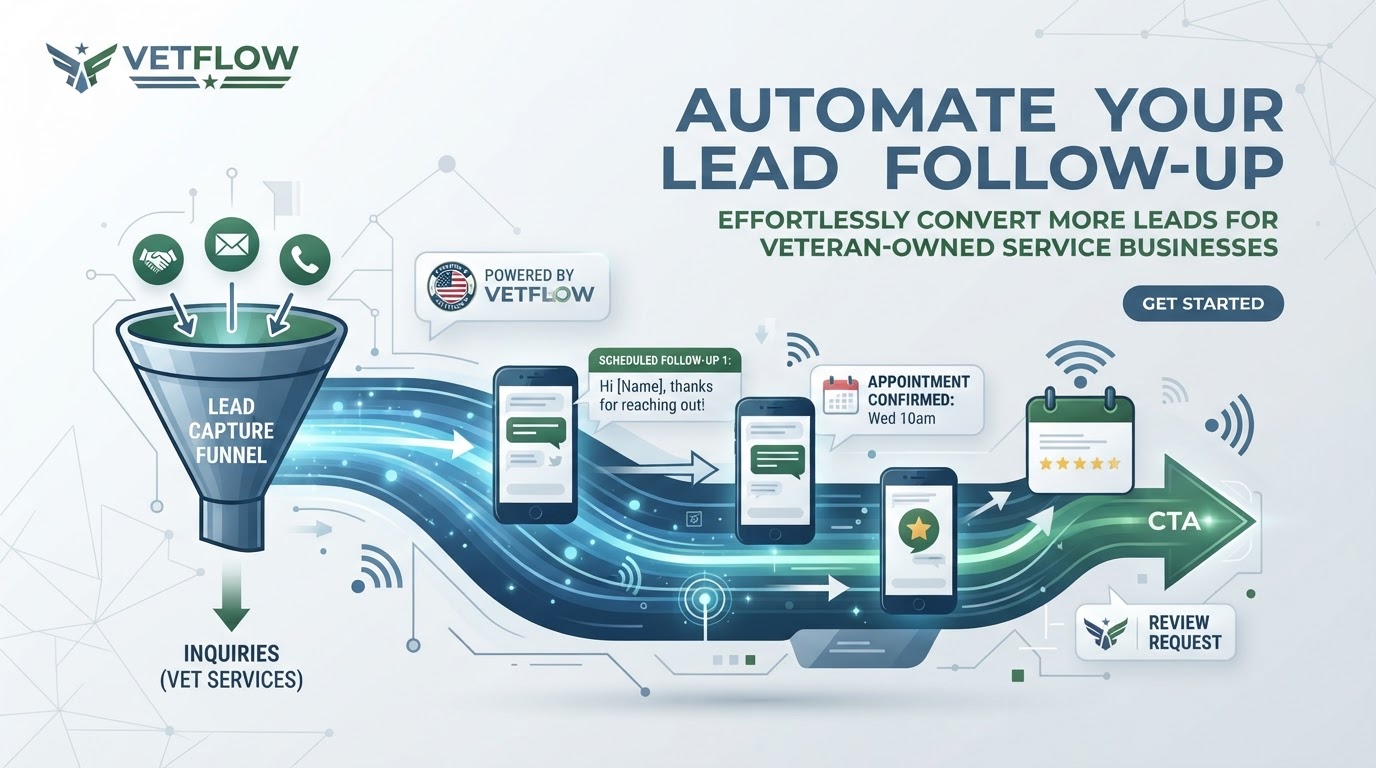
Beyond the instant response, a structured follow-up sequence keeps leads engaged until they convert. Here's the sequence architecture we deploy:
Minute 0: Instant reply. An automated email or SMS acknowledges the inquiry, provides a brief relevant response, and sets expectations ('We'll follow up within the hour'). If the lead came through the chatbot, the bot has already started the conversation.
Minute 5–60: Human follow-up. A human (the veteran entrepreneur or a team member) follows up personally, with the full context of the lead's inquiry and the automated conversation so far. Because the automation has already acknowledged and engaged the lead, the human follow-up is a warm continuation, not a cold outreach.
Day 1–14: Nurture sequence. If the lead hasn't converted, an automated email/SMS sequence provides relevant content, case studies, and offers — keeping the business top-of-mind without requiring daily human effort. The sequence adapts based on the lead's behavior (did they click a link, visit the pricing page, go quiet?).
Day 30+: Re-engagement. If the lead has gone dormant, an automated re-engagement message with an incentive brings them back. This recovers leads that most businesses forget about entirely. The business processes to automate guide covers this sequence as process #14.
05Cost and ROI
The full follow-up stack costs roughly $95–$450/month, depending on volume and tools. The ROI is measured in conversion lift and recovered leads:
| Metric | Before Automation | After Automation | Impact |
|---|---|---|---|
| Response time | 4–12 hours | Under 30 seconds | 7x qualification likelihood |
| Missed-call recovery | 0% | 30–50% | Recovered revenue |
| Lead-to-appointment rate | Variable | 20–30% lift | More booked appointments |
| After-hours lead capture | 0% | 100% | No lost after-hours leads |
For a veteran-owned service business with 50 leads per month and an average customer value of $500, a 20% conversion lift means 10 additional customers per month — $5,000 in additional monthly revenue, from a $95–$450/month investment. The math is decisive: the follow-up stack pays for itself many times over, and the veteran's discipline ensures it runs flawlessly.
06Failure Cases and Limitations
The most common failure is automating the response but not the follow-through. A business deploys instant reply and assumes the job is done — but the human follow-up is still slow or inconsistent. The automation has captured the lead, but the human hasn't engaged, and the lead goes cold anyway. The fix: the human follow-up must be as disciplined as the automated response. Set a standard (follow up within 1 hour during business hours) and hold to it — the veteran's discipline makes this achievable.
The second failure is generic, impersonal automation. The instant reply is a generic 'Thank you for your inquiry' that doesn't acknowledge what the lead actually asked. The lead feels processed, not served. The fix: personalize the automated response based on the lead's inquiry — AI can generate a relevant, contextual reply that feels human. This is the difference between automation that engages and automation that alienates.
A limitation to acknowledge: automation can't close the deal. It can capture, acknowledge, engage, and nurture — but the actual conversion (the sales conversation, the consultation, the proposal) requires a human. The veteran entrepreneur's role shifts from chasing leads to closing them — which is exactly where their time should go. Our lead response time automation guide covers this division of labor in detail.
07An Anonymized Example from Our Work
A veteran-owned roofing company was losing leads because the owner — a former Marine — was on job sites all day and couldn't answer calls or emails promptly. His average response time was 8 hours, and he estimated he was losing 30% of leads to competitors who answered faster. He knew responsiveness mattered — it was a core value from his service — but he couldn't be in two places at once.
We deployed the follow-up stack: an AI chatbot on his website for instant inquiry handling, missed-call text-back for every unanswered call, instant email replies for form submissions, and a nurture sequence for leads that didn't convert immediately. His response time dropped from 8 hours to under 30 seconds — every inquiry got an instant acknowledgment, and he followed up personally during his breaks and evenings, with full context from the automated conversation. Missed-call recovery brought back 40% of calls he would have lost. Within 2 months, his lead-to-estimate conversion rate lifted 25%, and he stopped losing leads to faster-answering competitors. The stack cost $280/month — less than the value of a single recovered roof job. His military discipline ensured the systems ran flawlessly, because he treated lead response with the same urgency he'd treated a mission.
08Responsiveness as a Competitive Weapon
Veteran-owned service businesses have a cultural advantage in responsiveness — but manual follow-up can't match the speed and consistency of automation. By deploying the automated follow-up stack, the veteran entrepreneur achieves the responsiveness they value, without sacrificing the service delivery that generates the leads in the first place. The stack captures every lead, responds instantly, nurtures consistently, and frees the veteran to do what they do best: deliver excellent service and close deals. If you're a veteran entrepreneur looking to build follow-up systems that honor your service through operational excellence, the automation audit and consulting service maps your business to this framework. Veterans Day is a fitting time to build systems that make responsiveness sustainable — because a business that responds fast is a business that wins.
Key Takeaways
- Response time is the biggest conversion predictor — 7x qualification likelihood within an hour, 8x conversion within 5 minutes.
- The follow-up stack ($95–$450/month): AI chatbot, instant email reply, missed-call text-back, nurture sequence, CRM routing.
- Translate military responsiveness: watchstanding → 24/7 coverage, rapid response → instant reply, accountability → CRM tracking.
- The follow-up sequence: instant reply (minute 0), human follow-up (minute 5–60), nurture (day 1–14), re-engagement (day 30+).
- Automation captures and engages; the veteran closes — shifting time from chasing leads to converting them.

Written by Moise
Founder & Lead Automation ArchitectMoise is the founder and lead automation architect at Wootomatic. With over a decade of hands-on experience designing, implementing, and maintaining high-throughput business automations, CRM pipelines, and custom AI agents, he has architected mission-critical workflows for hundreds of appointment-based and field-service businesses. His focus is on resilient, monitored systems that produce measurable ROI without fragile software bloat.
Ready to Put This Into Action?
Tell us about your workflow and we'll scope a custom automation within 24 hours.