On This Page
Thanksgiving Customer-Appreciation Ideas for Small Businesses
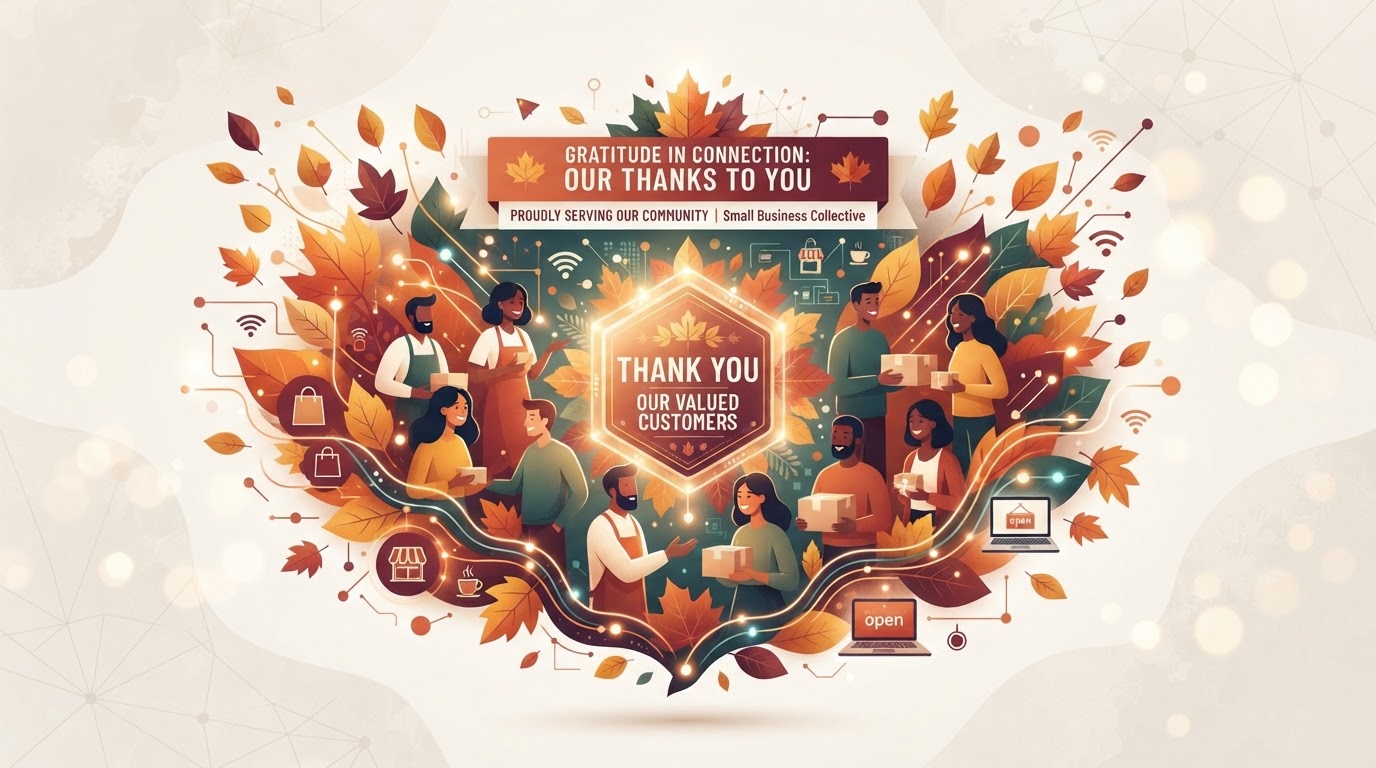
Thanksgiving is the natural moment for customer appreciation — but most small businesses either skip it entirely or send a generic 'Happy Thanksgiving' email that customers ignore. The opportunity is to make appreciation personal, timely, and genuine, and to do it at scale through automation so no customer is missed. This guide covers practical, automatable customer-appreciation ideas for small businesses around Thanksgiving, with implementation guides, cost ranges, and templates. The goal isn't a marketing campaign disguised as gratitude; it's authentic appreciation that strengthens relationships and, as a byproduct, improves retention and referrals.
01Why Thanksgiving Appreciation Matters
Customer appreciation isn't just a nice gesture — it's a business strategy. According to Bain & Company's customer retention research, increasing customer retention by 5% increases profits by 25–95%. Appreciated customers stay longer, spend more, and refer others. Thanksgiving, with its built-in theme of gratitude, is the natural moment to express that appreciation — and doing it authentically (not as a sales pitch) is what makes it effective.
The problem with most Thanksgiving appreciation efforts is that they're either absent (the business does nothing) or generic (a mass email that says 'Happy Thanksgiving from [Business]' with no personalization). Generic appreciation feels transactional — customers recognize it as a marketing email, not a genuine expression of gratitude. The fix is personalization at scale — which is exactly what automation enables.
Automation doesn't make appreciation less genuine; it makes it more consistent and more personalized. A well-configured automation can send a personalized thank-you to every customer, referencing their specific history with the business, at the right time, without requiring the owner to write 200 individual emails. This is the model we deploy — authentic appreciation, delivered consistently through automation. Our small business automation guide covers the general framework; this guide focuses on Thanksgiving-specific appreciation.
02Automatable Thanksgiving Appreciation Ideas
Here are practical, automatable customer-appreciation ideas, organized by effort and impact:
| Idea | Effort | Impact | Cost |
|---|---|---|---|
| Personalized thank-you email | Low | Medium | $0–$50 |
| Thank-you SMS with offer | Low | High | $15–$50 |
| Loyalty discount for repeat customers | Medium | High | Revenue cost |
| Thanksgiving review request | Low | Medium | $0–$50 |
| Handwritten card for top customers | High | Very High | $3–$5/card |
| Thanksgiving referral incentive | Medium | High | Revenue cost |
| Customer spotlight / feature | Medium | Medium | $0 |
The personalized thank-you email is the foundation. Using your CRM data, send an email that references the customer's specific history: 'It's been [X months] since you first worked with us, and we're grateful for the [specific service] we've provided.' This level of personalization shows the customer they're known, not just a name on a list. Automation makes this scalable — the CRM data populates the template, and the email sends automatically.
The thank-you SMS with offer has higher impact because SMS has a 98% open rate (vs. 20% for email). A brief, genuine thank-you with a small offer ('Thank you for being a customer — enjoy 15% off your next appointment as our Thanksgiving gift') drives both appreciation and revenue. The offer should be genuine — a real discount, not a bait-and-switch. Our missed-call text-back automation guide covers SMS automation architecture.
03The Personalized Thank-You Sequence
Here's the automated Thanksgiving appreciation sequence we deploy for clients:
Week before Thanksgiving: Personalized email. An automated email sends to every active customer, personalized with CRM data (name, time as customer, services used). The tone is genuine gratitude, not sales. Template: 'Dear [Name], as Thanksgiving approaches, we want to take a moment to say thank you. It's been [X months] since you first trusted us with [service], and we're genuinely grateful for your business. Wishing you a wonderful Thanksgiving with family and friends.'
Thanksgiving week: SMS with offer. An automated SMS sends to customers who opened the email (indicating engagement), with a genuine Thanksgiving offer. Template: 'Hi [Name], thank you for being a valued customer! As our Thanksgiving gift, enjoy 15% off your next [service] through end of November. Book at [link].' The offer is real, the tone is warm, and the booking link makes it easy to redeem.
Week after Thanksgiving: Review request. An automated review request sends to customers who redeemed the offer, asking them to share their experience. This converts the appreciation moment into social proof — customers who felt appreciated are more likely to leave positive reviews. Template: 'We're so glad you took advantage of our Thanksgiving offer! If you enjoyed your experience, we'd be grateful if you'd share a review at [link].' Our business processes to automate guide covers review request automation as process #12.
04The Handwritten Card Exception
Automation handles the scale, but for top customers — the 10–20% who generate 80% of revenue — a handwritten card creates an impact that no automated message can match. This is the one appreciation effort that should NOT be automated, because the personal touch is the entire point.
Identify your top customers using CRM data: highest lifetime value, longest tenure, most referrals. For these 10–50 customers (depending on business size), send a genuine handwritten Thanksgiving card. The card should be personal — reference something specific about the customer's relationship with the business. The cost is $3–$5 per card (card + postage + a few minutes of writing), and the impact on retention and referral for these high-value customers is significant.
The principle: automate the scale, personalize the value. Automation ensures every customer gets appreciated; the handwritten card ensures the most valuable customers get appreciated in a way that stands out. This combination — automated appreciation for all, personal appreciation for top customers — is the model that maximizes both coverage and impact. Our CRM & Pipeline Automation service helps identify the top customers through CRM data segmentation.
05Failure Cases and Limitations
The most common failure is appreciation disguised as a sales pitch. The 'thank you' email is 90% promotion and 10% gratitude — customers see through it instantly, and the effect is the opposite of appreciation (it feels manipulative). The fix: make the gratitude genuine and the offer secondary. If the email reads like a promotion, rewrite it until it reads like a thank-you that happens to include an offer.
The second failure is over-automating the personal touches. A business sends automated 'personalized' emails that are obviously templated — the personalization is shallow (just a first name), and the message feels generic. The fix: use real CRM data for personalization (tenure, services used, last appointment), not just a name field. The more specific the personalization, the more genuine it feels. Our lead nurturing guide covers personalization architecture.
A limitation to acknowledge: automated appreciation can't fully replace genuine human relationships. For your most important customers, a personal phone call or handwritten note will always outperform an automated email. Automation handles the scale (every customer gets appreciated); personal effort handles the value (top customers get special attention). Both are needed — neither alone is sufficient.
06An Anonymized Example from Our Work
A med spa with 400 active customers had never done a coordinated Thanksgiving appreciation effort — the owner sent thank-you emails to a few customers she thought of, and the rest got nothing. She wanted to appreciate all her customers but couldn't write 400 individual messages.
We deployed the automated Thanksgiving sequence: a personalized email to all 400 customers (using CRM data for tenure and services), an SMS with a 15% off offer to the 240 who opened the email, and a review request to the 85 who redeemed the offer. For the top 25 customers (by lifetime value), the owner wrote handwritten cards. The results: the email had a 62% open rate (vs. her typical 25%), 85 customers redeemed the offer (generating $12,750 in revenue from the appreciation campaign), 23 new reviews were posted (a 3x increase over her typical monthly rate), and the top 25 customers responded to the handwritten cards with genuine surprise and gratitude — three sent back thank-you notes for the thank-you note. The automated sequence cost $80 in SMS fees; the handwritten cards cost $125. The revenue from redeemed offers alone was 100x the cost — and the retention and referral impact compounded beyond that.
07Authentic Appreciation at Scale
Thanksgiving customer appreciation doesn't have to be an either/or — either genuine but small-scale, or large-scale but generic. Automation makes it possible to deliver authentic, personalized appreciation to every customer, at the right time, with genuine offers — while reserving personal effort for the top customers who warrant it. The sequence above is the blueprint; the principle is automate the scale, personalize the value. If you're looking to build appreciation systems that strengthen customer relationships, the automation audit and consulting service maps your customer base to this framework. Thanksgiving is a fitting time to build systems that express genuine gratitude — because a business that appreciates its customers is a business its customers appreciate.
Key Takeaways
- Customer appreciation is a business strategy — 5% retention increase yields 25–95% profit increase; Thanksgiving is the natural moment.
- Automate the scale (personalized emails, SMS with offers, review requests) and personalize the value (handwritten cards for top customers).
- The sequence: personalized email (week before), SMS with offer (Thanksgiving week), review request (week after).
- Make gratitude genuine and offers secondary — appreciation disguised as a sales pitch backfires.
- Use real CRM data for personalization (tenure, services) — shallow personalization (just a name) feels generic.

Written by Moise
Founder & Lead Automation ArchitectMoise is the founder and lead automation architect at Wootomatic. With over a decade of hands-on experience designing, implementing, and maintaining high-throughput business automations, CRM pipelines, and custom AI agents, he has architected mission-critical workflows for hundreds of appointment-based and field-service businesses. His focus is on resilient, monitored systems that produce measurable ROI without fragile software bloat.
Ready to Put This Into Action?
Tell us about your workflow and we'll scope a custom automation within 24 hours.