On This Page
Cyber Monday Marketing Automation Guide for Small Businesses
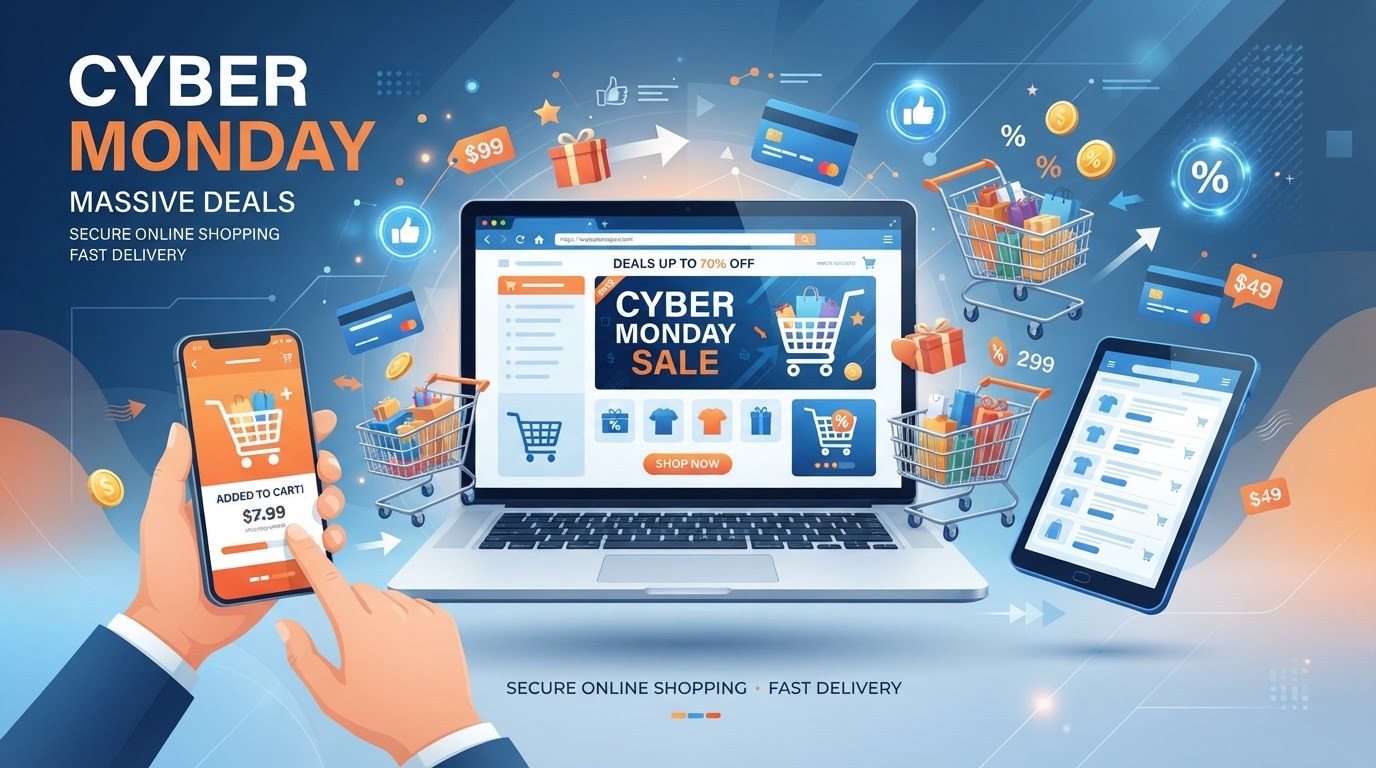
Cyber Monday is the biggest online sales day of the year, and for small businesses with any digital component — e-commerce, online booking, digital services — it's a make-or-break moment. The volume surge is brutal: traffic spikes 10–30x, inquiries flood every channel, and carts get abandoned at peak rates. Manual processes can't keep up, and the businesses that win are the ones with automation infrastructure already in place. This guide covers the complete Cyber Monday marketing automation stack — from email and SMS campaigns to abandoned cart recovery to customer support scaling — with a pre-event deployment timeline and cost ranges. You can also see our live [Cyber Monday promotion page](/promotions/cyber-monday) for current offer details.
01Why Cyber Monday Demands a Different Automation Stack
Cyber Monday differs from Black Friday in a key way: it's almost entirely online. There are no walk-ins, no in-person interactions — every customer interaction happens through your website, email, SMS, and support channels. This means the automation stack must be digital-first and capable of handling a pure online surge.
According to Adobe's Cyber Monday report, Cyber Monday consistently drives the largest single-day online sales volume of the year — billions of dollars, with mobile commerce accounting for over half of transactions. For a small business, even capturing a tiny slice of this demand can represent a record sales day — but only if the systems can handle the volume without breaking.
The three risks on Cyber Monday are volume, abandonment, and support overload. Volume: traffic spikes beyond what your site and systems can handle. Abandonment: impulse buyers abandon carts at 70%+ rates during peak hours. Support overload: inquiries flood every channel, and slow responses lose sales. Automation addresses all three — but it must be deployed before the day, not during. Our Black Friday automation checklist covers the retail-side preparation; this guide focuses on the Cyber Monday digital-specific stack.
02The Cyber Monday Automation Checklist
Here's the complete checklist, organized by function, with deployment timing and cost:
| # | Automation | Function | Deploy By | Cost |
|---|---|---|---|---|
| 1 | Email campaign sequence | Outreach | 2 weeks before | $0–$150 |
| 2 | SMS blast to opt-in list | Outreach | 1 week before | $50–$300 |
| 3 | Dedicated landing page | Conversion | 2 weeks before | $0–$100 |
| 4 | Abandoned cart recovery | Recovery | 1 week before | $30–$150 |
| 5 | Instant lead/inquiry response | Capture | 1 week before | $50–$200 |
| 6 | AI customer support bot | Support | 2 weeks before | $50–$200 |
| 7 | Order confirmation & tracking | Post-sale | 2 weeks before | $0–$50 |
| 8 | Post-sale nurture sequence | Retention | 1 week before | $0–$100 |
| 9 | Real-time reporting dashboard | Analytics | 2 weeks before | $0–$50 |
| 10 | Site performance monitoring | Operations | 2 weeks before | $0–$100 |
Items 1–4 are the revenue drivers. The email and SMS campaigns drive traffic to your Cyber Monday offers. The landing page converts that traffic. Abandoned cart recovery recaptures the majority who leave without completing — often the single highest-ROI automation of the day. Our missed-call text-back automation guide covers the SMS architecture that powers items 2 and 5.
Items 5–10 are the operational infrastructure. Instant response and the support bot handle the inquiry surge. Order confirmations and tracking keep customers informed (reducing support load). Post-sale nurture converts one-time Cyber Monday buyers into repeat customers. The reporting dashboard gives real-time visibility. Site monitoring ensures your website doesn't crash under the traffic spike — a crash on Cyber Monday is catastrophic, as every minute of downtime is lost revenue at peak demand.
03Email and SMS Campaign Architecture
The outreach campaigns drive traffic to your Cyber Monday offers, and their architecture determines how much demand you generate. Here's the sequence:
Email sequence (3 messages over 10 days): First, a 'coming soon' teaser 10 days before — announce the Cyber Monday sale without revealing full details, building anticipation. Second, a 'here's the deal' email 3 days before — reveal the offers with a link to the landing page. Third, a 'live now' email on Cyber Monday morning — the offers are live, shop now. According to Mailchimp's email marketing benchmarks, holiday email campaigns see 30–40% higher open rates than average — making this the highest-reach channel for Cyber Monday demand generation.
SMS blast (1–2 messages): Send a 'live now' SMS on Cyber Monday morning to your opt-in list, and optionally a 'last chance' SMS in the final hours. SMS has a 98% open rate and most messages are read within 3 minutes — making it the most reliable way to drive immediate traffic. Keep it short and actionable: 'Cyber Monday is live! [Offer] at [link]. Today only.' Critical: only send to customers who have explicitly opted into SMS marketing — our TCPA and AI texting compliance guide covers the consent requirements in detail.
Segmentation. Don't blast the same message to your entire list. Segment by past purchase behavior: customers who bought similar products get a targeted offer; customers who haven't purchased in 6 months get a 'we miss you' win-back offer; new subscribers get a first-time buyer incentive. Segmented campaigns consistently outperform generic blasts by 2–3x in conversion rate.
04Abandoned Cart Recovery: The Cyber Monday MVP
On Cyber Monday, cart abandonment spikes to 70%+ — meaning the majority of interested buyers leave without completing. Abandoned cart recovery is the automation that recaptures them, and it's often the single highest-ROI system of the day.
The 3-touch recovery sequence: First touch (30 minutes after abandonment): a simple reminder — 'You left [item] in your cart. Complete your purchase at [link].' Second touch (6 hours after): an incentive — 'Your cart is waiting. Here's 10% off to help you decide: [code].' Third touch (24 hours after): a final notice — 'Last chance — your cart expires soon. Complete at [link].' According to the Baymard Institute's cart abandonment research, recovery sequences typically recapture 10–15% of abandoned carts — on a high-volume Cyber Monday, that's significant recovered revenue.
For service businesses (no physical cart): adapt to 'abandoned bookings' — when a customer starts the booking process but doesn't complete. The same sequence applies: reminder, incentive, final notice. This recovers appointments that would otherwise be lost, which is especially valuable when booking volume surges. Our appointment and calendar automation service builds these recovery sequences.
Timing is critical on Cyber Monday. The first touch must go out within 30 minutes — not the next day. Cyber Monday buyers are in a buying mood for a few hours; if you wait until Tuesday to follow up, the impulse is gone and the recovery rate collapses. Automation ensures the sequence fires instantly, every time, for every abandonment — something no human team could maintain during a volume surge.
05Scaling Customer Support for the Surge
Cyber Monday generates a surge of customer inquiries — questions about products, shipping, returns, order status — that can overwhelm a small support team. The businesses that handle the surge well are the ones with automated support infrastructure.
AI customer support bot. Deploy an AI chatbot trained on your product catalog, shipping policies, return policy, and FAQs. The bot handles 60–70% of inquiries autonomously — 'when will my order ship,' 'what's your return policy,' 'do you have this in size large' — and escalates the rest to humans with full context. This filters the volume so your human team only touches the inquiries that need them. Our AI chatbots and voice assistants service builds these support bots as a standard deliverable.
Automated order confirmations and tracking. Every order triggers an automated confirmation email with order details and a tracking link. When the order ships, an automated shipping notification goes out. These automated messages answer the most common support questions ('where's my order?') before they become support tickets — reducing support load by 30–50% during the surge.
Escalation routing. Define which inquiries need human attention and route them automatically: questions about refunds, complaints, complex product questions, and high-value orders go to a human immediately; everything else stays with the bot. The routing should be based on intent detection (what the customer is asking) and sentiment (frustrated customers escalate immediately). Our AI chatbot human handoff guide covers the escalation framework in detail.
06The Pre-Cyber Monday Deployment Timeline
Deploy the checklist in the weeks before Cyber Monday — never on the day. Here's the timeline:
4 weeks before: Audit and plan. Review last year's Cyber Monday performance. Identify where traffic spiked, carts were abandoned, and support was overwhelmed. Map the automations you need to the checklist. Our automation audit and consulting service covers this discovery phase.
3 weeks before: Build the foundation. Deploy the landing page (item 3), order confirmation and tracking (item 7), reporting dashboard (item 9), and site performance monitoring (item 10). Test the landing page under load — a crash on Cyber Monday is catastrophic.
2 weeks before: Build the outreach and support. Deploy the email campaign sequence (item 1), the AI support bot (item 6), and instant lead response (item 5). Test the support bot thoroughly with common Cyber Monday questions.
1 week before: Build the revenue-critical automations. Deploy the SMS blast (item 2), abandoned cart recovery (item 4), and post-sale nurture sequence (item 8). Test the abandoned cart sequence by simulating abandonments — a broken recovery sequence on Cyber Monday is a massive lost opportunity.
Cyber Monday: Monitor and respond. The automations handle the volume; your job is monitoring the dashboard, handling escalations, and ensuring the systems are running. Don't build anything new today — watch, respond, and let the automation do its job.
07Failure Cases and Limitations
The most common failure is a website crash during the traffic spike. A small business's website isn't built for 10–30x traffic, and on Cyber Monday, it crashes — taking all the demand the campaigns generated and converting it to zero. The fix: deploy site performance monitoring and load testing before the day. If your site can't handle the projected traffic, upgrade your hosting or use a CDN. The cost of a crash far exceeds the cost of preparation.
The second failure is no abandoned cart recovery. A business drives traffic, gets carts started, and then... nothing. The 70% who abandon are gone forever. The fix: deploy the 3-touch recovery sequence before Cyber Monday. This single automation often generates more recovered revenue than any other system. Our CRM migration checklist guide covers the data infrastructure needed to track cart abandonment and recovery.
A limitation to acknowledge: Cyber Monday is inherently digital. If your business has no online component — no e-commerce, no online booking, no digital services — the day's online-shopping angle doesn't apply, and a generic promotion will underperform. The ideas in this guide are designed for businesses with a digital sales channel. For purely local, in-person businesses, Small Business Saturday is the more relevant event.
08An Anonymized Example from Our Work
A small e-commerce business selling specialty coffee gear had participated in Cyber Monday for two years with disappointing results — they drove traffic but lost most of it to cart abandonment and couldn't handle the support surge. Their conversion rate on Cyber Monday was 1.2%, well below their 2.5% average.
We deployed the full automation stack: a segmented email sequence (3 messages over 10 days), an SMS blast to their opt-in list, a dedicated landing page, the 3-touch abandoned cart recovery sequence, an AI support bot trained on their product catalog and policies, and a real-time reporting dashboard. On Cyber Monday, their traffic spiked 18x — but the site held (thanks to the performance monitoring and a CDN upgrade). The abandoned cart recovery sequence recaptured 12% of abandoned carts — 340 recovered orders at an average of $65 each, generating $22,000 in recovered revenue. The support bot handled 68% of inquiries, keeping their two-person support team from being overwhelmed. Their conversion rate rose to 2.8% — above their average, despite the volume surge. The automation stack cost $280/month and paid for itself within the first two hours of Cyber Monday.
09Winning Cyber Monday with Automation
Cyber Monday is a volume event that rewards preparation and punishes improvisation. The businesses that win are the ones with automation infrastructure deployed before the day — outreach campaigns that drive demand, abandoned cart recovery that recaptures it, and support automation that handles the surge. The checklist and timeline above ensure every piece is in place before the traffic hits. If you're ready to build this infrastructure, the automation audit and consulting service maps your business to the plan. And for current Cyber Monday offer details, visit our promotion page. Because on the biggest online sales day of the year, the businesses that win are the ones whose systems can handle the volume — while their competitors are still trying to catch up.
Key Takeaways
- Cyber Monday is the biggest online sales day of the year — for small businesses with a digital channel, it's a make-or-break moment that demands automation infrastructure.
- Abandoned cart recovery is the MVP — 70%+ of carts are abandoned during peak hours, and a 3-touch sequence recaptures 10–15% of them.
- Deploy email (3 messages over 10 days) and SMS campaigns (opt-in only) to drive demand, with segmentation for 2–3x better conversion.
- Scale support with an AI bot (handles 60–70% of inquiries) and automated order confirmations to reduce support load 30–50%.
- Deploy everything 1–4 weeks before the day — never build on Cyber Monday itself; a crash or broken automation during the surge is catastrophic.

Written by Moise
Founder & Lead Automation ArchitectMoise is the founder and lead automation architect at Wootomatic. With over a decade of hands-on experience designing, implementing, and maintaining high-throughput business automations, CRM pipelines, and custom AI agents, he has architected mission-critical workflows for hundreds of appointment-based and field-service businesses. His focus is on resilient, monitored systems that produce measurable ROI without fragile software bloat.
Ready to Put This Into Action?
Tell us about your workflow and we'll scope a custom automation within 24 hours.