On This Page
Black Friday Automation Checklist for Small Businesses
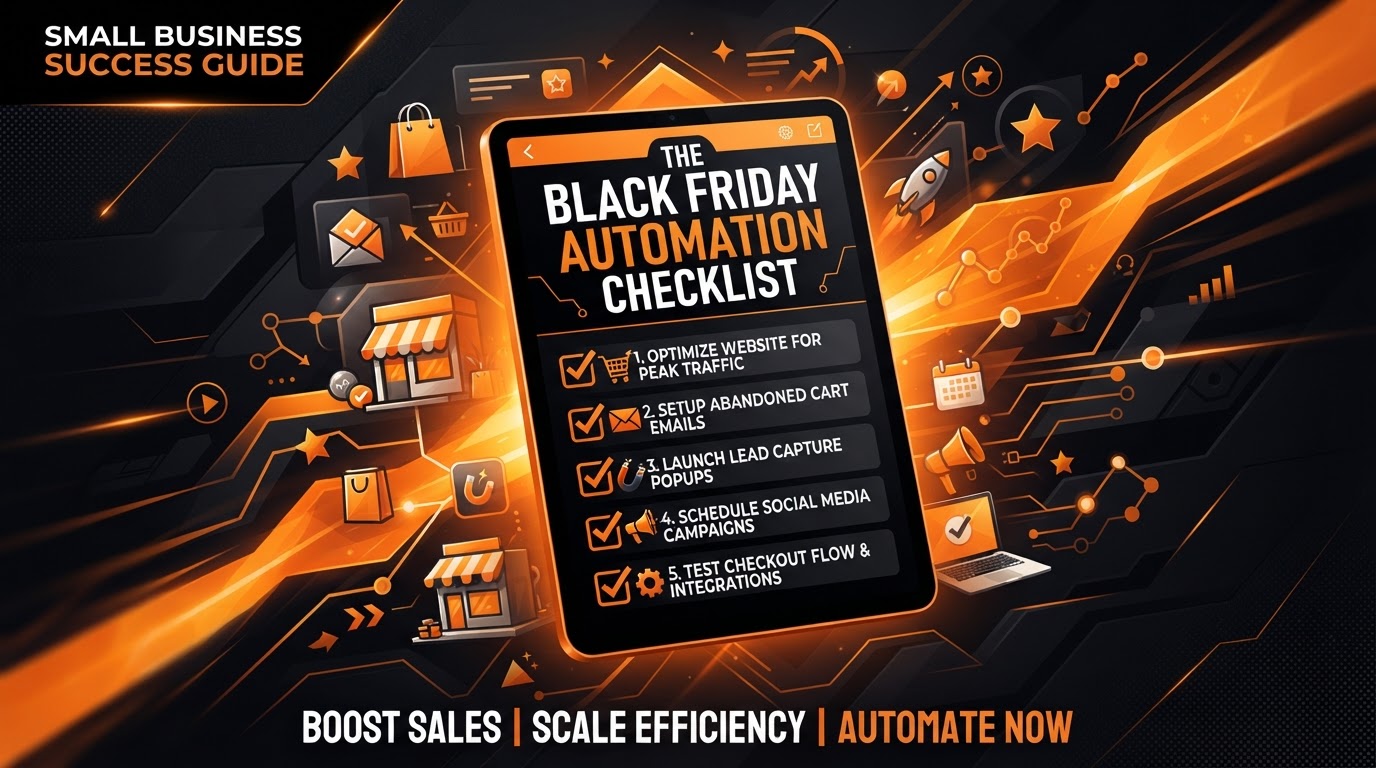
Black Friday is the highest-stakes sales day of the year for many small businesses — and the difference between a record-breaking day and a disappointing one often comes down to automation. Manual processes can't keep up with the surge in traffic, inquiries, and orders; leads fall through the cracks, carts get abandoned, and follow-up gets delayed until the momentum is gone. This checklist covers every automation a small business needs to deploy before Black Friday — from lead capture to abandoned cart recovery to post-sale follow-up — with a pre-Black Friday deployment timeline and cost ranges. The goal is to capture every opportunity the day generates, not just survive it.
01Why Black Friday Demands Automation
Black Friday creates a volume spike that manual processes structurally cannot handle. Traffic surges 5–20x, inquiries flood every channel, orders pile up, and carts get abandoned at higher rates (because impulse buying leads to second thoughts). A business running manual processes on Black Friday is like a highway with no traffic lights during rush hour — chaos, collisions, and missed destinations.
According to Adobe's Black Friday analytics, Black Friday generates billions in online sales — but abandoned cart rates spike to 70%+ during peak hours, meaning the majority of interested buyers leave without completing. For a small business, every abandoned cart is a lost sale that automated recovery could have captured. The businesses that win on Black Friday aren't necessarily the ones with the best deals — they're the ones with the best systems for capturing, converting, and following up on the surge.
Automation is the infrastructure that handles the volume. Lead capture automation ensures no inquiry goes unanswered during the surge. SMS campaigns reach customers where email can't. Abandoned cart recovery recaptures the 70% who would otherwise leave. Post-sale follow-up converts one-time Black Friday buyers into repeat customers. Our small business automation guide covers the general framework; this checklist is the Black Friday-specific deployment.
02The Black Friday Automation Checklist
Here's the complete checklist, organized by category, with deployment timing and cost:
| # | Automation | Category | Deploy By | Cost |
|---|---|---|---|---|
| 1 | Lead capture & instant response | Lead capture | 2 weeks before | $50–$200 |
| 2 | Black Friday SMS campaign | Outreach | 1 week before | $50–$300 |
| 3 | Email teaser sequence | Outreach | 2 weeks before | $0–$100 |
| 4 | Abandoned cart recovery | Recovery | 1 week before | $30–$150 |
| 5 | Inventory/booking alerts | Operations | 2 weeks before | $0–$50 |
| 6 | Order confirmation & tracking | Post-sale | 2 weeks before | $0–$50 |
| 7 | Post-sale follow-up sequence | Retention | 1 week before | $0–$100 |
| 8 | Review request automation | Retention | 1 week before | $0–$50 |
| 9 | Reporting dashboard | Analytics | 2 weeks before | $0–$50 |
| 10 | Customer support bot | Support | 2 weeks before | $50–$200 |
Items 1–4 are the revenue-critical automations. Lead capture ensures no inquiry is missed during the surge. SMS and email campaigns drive traffic to your Black Friday offers. Abandoned cart recovery recaptures the majority of buyers who leave without completing — this single automation often generates the highest ROI of any Black Friday system. Our missed-call text-back automation guide covers the SMS architecture that powers items 1 and 2.
Items 5–10 are the operational automations. Inventory alerts prevent overselling (or overbooking for service businesses). Order confirmations and tracking keep customers informed (reducing support load). Post-sale follow-up and review requests convert Black Friday buyers into repeat customers. The reporting dashboard gives you real-time visibility into how the day is performing. The customer support bot handles the surge in inquiries without overwhelming your team. Our AI chatbots and voice assistants service builds these support bots as a standard deliverable.
03The Pre-Black Friday Deployment Timeline
Deploy the checklist in the weeks before Black Friday, not on the day. Here's the timeline:
4 weeks before: Audit and plan. Review last year's Black Friday performance. Identify where leads were lost, carts were abandoned, and follow-up was delayed. Map the automations you need to the checklist above. This is the planning phase — don't build yet, just plan. Our automation audit and consulting service covers this discovery phase.
3 weeks before: Build the core automations. Deploy lead capture and instant response (item 1), the email teaser sequence (item 3), inventory/booking alerts (item 5), order confirmation (item 6), and the reporting dashboard (item 9). These are the foundational systems that need to be tested before the surge.
2 weeks before: Build the revenue-critical automations. Deploy the Black Friday SMS campaign (item 2), abandoned cart recovery (item 4), and the customer support bot (item 10). Test each thoroughly — send test SMS, simulate abandoned carts, run test inquiries through the bot. A broken automation on Black Friday is worse than no automation.
1 week before: Build the retention automations. Deploy the post-sale follow-up sequence (item 7) and review request automation (item 8). Final testing of all systems. Brief your team on what's automated and what needs human handling. Confirm the reporting dashboard is tracking the right metrics.
Black Friday: Monitor and respond. The automations handle the volume; your job is monitoring the dashboard, handling escalations, and ensuring the systems are running. Don't build anything new today — just watch, respond, and let the automation do its job.
04Abandoned Cart Recovery: The Highest-ROI Automation
Abandoned cart recovery deserves special attention because it's often the single highest-ROI Black Friday automation. Here's the architecture:
Trigger: cart abandonment. When a customer adds an item to their cart (or starts a booking) but doesn't complete within 30 minutes, the recovery sequence triggers. The trigger should capture the customer's email or phone (if they entered it before abandoning) and the contents of their cart.
Sequence: 3 touchpoints over 48 hours. First touch (30 minutes after abandonment): a gentle reminder — 'You left [item] in your cart — still interested? Complete your purchase at [link].' Second touch (6 hours after): an incentive — 'Your cart is still waiting. Here's 10% off to help you decide: [code].' Third touch (24 hours after): a final reminder — 'Last chance — your cart expires soon. Complete your purchase at [link].' According to Baymard Institute's cart abandonment research, the average cart abandonment rate is 70%, and recovery sequences typically recapture 10–15% of those — meaning significant recovered revenue.
For service businesses (no physical cart): adapt the concept to 'abandoned bookings' — when a customer starts the booking process but doesn't complete. The same sequence applies: reminder, incentive, final notice. This recovers appointments that would otherwise be lost, which is especially valuable during Black Friday when booking volume surges. Our appointment and calendar automation service builds these recovery sequences.
05Post-Sale Follow-Up: Converting One-Time Buyers to Repeat Customers
Black Friday brings in one-time deal-seekers — the question is whether they become repeat customers or never return. Post-sale follow-up automation is what makes the difference:
Immediate (order confirmation + value add): Beyond the standard order confirmation, send a value-add message — a tip for using the product, a guide for getting the most from the service, or a welcome to the community. This shifts the relationship from transactional to valued, which is the foundation for repeat business.
7 days post-purchase (check-in): An automated check-in: 'How are you enjoying your [product/service]? We'd love to hear how it's working for you.' This shows you care about their experience, not just their money — and it opens the door to feedback and support.
30 days post-purchase (loyalty offer): An automated offer that encourages a return visit: 'It's been a month since your Black Friday purchase — as a thank-you, enjoy 15% off your next [service/purchase].' This converts the one-time buyer into a repeat customer, which is where the long-term value of Black Friday really lives.
60 days post-purchase (review request): An automated review request: 'If you've been enjoying your [product/service], we'd be grateful if you'd share a review at [link].' Happy customers are most likely to review 60 days after purchase, when they've had time to experience the value. Our business processes to automate guide covers this sequence as process #12.
06Failure Cases and Limitations
The most common failure is deploying automations without testing. A business sets up abandoned cart recovery on Black Friday eve, doesn't test it, and discovers on Black Friday that the trigger is broken or the SMS aren't sending. The automation that was supposed to capture revenue is instead losing it. The fix: deploy and test every automation at least one week before Black Friday. Run through the full sequence manually — simulate an abandoned cart, verify the SMS sends, check the link works. Our automation monitoring best practices guide covers testing protocols.
The second failure is over-sending during the surge. A business sends too many emails and SMS during Black Friday — teaser, launch, reminder, last chance, final chance, really final chance — and customers unsubscribe or tune out. The fix: be strategic about frequency. One teaser, one launch, one reminder, one last chance. Four touchpoints, not ten. Quality over quantity — each message should add value, not just add noise.
A limitation to acknowledge: automation can't replace human judgment for complex or high-value Black Friday interactions. A customer with a question about a large order, a complaint about a sold-out item, or a request for a custom deal needs a human. The automation handles the volume (the 80% of interactions that are predictable); the human handles the value (the 20% that require judgment). Build escalation into every customer-facing automation so the complex cases reach a human quickly.
07An Anonymized Example from Our Work
A small e-commerce business selling skincare products had a disappointing Black Friday the previous year — they'd made $28,000 in sales but estimated they'd lost $15,000 in abandoned carts and un-responded inquiries. The owner wanted to capture that lost revenue this year.
We deployed the full Black Friday automation checklist over 4 weeks: lead capture and instant response for inquiries, an SMS campaign to their customer list, an email teaser sequence, abandoned cart recovery (3-touchpoint sequence over 48 hours), inventory alerts, order confirmations, post-sale follow-up, review requests, a real-time reporting dashboard, and a customer support bot for FAQ handling. On Black Friday, the automations handled 1,200 inquiries (the bot resolved 65% autonomously), the abandoned cart recovery sequence recaptured $11,400 in otherwise-lost sales (a 12% recovery rate), and the post-sale follow-up converted 28% of one-time Black Friday buyers into repeat customers within 60 days. Total Black Friday revenue was $52,000 — nearly double the previous year — with $11,400 directly attributable to the abandoned cart recovery alone. The automation stack cost $450/month; the recovered revenue was 25x the monthly cost, in a single day.
08Capturing Every Opportunity the Day Generates
Black Friday generates a surge of opportunity — but only the businesses with the right automation infrastructure capture it. Manual processes can't handle the volume; leads are lost, carts are abandoned, and follow-up is delayed until the momentum is gone. The checklist above is the complete deployment — lead capture, SMS and email campaigns, abandoned cart recovery, inventory alerts, post-sale follow-up, review requests, reporting, and support — and the timeline ensures everything is tested before the surge. If you're looking to build Black Friday systems that capture every opportunity, the automation audit and consulting service maps your business to this checklist. Because on the biggest sales day of the year, the businesses that win are the ones with the best systems — not just the best deals.
Key Takeaways
- Black Friday creates a volume spike that manual processes can't handle — automation is the infrastructure that captures the surge.
- The 10-item checklist covers lead capture, SMS/email campaigns, abandoned cart recovery, inventory alerts, post-sale follow-up, reviews, reporting, and support.
- Deploy in 4 phases: audit (4 weeks before), core systems (3 weeks), revenue-critical (2 weeks), retention (1 week) — test everything before the day.
- Abandoned cart recovery is the highest-ROI automation — 3 touchpoints over 48 hours typically recapture 10–15% of abandoned carts.
- Post-sale follow-up converts one-time deal-seekers into repeat customers — the long-term value of Black Friday lives in retention.

Written by Moise
Founder & Lead Automation ArchitectMoise is the founder and lead automation architect at Wootomatic. With over a decade of hands-on experience designing, implementing, and maintaining high-throughput business automations, CRM pipelines, and custom AI agents, he has architected mission-critical workflows for hundreds of appointment-based and field-service businesses. His focus is on resilient, monitored systems that produce measurable ROI without fragile software bloat.
Ready to Put This Into Action?
Tell us about your workflow and we'll scope a custom automation within 24 hours.