On This Page
Restaurant AI Phone Agent: Reservations, FAQs, and Human Escalation
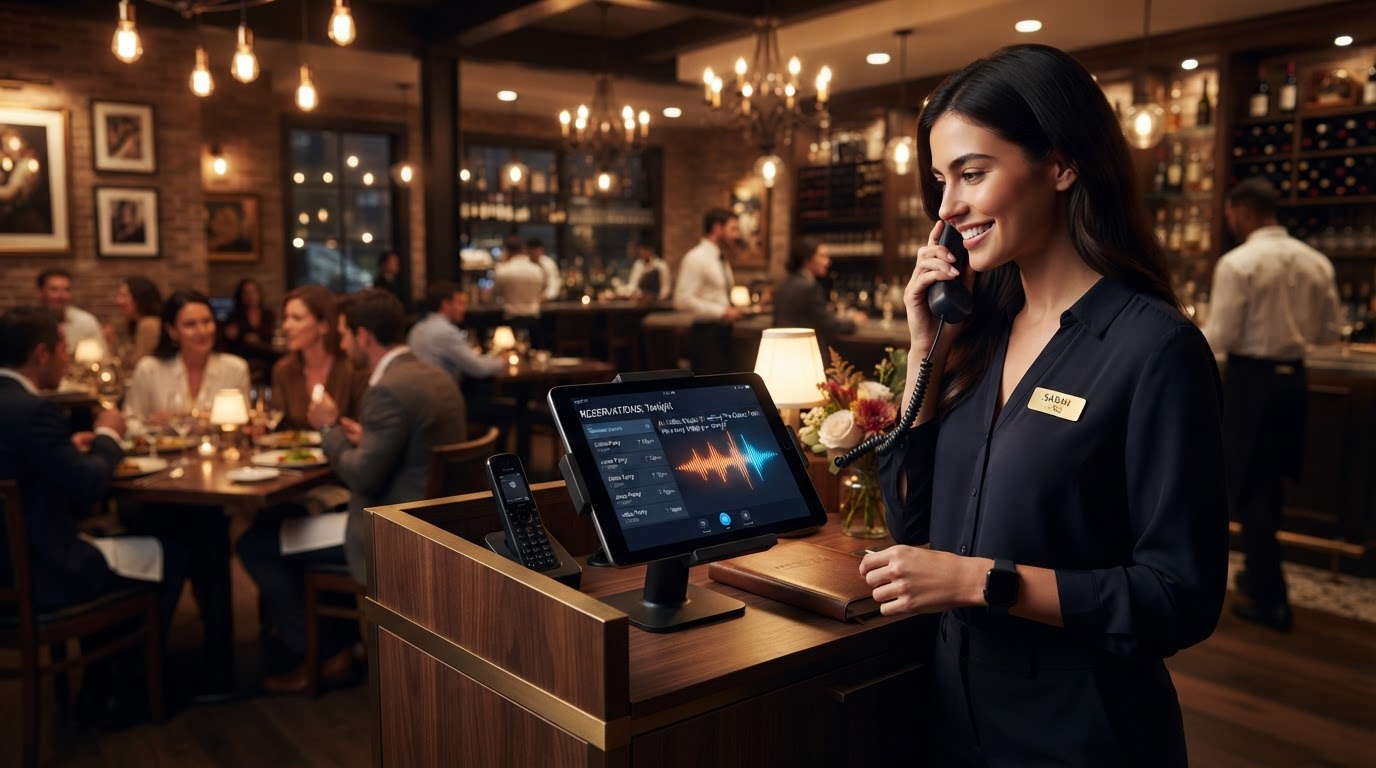
Restaurants have a phone problem that's invisible to owners but obvious to every customer who calls during a dinner rush. The host is seating guests, the phone rings unanswered, the caller gives up and calls the next restaurant on Google Maps — and a $80 reservation or a $45 takeout order walks out the door. During peak hours, a busy restaurant can miss 10–20 calls per hour, each representing a customer who wanted to spend money and couldn't. An AI phone agent — one that answers instantly, handles reservations, answers FAQs, takes orders, and escalates to a human for anything it can't handle — captures every one of those calls without adding staff. This guide covers how to deploy a restaurant AI phone agent that feels like a competent team member, not a frustrating robot.
01The Restaurant Phone Problem
The restaurant phone rings most during the exact moments when no one can answer it: Friday dinner rush, Saturday brunch, Sunday game day. The host is seating a party of six, the server is in the weeds, the manager is expediting, and the phone rings to voicemail — the fifth time this hour. Each missed call is a lost customer: a reservation that goes to the restaurant down the street, a takeout order that goes to the delivery app instead, a catering inquiry that goes to a competitor who answered. According to Toast's restaurant industry report, restaurants miss an average of 15% of inbound calls during peak hours — and 60% of those callers don't call back.
The math is straightforward: a restaurant doing $30,000/week in revenue that misses 15 calls per day at $40 average ticket loses $600/day — $21,000/month, $252,000/year — to unanswered phones. These are customers who wanted to spend money at your restaurant and couldn't. The AI phone agent doesn't just save time; it recovers revenue that's currently evaporating during every shift.
The challenge is that the phone agent must handle the real complexity of restaurant calls: variable party sizes, special requests, menu questions, dietary restrictions, reservation changes, and the inevitable edge cases — 'Can I bring a cake for a birthday?' 'Do you have high chairs?' 'Is there parking nearby?' A generic chatbot fails on these; a properly-designed AI phone agent handles them naturally, escalating only the truly complex or sensitive cases to a human. The AI chatbots and voice assistants service builds these conversational agents for restaurant-specific use cases.
02What the AI Phone Agent Handles
Reservations are the primary use case. The AI agent answers the call, understands the request ('I'd like to book a table for 4 at 7pm on Friday'), checks availability in the reservation system, and books it — or offers alternatives ('We're full at 7pm, but I have 6pm or 8:30pm — which works?'). The booking flows directly into the reservation system and sends a confirmation SMS to the caller. This eliminates the phone-tag that typically delays reservations by hours and ensures every reservation request is captured — not lost to a missed call.
FAQs are the second-highest-volume call type: 'What are your hours?' 'Where are you located?' 'Do you take reservations?' 'Is there parking?' 'Do you have a patio?' 'What's on your menu?' A properly-trained AI agent answers these instantly from your knowledge base — your Google Business Profile, your website, your menu, your policies. The agent should know your hours, your address, your parking situation, your patio availability, your menu highlights, your dietary accommodations (gluten-free, vegan, allergy-friendly), and your policies (large parties, kids, pets, corkage). This is the difference between an agent that feels like a team member and one that feels like a dead end.
Takeout orders are the revenue opportunity most restaurants miss. During peak hours, a caller who wants to place a $60 takeout order gives up when the phone isn't answered and orders from a delivery app instead — where the restaurant loses 20–30% to platform fees. An AI phone agent that takes the order directly captures that revenue at full margin. The agent walks the caller through the menu, confirms the order, takes the payment (or arranges pickup payment), and sends a confirmation with pickup time. The business processes to automate before hiring framework identifies order-taking as a high-ROI automation for restaurants.
03Designing the Conversation: Not Sounding Like a Robot
The number one risk with an AI phone agent is that it sounds robotic — and a robotic agent is worse than voicemail, because it frustrates the caller and damages the brand. The design principle: the agent should sound like your best host. If your restaurant is upscale, the agent is polished and professional; if it's a casual family spot, the agent is warm and friendly; if it's a late-night pizza place, the agent can be playful. The tone is trained on your brand voice, not a generic assistant template.
The conversation should be natural, not menu-driven. Instead of 'Press 1 for reservations, press 2 for takeout,' the agent greets ('Thanks for calling [Restaurant]! How can I help you?') and understands the intent from the natural response. The caller says 'I'd like to book a table' — the agent handles it. The caller says 'Do you have gluten-free options?' — the agent answers. The caller says 'I need to cancel my reservation' — the agent handles the change. This natural language understanding is what makes the agent feel like a person, not a phone tree.
Pacing matters. A human host speaks at a natural pace, pauses to listen, and doesn't rush. The AI agent should match this — not fire off rapid-fire responses that feel mechanical. Latency under 800ms (the threshold we describe in our innovative AI tools analysis) is essential; anything slower feels like a bad connection, not a conversation. The agent should also handle interruptions — if the caller says 'wait, actually make it 8pm instead,' the agent adjusts naturally, not starts over from the top. These conversational nuances are what separate an agent that delights from one that frustrates.
04Human Escalation: When the AI Can't Handle It
The AI phone agent can't handle everything, and trying to make it handle everything is what makes it fail. The design principle: the AI handles the 80% of calls that are routine; the human handles the 20% that need judgment. When the AI encounters something it can't handle — a complex catering request, a complaint, a special event booking, a question it doesn't know the answer to — it escalates smoothly: 'Let me get someone who can help with that — one moment.' The call is routed to a human staff member with the context attached, so the human doesn't start from scratch.
The escalation triggers should be clear: any request the AI isn't trained on (catering, private events, large parties over a threshold), any complaint or dissatisfaction, any payment dispute, and any call where the AI has failed to understand the request after two clarifying questions. The last trigger is important — if the AI can't understand the caller, continuing to ask 'I'm sorry, could you repeat that?' creates a frustrating loop. Better to escalate to a human who can handle the ambiguity.
The human escalation is what makes the AI agent safe to deploy. Without it, the AI is a gamble — it might handle the call well or it might frustrate the customer. With escalation, the AI handles what it can and defers what it can't, and the customer never gets trapped in a robotic loop. This is the same hybrid model we describe in the AI agent vs chatbot framework — the AI handles volume, the human handles value, and the handoff is seamless. The chatbot human handoff guide covers the escalation architecture in more detail.
05Integration with Your Reservation and POS Systems
The AI phone agent's value depends on its integrations. Without integration, the agent is a glorified voicemail — it can take messages but can't actually book a reservation or place an order. The integrations that matter: your reservation system (OpenTable, Resy, Tock, or your own), your POS system (for takeout orders), your payment processor (for phone orders), and your CRM (for customer history and preferences).
The reservation integration is the highest priority. When the AI agent books a table, it should write directly to the reservation system — checking real availability, not a static schedule. This integration eliminates the double-booking risk that comes with manual reservation entry and ensures the host stand sees the AI's bookings in real time. If the agent can't write to the reservation system, it's taking a message that a human has to process — which defeats the purpose.
The POS integration enables direct takeout orders. The agent walks the caller through the menu (pulled from the POS), confirms the order, and sends it to the kitchen — just like a server entering it at the terminal. For payment, the agent can take the card over the phone (with PCI-compliant processing) or send a payment link via SMS that the caller taps to complete. This is the integration that captures the takeout revenue currently lost to unanswered phones. The workflow and integration automation service builds these POS and reservation integrations as a standard deliverable.
06Measuring the AI Agent's Performance
An AI phone agent without measurement is a gamble. Track these metrics: call answer rate (should be 100% during business hours — the AI never takes a break), automated resolution rate (percentage of calls the AI handles without escalation — should be 70–85%), revenue captured (reservations and orders booked by the AI), customer satisfaction (post-call survey), and escalation rate (percentage of calls routed to a human — should be 15–30%).
The automated resolution rate is the key metric. If it's below 60%, the AI is escalating too much — either it's under-trained (doesn't know the answers) or the call routing is too conservative (escalating calls the AI could handle). If it's above 90%, the AI might be handling calls it shouldn't — complex requests where a human would provide a better experience. The sweet spot is 70–85%, where the AI handles the routine and the human handles the exceptional.
Review the call logs weekly — listen to 10–20 calls to find patterns: questions the AI is escalating that it should be answering, requests it's misunderstanding, and conversations where it sounded robotic. This tuning loop is what separates an AI agent that gets better over time from one that ossifies. The automation monitoring best practices framework covers the review cadence that keeps the agent improving — for restaurants, the weekly call review is the highest-leverage 30 minutes the owner can spend. The revenue impact is measurable: restaurants deploying AI phone agents typically recover 10–20% of previously-missed call revenue within the first month.
Key Takeaways
- Restaurants miss 15% of calls during peak hours — each missed call is a lost reservation or order from a customer who wanted to spend money.
- The AI agent handles the 80% of routine calls (reservations, FAQs, takeout orders) and escalates the 20% that need human judgment.
- Conversation design — natural language, brand-matched tone, sub-800ms latency, interruption handling — is what separates an agent that delights from one that frustrates.
- Integration with reservation and POS systems is what makes the agent functional — without it, it's just a glorified voicemail.
- Track automated resolution rate (target 70–85%) and review call logs weekly — the tuning loop is what makes the agent better over time.

Written by Moise
Founder & Lead Automation ArchitectMoise is the founder and lead automation architect at Wootomatic. With over a decade of hands-on experience designing, implementing, and maintaining high-throughput business automations, CRM pipelines, and custom AI agents, he has architected mission-critical workflows for hundreds of appointment-based and field-service businesses. His focus is on resilient, monitored systems that produce measurable ROI without fragile software bloat.
Ready to Put This Into Action?
Tell us about your workflow and we'll scope a custom automation within 24 hours.
Start Your Automation Project