On This Page
Missed-Call Text-Back for Antioch Home Service Businesses: How to Recover More Leads Automatically
When someone in Antioch needs an air conditioner repaired, a leaking pipe fixed, or an electrician dispatched, they usually do not want to wait. They call the first home service company that looks qualified, and if nobody answers, they often move directly to the next business in the search results. For an Antioch contractor, that single missed call could represent a repair, inspection, estimate, or emergency job worth hundreds — or thousands — of dollars. The problem is not necessarily a lack of leads. It may be that interested customers cannot reach the business quickly enough. A missed-call text-back system solves this by automatically sending a text message whenever the business cannot answer an incoming call, turning an unanswered phone into a second chance to capture and qualify the job.
01What Is Missed-Call Text-Back?
Missed-call text-back is an automated workflow that detects an unanswered business call and immediately sends the caller an SMS message. A basic workflow looks like this:
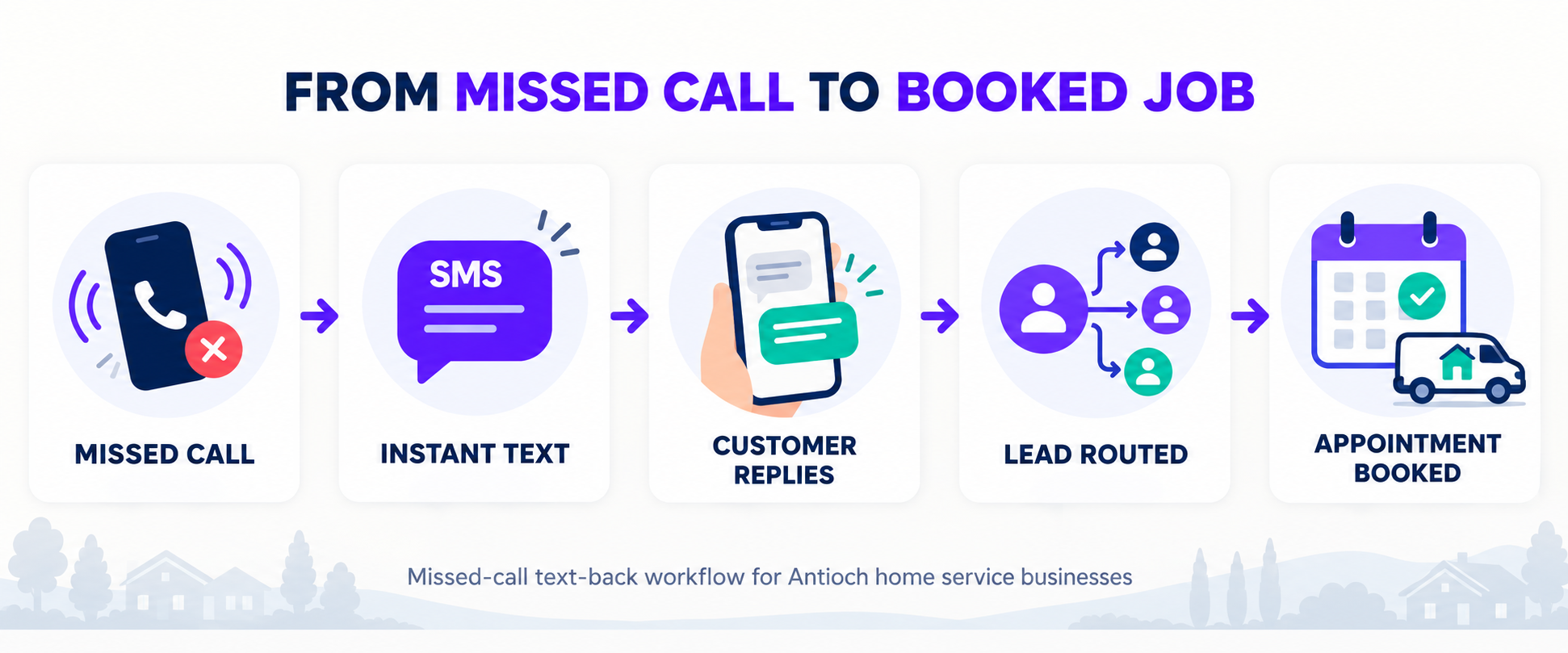
- 1A potential customer calls your business.
- 2The call is missed, declined, or reaches voicemail.
- 3The automation sends a text message within seconds.
- 4The caller replies with information about the job.
- 5The conversation is assigned to the appropriate employee.
- 6The lead is added to the CRM.
- 7Follow-up continues until the customer books, opts out, or says they no longer need service.
The system does not replace your office staff or technicians. It covers the gap between the missed call and the moment someone from your company becomes available. Instead of hearing voicemail and leaving, the caller immediately receives a response such as:
The customer gets an immediate acknowledgment, while the business gains another opportunity to capture and qualify the job. Our email and SMS marketing service is built around closing exactly this response gap.
02Why Missed Calls Matter for Antioch Home Service Companies
Home service customers frequently call because they have an immediate problem. An Antioch homeowner may be dealing with any of the following:
- An air conditioner that stopped working
- A leaking water heater
- A clogged drain
- An electrical outlet that is sparking
- A garage door that will not close
- A damaged roof
- A pest problem
- A broken appliance
- A landscaping or irrigation emergency
- A property that needs urgent cleaning or restoration
These callers are not casually browsing. Many are ready to schedule service as soon as they find a company that responds. This creates a straightforward competitive reality: the business that starts the conversation first often has the best opportunity to win the job.
Missed calls are especially common when technicians are driving or working at job sites, the office is closed, staff members are helping other customers, several calls arrive simultaneously, calls come in during lunch, evenings, or weekends, or the owner is operating the business without a dedicated receptionist. Hiring additional staff may eventually make sense, but it is not the only way to improve response times — automated text-back gives smaller Antioch service companies a practical way to respond without keeping someone beside the phone all day.
For the broader local context, see our Antioch service area page and our email and SMS marketing for Antioch businesses.
03How Missed-Call Text-Back Recovers Leads
A properly designed system does more than send "Sorry we missed you." It moves the caller toward the next useful step, one question at a time.
1. It acknowledges the customer immediately. The first message confirms that the call reached the correct business and that someone will respond. This reduces uncertainty and gives the customer a reason to pause before calling another contractor.
2. It identifies the requested service. The automation can ask a simple question — "What type of service can we help you with today?" — and use the response to distinguish an HVAC request from plumbing, electrical, roofing, or another service category.
3. It confirms the service area. An Antioch home service company may serve Antioch, Brentwood, Oakley, Pittsburg, Bay Point, Discovery Bay, and other nearby communities. The workflow can ask for a ZIP code or city before an employee spends time reviewing the lead.
4. It captures urgency. Not every lead requires the same response. The system can ask whether the request is an emergency, something needed today, or a project being planned — then route emergencies immediately while estimate requests flow into the normal scheduling workflow.
5. It offers the next available appointment. When connected to a calendar, the conversation can provide available appointment windows or send the customer a booking link. Our appointment and calendar automation service handles this booking layer.
6. It records the conversation. The caller's name, phone number, service request, and messages are stored in the company's CRM, so employees can see what the customer needs before calling back. See our CRM and pipeline automation service for the record-keeping layer.
04Home Service Businesses That Can Use Missed-Call Automation
Missed-call text-back can support almost any appointment-based or field-service business in Antioch.
HVAC companies. Heating and cooling calls often arrive during seasonal demand spikes. Automated text-back can collect the equipment type, problem, property location, and scheduling preference.
Plumbers. A plumbing workflow can ask whether the customer has a leak, clogged drain, water-heater issue, or another problem. Emergency cases can be routed to an on-call technician.
Electricians. The system can distinguish between service upgrades, installations, and urgent electrical concerns. Safety-related messages should instruct customers to contact emergency services when appropriate rather than relying on an automated conversation.
Roofers. Roofing companies can collect the property address, type of roof, visible damage, and whether the request involves an inspection, repair, or replacement estimate.
General contractors. A contractor can use text-back to identify the project category, approximate timeline, location, and whether the customer owns the property.
Garage-door companies. Callers can specify whether the door is stuck, damaged, off its track, or experiencing an opener problem. The request can then be routed based on urgency.
Cleaning and restoration companies. The workflow can distinguish routine cleaning from water, fire, mold, or other restoration requests requiring faster escalation.
Pest-control companies. Customers can identify the pest, the affected part of the property, and a preferred inspection time before an employee responds.
05What the First Text Message Should Say
The first message should be short, transparent, and easy to answer. A practical template is:
Avoid sending a large paragraph or asking five questions at once. The immediate objective is to begin a conversation. After the customer replies, the workflow can ask one additional question at a time. For example:
Then:
The messages should sound like the business — not like a generic bot copied across dozens of companies. Read our missed-call text-back automation guide for the full message architecture.
06What Happens After the Customer Replies?
Text-back is only the first component. The workflow needs clear routing and follow-up rules. A complete system can:
- Create or update the contact in the CRM
- Record the missed-call source
- Apply a service-category tag
- Assign the lead to the correct employee
- Notify the office or on-call technician
- Send a scheduling link
- Create a sales opportunity
- Trigger follow-up when the customer stops responding
- Stop automated messages when an employee takes over
- Record whether the lead booked, declined, or was outside the service area
The workflow should also prevent duplicate messages. A customer who calls three times within several minutes should not receive the same introductory text three times — repeat calls often indicate urgency, so the system should alert the team instead. Our workflow and integration automation service builds these routing and deduplication rules.
Stop Losing Antioch Leads to Voicemail
We'll map your missed-call workflow, wire the text-back automation, and connect it to your CRM and calendar — done-for-you on a flexible monthly subscription.
07After-Hours Missed-Call Text-Back
After-hours calls deserve a separate response. A useful message might say:
If the company provides emergency service, the message can include an emergency-routing option:
Only advertise emergency or 24-hour service when someone is genuinely available to respond. Automation should never promise immediate human assistance that the business cannot deliver. For the broader response-time framework, read our lead response time automation guide.
08Common Mistakes to Avoid
Sending a generic message with no next step. "Sorry we missed you" acknowledges the call but does not help qualify or schedule the lead. Ask one simple question that encourages a response.
Automating too much too soon. Customers with urgent home-service problems may not want to complete a long SMS questionnaire. Collect the minimum information necessary to route the request, then let an employee take over.
Continuing automation after a human responds. Once an employee joins the conversation, automated messages should pause. Otherwise, the customer may receive conflicting or repetitive replies.
Ignoring repeat callers. Repeat calls can indicate urgency. The system should alert the team when the same number calls more than once within a short period.
Failing to test the workflow. Test unanswered calls, after-hours calls, repeat calls, landlines, spam numbers, opt-outs, employee handoffs, and appointment confirmations before relying on the system.
Treating every lead the same. A burst pipe should not follow the same sequence as a future remodeling estimate. Use routing rules based on service type and urgency.
09SMS Consent and Compliance
Businesses using automated text messaging must follow applicable telecommunications and privacy requirements. At a minimum:
- Clearly identify the business
- Explain the purpose of the conversation
- Provide opt-out instructions
- Honor STOP requests promptly
- Avoid adding inquiry-related callers to unrelated marketing campaigns
- Separate service communications from promotional consent
- Maintain records of consent when sending recurring marketing messages
- Control message frequency
- Keep customer information secure
A missed-call response related directly to the customer's call is different from enrolling that person in a long-term promotional campaign. Do not treat one missed call as unlimited permission to send marketing texts — entering a phone number is not blanket consent. Have your specific workflow and disclosure language reviewed by qualified counsel. The Federal Communications Commission publishes consumer-facing guidance on the Telephone Consumer Protection Act that is a useful starting point.
10How to Measure Whether It Works
The goal is not simply to send more text messages. The goal is to recover opportunities that would otherwise be lost. Track the following:
- Number of missed calls
- Percentage receiving an automated response
- Customer reply rate
- Average time before the first response
- Number of qualified leads
- Appointments booked from missed calls
- Jobs completed
- Revenue attributed to recovered calls
- Opt-out rate
- Leads lost because they were outside the service area
- Messages requiring human escalation
Compare these measurements with a baseline from before the automation was launched. For example, if the company received 80 missed calls during the previous month, determine how many callers left messages, received callbacks, and ultimately booked. After launching text-back, compare the same stages. This shows whether the workflow produces business value instead of merely generating activity.
11How Much Does Missed-Call Text-Back Cost?
Cost depends on the systems already used by the business. A company may need a business phone number capable of triggering automations, SMS usage, CRM access, workflow setup, calendar integration, employee notifications, and ongoing monitoring and maintenance. The typical components and their monthly cost ranges:
| Component | Monthly Cost | What It Does |
|---|---|---|
| Business number with automation triggers | $20–$50 | Detects missed calls and starts the workflow |
| SMS usage (per message) | $30–$120 | Sends the text-back and follow-up messages |
| CRM access | $149–$300 | Stores contacts, tags, and conversation history |
| Calendar integration | $50–$150 | Offers available appointment windows |
| Workflow setup & monitoring | included in plan | Routing rules, deduplication, tuning |
A basic missed-call response is relatively straightforward. A more advanced system that qualifies requests, routes emergencies, schedules appointments, and tracks revenue requires additional configuration. Wootomatic's managed automation plans start at $149 per month, while custom implementations vary based on the phone system, CRM, integrations, and workflow complexity. Review the current Wootomatic pricing and plans for available options.
12Setting Up Missed-Call Text-Back in Antioch
A reliable implementation normally follows these stages:
Step 1: Map the current call process. Document what happens when someone calls, who answers, where voicemails go, and how employees currently follow up.
Step 2: Define routing rules. Decide which service requests are urgent, which employee receives each category, and which communities the company serves.
Step 3: Write the messages. Create separate language for business hours, after-hours requests, emergencies, appointment scheduling, and follow-up.
Step 4: Connect the systems. Connect the business number, CRM, calendar, and notification channels.
Step 5: Test real scenarios. Place test calls from different numbers and confirm that every message, assignment, and notification works as intended.
Step 6: Monitor results. Review missed calls, responses, bookings, and failed messages regularly. Refine the workflow based on actual conversations. Our automation audit and consulting service can scope this end-to-end before you commit to a build.
13Turn Missed Calls Into Booked Jobs
Antioch home service companies do not always need more leads. Sometimes they need a better system for responding to the leads they already receive. Missed-call text-back gives contractors a second opportunity to connect with customers who might otherwise call someone else. When combined with CRM routing, appointment automation, and human follow-up, it can turn an unanswered phone call into a scheduled estimate or completed service job.
Wootomatic builds managed AI, CRM, and workflow automation for appointment-based and service businesses throughout Antioch and the greater Bay Area. Explore AI and workflow automation for Antioch businesses, learn about CRM and pipeline automation, or request a consultation to map your missed-call workflow. For contractors running seasonal promotions, our promotions hub shows how to align offers with active campaigns.
Key Takeaways
- A missed call from an Antioch homeowner can represent a job worth hundreds or thousands of dollars — and the caller usually moves to the next business if no one answers.
- Missed-call text-back sends an automated SMS within seconds, acknowledges the call, and starts a one-question-at-a-time conversation that qualifies and routes the lead.
- HVAC, plumbing, electrical, roofing, garage-door, cleaning, restoration, and pest-control companies can all use it to respond while staff are on job sites or after hours.
- Track missed calls, reply rate, appointments booked, and revenue attributed — compare against a pre-launch baseline to prove the workflow produces business value.
- SMS consent and TCPA compliance are non-negotiable: identify the business, provide opt-out, honor STOP, and never treat one missed call as permission for marketing campaigns.
Frequently Asked Questions

Written by Moise
Founder & Lead Automation ArchitectMoise is the founder and lead automation architect at Wootomatic. With over a decade of hands-on experience designing, implementing, and maintaining high-throughput business automations, CRM pipelines, and custom AI agents, he has architected mission-critical workflows for hundreds of appointment-based and field-service businesses. His focus is on resilient, monitored systems that produce measurable ROI without fragile software bloat.
Put This Into Practice
We build and manage these automations for service businesses on a flexible monthly subscription. Explore the related service to see how it works: