On This Page
CRM and Automation Guide for Veteran-Owned Small Businesses
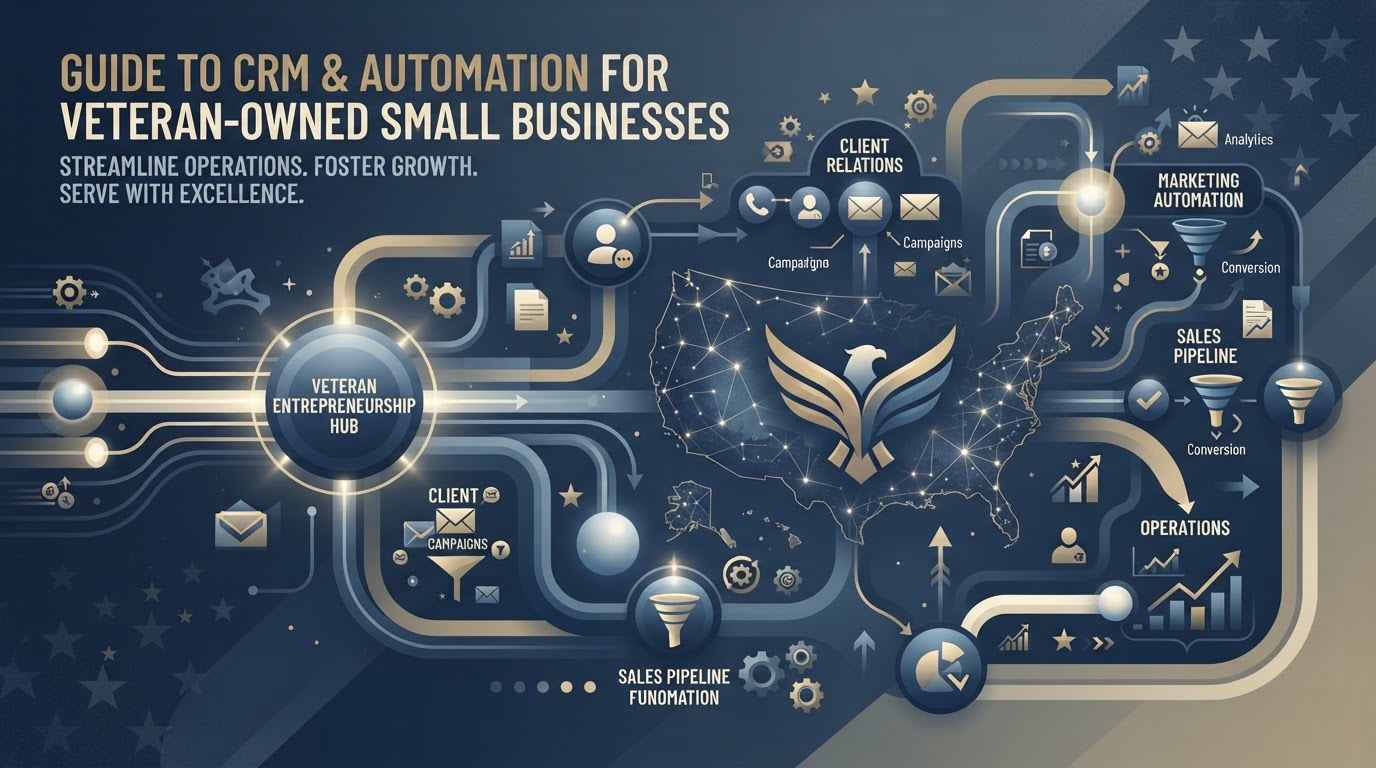
Veteran-owned businesses bring a unique advantage to automation: the operational discipline, systems thinking, and process orientation that military service instills. The skills that make a successful service member — attention to detail, adherence to process, accountability, and mission focus — are exactly the skills that make automation successful. This guide is for the veteran entrepreneur building a service business, covering the CRM and automation stack that fits, the phased deployment plan, and how to translate military operational discipline into a civilian business advantage. Veterans Day is a fitting time to honor that service by building systems that make the business sustainable.
01Why Veterans Excel at Business Automation
Military service trains people to think in systems: standard operating procedures, checklists, escalation protocols, after-action reviews, and clear chains of accountability. These are the exact foundations that successful business automation requires. A veteran who can follow and maintain an SOP can follow and maintain an automated workflow. A veteran who understands escalation protocols understands automated escalation rules. A veteran who runs after-action reviews understands the importance of monitoring and reviewing automation performance.
According to the Small Business Administration's veteran-owned business data, veteran-owned businesses employ over 5 million people and generate $1.3 trillion in revenue annually. Veterans are 45% more likely to be self-employed than non-veterans — and the operational discipline they bring is a significant competitive advantage when applied to business systems.
The translation is direct: military SOPs become automated workflows; escalation protocols become routing rules; after-action reviews become performance dashboards; mission focus becomes goal-oriented automation. The veteran entrepreneur doesn't need to learn systems thinking from scratch — they need to translate the systems thinking they already have into the language of business automation. Our small business automation guide covers the general framework; this guide adapts it to the veteran context.
02The CRM and Automation Stack for Veteran-Owned Businesses
Here's the stack we recommend for veteran-owned service businesses — each chosen for reliability, clarity, and alignment with operational discipline:
| Component | Purpose | Monthly Cost | Military Analogy |
|---|---|---|---|
| Cloud CRM | System of record for all contacts and deals | $50–$150 | Personnel roster |
| Automated lead capture | Never miss an inquiry | $0–$50 | Sentry post |
| 24/7 scheduling | Self-serve appointment booking | $15–$50 | Duty roster |
| Automated follow-up | Consistent engagement | $30–$100 | Check-in protocol |
| Reporting dashboard | Performance visibility | $0–$50 | Sitrep (situation report) |
| Automated invoicing | Cash flow consistency | $0–$25 | Supply chain |
The CRM is the system of record — the personnel roster for your business. Every contact, deal, appointment, and interaction lives there. A veteran who maintained a clean personnel roster understands the value of a clean CRM: if the data is accurate and current, every downstream system works. If the data is messy, everything breaks. Start with the CRM and keep it disciplined.
The reporting dashboard is the sitrep. In the military, a sitrep gives leadership a clear picture of the current situation. In business, a reporting dashboard does the same — key metrics, current status, exceptions flagged. A veteran who reads sitreps can read a dashboard, and the discipline of reviewing it regularly (daily or weekly) is the same discipline that keeps operations running smoothly. Our CRM & Pipeline Automation service configures these dashboards as a standard deliverable.
03Translating Military Discipline to Automation
The specific military skills that translate directly to automation success:
Standard Operating Procedures → Automated workflows. An SOP is a documented, repeatable process. An automated workflow is an SOP that executes itself. The veteran who writes and follows SOPs can design and maintain automated workflows — the discipline is identical. Document the process, define the steps, identify exceptions, and build the workflow to match. Our 15 business processes to automate guide lists the processes most worth turning into workflows.
Escalation protocols → Routing rules. Military escalation protocols define who handles what, and when to escalate to the next level. Automated routing rules do the same: a high-value lead routes to the owner immediately; a complex support issue escalates to a specialist; a complaint escalates to management. The veteran who understands escalation protocols can design routing rules that ensure the right person handles the right situation at the right time. Our AI chatbot human handoff guide covers the escalation framework.
After-action reviews → Performance reviews. The military after-action review asks: what was supposed to happen, what actually happened, what went well, what needs improvement. The automation performance review asks the same: what was the automation supposed to do, what did it do, where did it excel, where did it fail. The veteran who runs after-action reviews can run automation performance reviews — and the discipline of doing it regularly (monthly, not annually) is what keeps the systems healthy. Our automation monitoring best practices guide covers the review cadence.
04The Phased Deployment Plan
Building the CRM and automation stack in phases, with the discipline of a military deployment plan:
Phase 1 (Weeks 1–2): Establish the system of record. Deploy the CRM, migrate existing contacts, and establish data discipline. Every contact, deal, and interaction goes in the CRM — no exceptions. This is the foundation; everything depends on it. Cost: $50–$150/month.
Phase 2 (Weeks 3–4): Automate lead capture and response. Deploy automated intake, instant response, and missed-call text-back. Every inquiry is now captured and responded to instantly. Cost: $50–$200/month.
Phase 3 (Weeks 5–6): Automate scheduling and follow-up. Deploy self-serve booking, reminders, and nurture sequences. Appointments flow without manual coordination, and follow-up is consistent. Cost: $45–$150/month.
Phase 4 (Weeks 7–8): Deploy reporting and invoicing. Set up the reporting dashboard (the sitrep) and automated invoicing. The business now has full operational visibility and consistent cash flow. Cost: $0–$75/month.
Total: 8 weeks, $145–$575/month. The result: a business with a clean system of record, automated lead capture, consistent follow-up, operational visibility, and reliable cash flow — all maintained with the discipline that military service instills. The automation audit and consulting service maps your specific business to this phased plan.
05Failure Cases and Limitations
The most common failure for veteran-owned businesses is over-engineering the systems. Veterans with strong systems thinking sometimes build overly complex automations — too many steps, too many branches, too much sophistication — that become hard to maintain. The military principle of KISS (Keep It Simple, Stupid) applies to automation: simple, robust workflows are more reliable than complex ones. Build the minimum viable automation that solves the problem, and add complexity only when needed.
The second failure is neglecting the after-action review. A veteran deploys the automation stack, sees it working, and assumes the job is done. But automations drift — data changes, APIs update, business conditions shift. Without regular performance reviews (the after-action review), the systems degrade silently. The fix: schedule a monthly review of automation performance, just as you would schedule a regular training or inspection. Discipline isn't a one-time effort; it's a sustained practice.
A limitation to acknowledge: automation doesn't replace the veteran entrepreneur's judgment, leadership, or relationships. The systems handle the operational work; the veteran handles the strategic work. The goal isn't an automated business that runs without the owner; it's a business where the owner's discipline and systems thinking are amplified by automation, not replaced by it.
06An Anonymized Example from Our Work
A veteran-owned HVAC business was run by a former Navy officer who had built strong operational discipline but was overwhelmed by the administrative load. Lead follow-up was inconsistent, scheduling was a daily scramble, and he had no visibility into his business metrics. He was working 70-hour weeks and considering hiring an office manager — but the margins didn't support it.
We deployed the CRM and automation stack over 8 weeks, leveraging his operational discipline throughout. The CRM became his system of record — he maintained it with the same rigor he'd maintained a personnel roster. Automated lead capture and response eliminated the follow-up gap. Self-serve scheduling ended the daily scramble. The reporting dashboard gave him the sitrep he'd been missing — he could see lead volume, conversion rate, no-show rate, and revenue at a glance. Within 3 months, his workweek dropped from 70 to 50 hours, his lead response time dropped from 6 hours to under 30 seconds, and his conversion rate lifted 18%. He never hired the office manager. The automation stack cost $380/month — a fraction of the salary — and his military discipline made the systems run flawlessly, because he treated maintenance like a regular inspection.
07Operational Excellence as a Competitive Advantage
Veteran-owned businesses have a built-in advantage in the automation era: the operational discipline that military service instills is exactly what successful automation requires. The veteran who translates SOPs into workflows, escalation protocols into routing rules, and after-action reviews into performance reviews builds a business that runs with the precision of a well-led unit. The CRM and automation stack above is the toolkit; the discipline is the differentiator. If you're a veteran entrepreneur looking to build systems that honor your service through operational excellence, the automation audit and consulting service maps your business to this framework. Veterans Day is a fitting time to build systems that make the business sustainable — because a business built on discipline is a business built to last.
Key Takeaways
- Veterans bring operational discipline, systems thinking, and process orientation — the exact skills that make automation successful.
- The stack: cloud CRM (system of record), automated lead capture, scheduling, follow-up, reporting dashboard (sitrep), and invoicing — $145–$575/month.
- Translate military skills: SOPs → workflows, escalation protocols → routing rules, after-action reviews → performance reviews.
- Deploy in 4 phases over 8 weeks, maintaining the CRM with the discipline of a personnel roster.
- Keep it simple (KISS) and run monthly after-action reviews — discipline is a sustained practice, not a one-time effort.

Written by Moise
Founder & Lead Automation ArchitectMoise is the founder and lead automation architect at Wootomatic. With over a decade of hands-on experience designing, implementing, and maintaining high-throughput business automations, CRM pipelines, and custom AI agents, he has architected mission-critical workflows for hundreds of appointment-based and field-service businesses. His focus is on resilient, monitored systems that produce measurable ROI without fragile software bloat.
Ready to Put This Into Action?
Tell us about your workflow and we'll scope a custom automation within 24 hours.