
On This Page
Year-End Business Automation Audit: The Complete Checklist
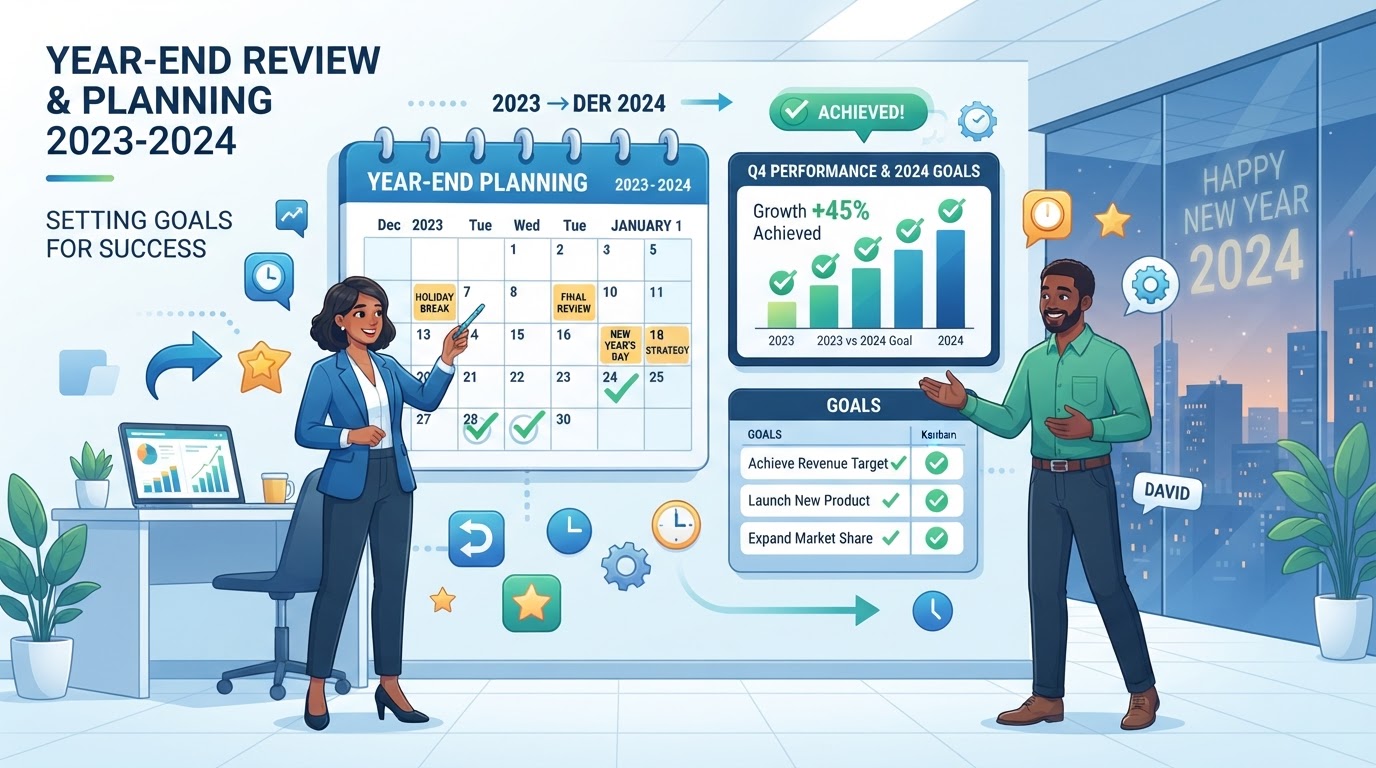
Year-end is the natural time to audit your automation stack — the year's data is complete, the new year's planning is ahead, and the quiet week between holidays is the perfect moment to clean up the systems that ran your business all year. But most businesses skip the audit, and their automations drift — broken workflows, stale data, over-permissioned integrations — until something fails catastrophically. This checklist is the year-end automation audit we run with every client, covering CRM cleanup, workflow review, reporting verification, integration inventory, and planning for the new year. You can also see our live [year-end promotion page](/promotions/year-end-business-planning) for current offers.
01Why Year-End Is the Ideal Audit Time
Year-end has three properties that make it the perfect audit window. First, the year's data is complete — you can review 12 months of automation performance, not a partial snapshot. Second, the new year's planning is ahead — you can align your automation priorities with your business goals before the year starts. Third, the holiday lull provides the time — the quiet week between Christmas and New Year's is when most businesses have the bandwidth to do this work, if they choose to.
The cost of skipping the audit is cumulative. Every automation drifts over time: APIs change, data schemas evolve, business processes shift, and workflows that worked in January break by December — silently, because nobody's checking. According to our own automation monitoring best practices research, the average automation has a 15–20% degradation rate over 12 months without maintenance — meaning a fifth of your automations are partially or fully broken by year-end, and you don't know which ones.
The audit is how you catch the drift before it becomes a failure. It's a systematic review of every automation, every integration, every data source — verifying what's working, fixing what's broken, and planning what to build next. Done once a year, it prevents the silent accumulation of broken workflows that eventually leads to a catastrophic failure. Our automation audit and consulting service runs this exact audit for clients.
02The Year-End Automation Audit Checklist
Work through this checklist systematically. Each item includes the risk it addresses and the time to complete.
| # | Audit Item | Risk Addressed | Time to Complete |
|---|---|---|---|
| 1 | CRM data deduplication | Campaign failures, lost contacts | 2–4 hours |
| 2 | Workflow error rate review | Silent failures, lost data | 1–2 hours |
| 3 | Integration inventory & key rotation | Security, over-permissioning | 1–2 hours |
| 4 | Reporting accuracy verification | Bad decisions from bad data | 1 hour |
| 5 | Automation documentation update | Knowledge loss, unmaintainable systems | 2–3 hours |
| 6 | Stale lead/contact cleanup | Wasted campaign spend | 1–2 hours |
| 7 | Permission & access audit | Security, insider access | 1 hour |
| 8 | Cost-to-value review | Overspending on unused tools | 1 hour |
| 9 | New year automation planning | Misaligned priorities | 1–2 hours |
| 10 | Backup & recovery verification | Data loss, no recovery path | 1 hour |
Items 1–5 are the core audit. If you do nothing else, complete these five — they address the most common and most damaging automation failures. The CRM deduplication prevents campaign failures and lost contacts. The workflow error rate review catches silent failures. The integration inventory addresses security risks from over-permissioned or unused integrations. The reporting accuracy verification ensures your business decisions are based on correct data. The documentation update prevents the knowledge loss that makes automations unmaintainable when team members leave.
Items 6–10 are the optimization and planning layer. Stale lead cleanup reduces wasted campaign spend. The permission audit closes security gaps. The cost-to-value review eliminates overspending on unused tools. The new year planning aligns automation priorities with business goals. The backup verification ensures you have a recovery path if anything fails. All ten items take roughly 12–19 hours total — a manageable investment for a year of reliable automation.
03Item 1: CRM Data Deduplication
Duplicate contacts are the most common CRM problem and the most damaging — they cause campaigns to send multiple emails to the same person, skew reporting with inflated contact counts, and create fragmented customer records that prevent personalization. The year-end deduplication pass merges duplicates, fills in missing fields, and removes invalid records.
The process: Export your full contact list, sort by email and phone to identify duplicates, merge duplicate records (preserving the most complete version of each field), fill in missing fields (email, phone, address) from other sources where possible, and remove contacts with invalid email addresses (bounced, spam traps). For a CRM with 5,000 contacts, this takes 2–4 hours and typically reduces the contact count by 10–20% — meaning 500–1,000 duplicates were cleaned. Our CRM migration checklist covers this data hygiene process in detail.
After deduplication, verify the cleanup. Send a test campaign to a small segment and confirm it reaches the right contacts without duplicates. Check that merged records retained the correct data. A botched deduplication can lose data — always export a backup before merging, and verify the results before considering the cleanup complete.
04Items 2–3: Workflow Review and Integration Inventory
Every automation workflow should be reviewed for error rates and relevance. Pull the error logs for each workflow over the past 12 months and calculate the error rate: total executions / total errors. A workflow with a 15% error rate is failing one in seven times — and if it's a lead capture workflow, that's one in seven leads lost silently.
For each workflow, ask three questions: Is it still needed? (Business processes change — a workflow built for a service you no longer offer should be retired.) Is it working? (Check the error rate and review the output for correctness.) Is it documented? (If the person who built it left, can someone else understand and maintain it?) Workflows that fail any of these questions need attention — either fixing, documenting, or retiring.
The integration inventory is the security complement. List every integration your automations use — every API key, every connected app, every webhook. For each, verify: is it still active? (Remove unused integrations and revoke their keys.) Is it scoped to least-privilege? (An integration that only needs read access should not have write access.) Is the key rotated recently? (Rotate any key older than 90 days.) This is the same security discipline we cover in our AI CRM security checklist — the integration inventory is where security drift accumulates.
05Items 4–5: Reporting and Documentation
Reporting accuracy is the foundation of good decisions — if your reports are wrong, your decisions are wrong. Verify your reporting by cross-checking: pull a metric from your reporting dashboard and verify it against the source data (the CRM, the ad platform, the payment processor). If the numbers don't match, the reporting workflow has a bug — fix it before making new year decisions based on bad data.
Documentation is the often-skipped but essential audit item. For each automation, document: the purpose (what business process it automates), the trigger (what starts it), the steps (what it does), the dependencies (what it connects to), the error handling (what happens when it fails), and the owner (who maintains it). This documentation is what makes the automation maintainable when team members change — and it's what we create as a standard deliverable in our workflow and integration automation service.
06Items 8–9: Cost Review and New Year Planning
The cost-to-value review eliminates overspending on unused tools. List every tool subscription and automation platform your business pays for. For each, ask: is it being used? Is the usage worth the cost? Can it be downgraded to a cheaper plan? Many businesses carry subscriptions for tools they stopped using months ago — the year-end review is when you cancel them.
The new year automation planning aligns your automation priorities with your business goals. What are the top 3 business goals for the new year? What automations would support each goal? What's the priority order? This planning ensures your automation investment is directed at the highest-impact areas — rather than building automations that don't serve the year's strategic priorities. Our 15 business processes to automate guide can help identify the processes to prioritize.
07Failure Cases and Limitations
The most common failure is skipping the audit entirely. The business is busy, the audit seems non-urgent, and it gets postponed — until a silent failure costs a month of lost leads or a security breach from an unused integration. The fix: schedule the audit as a recurring year-end event. Treat it as a non-negotiable business practice, not an optional task. The 12–19 hours of audit time prevent hundreds of hours of failure recovery.
The second failure is auditing without fixing. The audit identifies problems, but nobody follows through on the fixes — the broken workflow stays broken, the over-permissioned key stays over-permissioned, the unused integration stays connected. The fix: assign each audit finding an owner and a deadline. An audit without follow-through is just a list of problems you know about but haven't solved.
A limitation to acknowledge: the full 10-item audit takes 12–19 hours, which may be more than a very small business can spare in one sitting. In that case, prioritize: items 1–5 (CRM deduplication, workflow review, integration inventory, reporting verification, documentation) are the core — even those five alone will dramatically improve automation reliability. The rest can be spread across the first quarter.
08An Anonymized Example from Our Work
A growing service business hadn't audited their automation stack in 18 months. When we ran the year-end audit, we found: 340 duplicate contacts in their CRM (causing campaign emails to double-send), 3 workflows with error rates above 20% (silently failing on one in five leads), 7 unused integrations with active API keys (security risk), a reporting dashboard that was undercounting revenue by 12% (bad data leading to bad decisions), and $340/month in tool subscriptions for features they weren't using. The audit took 14 hours over two days. The fixes: deduplicated the CRM (reducing contacts from 4,200 to 3,860), fixed the 3 broken workflows (recovering an estimated 40+ leads per month that were being silently lost), revoked the 7 unused integration keys, fixed the reporting bug, and cancelled the unused subscriptions. The estimated impact: $2,800/month in recovered leads and saved subscription costs — a 20x return on the 14 hours of audit time. The client's reaction: 'I had no idea so much was broken — it was all working fine on the surface.'
09Start the New Year with a Clean Stack
The year-end audit is the single highest-ROI maintenance practice for any automated business. It catches the silent failures, cleans the accumulated drift, and aligns your systems with the new year's goals — all in 12–19 hours. The checklist above ensures every component is reviewed; the follow-through ensures every finding is fixed. If you'd rather have a professional run this audit, the automation audit and consulting service covers the full process. And for year-end offers, visit our promotion page. Because a business that starts the new year with a clean, verified, documented automation stack is a business that's built to scale — without the silent failures that slow everyone else down.
Key Takeaways
- Year-end is the ideal audit time — complete data, ahead of new year planning, and the holiday lull provides the bandwidth.
- The 10-item audit covers CRM deduplication, workflow review, integration inventory, reporting verification, documentation, and cost review — 12–19 hours total.
- Items 1–5 are the core: a fifth of automations degrade 15–20% over 12 months without maintenance — the audit catches the drift before it fails.
- Assign each finding an owner and deadline — an audit without follow-through is just a list of known problems.
- The audit typically returns 20x+ the time invested in recovered leads, saved costs, and prevented failures.

Written by Moise
Founder & Lead Automation ArchitectMoise is the founder and lead automation architect at Wootomatic. With over a decade of hands-on experience designing, implementing, and maintaining high-throughput business automations, CRM pipelines, and custom AI agents, he has architected mission-critical workflows for hundreds of appointment-based and field-service businesses. His focus is on resilient, monitored systems that produce measurable ROI without fragile software bloat.
Ready to Put This Into Action?
Tell us about your workflow and we'll scope a custom automation within 24 hours.