On This Page
Best Business Automations for Military Spouse Entrepreneurs
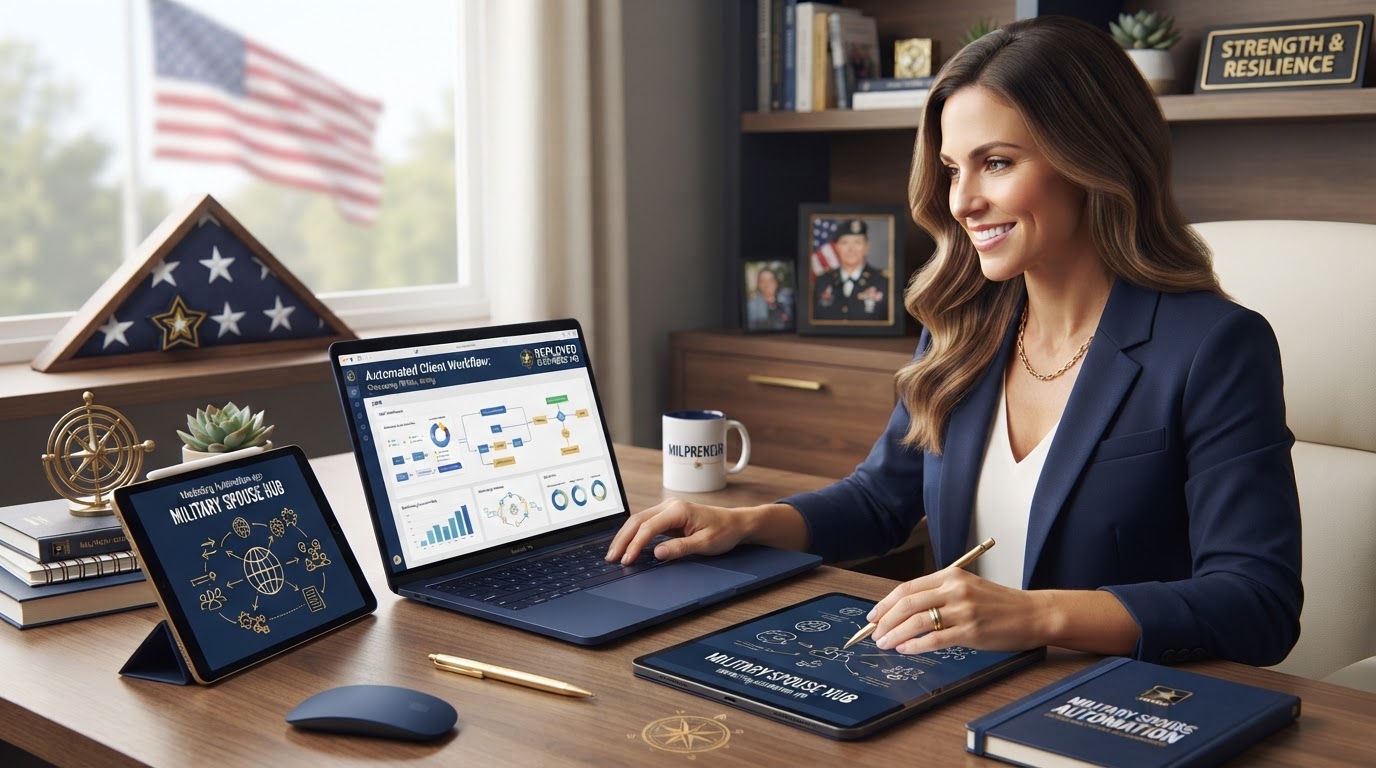
Military spouse entrepreneurs build businesses under constraints most founders never face: frequent PCS moves that uproot local networks, unpredictable family schedules driven by deployment cycles, and the need to operate a business that can survive a cross-country relocation every 2–3 years. Traditional business advice often doesn't account for these realities. This guide is for the military spouse entrepreneur who needs their business to be portable, resilient, and capable of running through transitions — and the specific automations that make that possible. Military Family Month is the right time to build systems that honor the sacrifice by making the business sustainable.
01The Military Spouse Business Challenge
Military spouse entrepreneurs face a fundamental tension: building a business takes time and local roots, but military life demands mobility. According to the Small Business Administration's military spouse entrepreneurship research, military spouse entrepreneurship is growing — but so are the challenges of maintaining a business through frequent relocations, deployments, and unpredictable schedules. The businesses that survive and thrive are the ones that aren't tied to a physical location or a single person's constant availability.
The three core challenges are portability, continuity, and capacity. Portability: the business must survive a PCS move without losing customers, systems, or momentum. Continuity: the business must run during deployments, trainings, and family disruptions when the entrepreneur's time is constrained. Capacity: the entrepreneur must do more with less time, because military family life demands flexibility that most business models don't accommodate.
Automation is the answer to all three. A business where lead capture, scheduling, follow-up, and delivery are automated is portable (the systems move with you), continuous (they run when you can't), and capacity-multiplying (they do the work of a team you can't hire). This isn't about replacing the entrepreneur's judgment — it's about freeing the entrepreneur from the repetitive work that makes a military spouse business fragile. Our small business automation guide covers the general framework; this guide adapts it to the military spouse context.
02The Portable Business Automation Stack
Here's the automation stack we recommend for military spouse entrepreneurs — each chosen specifically for portability and resilience:
| Automation | Why It Matters for Military Spouses | Monthly Cost |
|---|---|---|
| Cloud-based CRM | Moves with you, no local server | $50–$150 |
| Automated lead capture | Never miss a lead during a move | $0–$50 |
| 24/7 self-serve scheduling | Books while you're on duty/moving | $15–$50 |
| Automated follow-up sequences | Maintains relationships during deployments | $30–$100 |
| Virtual phone system | Keep one number across PCS moves | $15–$30 |
| Automated invoicing & payments | Cash flow doesn't stop during transitions | $0–$25 |
| Cloud document storage | Contracts and files accessible anywhere | $0–$15 |
The virtual phone system is the unsung hero. A military spouse who uses a personal cell phone for business loses their business number with every PCS move (new area code, new number, lost contacts). A virtual phone number (Google Voice, VoIP service) stays the same regardless of location — customers reach you at the same number whether you're in Virginia, California, or Germany. This single automation preserves the business's contact continuity across moves.
Cloud-based everything is the portability principle. Every system — CRM, scheduling, documents, phone, payments — should be cloud-based and accessible from any device with an internet connection. A business that depends on a local computer, a local server, or paper files is a business that breaks during a move. Cloud-based systems move with you; local systems don't. This is the foundation that makes everything else portable.
03Automations for Deployment and Training Cycles
During deployments or trainings, the military spouse entrepreneur's time is severely constrained — sometimes to evenings only, sometimes to nothing for weeks. The business must run without them. These automations are specifically for maintaining business continuity during constrained-availability periods:
Automated lead response ensures every inquiry gets an instant reply, even when the entrepreneur can't check email for days. An AI chatbot on the website handles FAQs and captures leads 24/7; an automated email sequence engages every new lead with relevant information until the entrepreneur can personally follow up. This is the difference between a lead that waits and a lead that leaves — and during a deployment, the entrepreneur can't afford to lose leads to slow response. Our lead response time automation guide covers the architecture.
Self-serve scheduling with automated reminders keeps appointments flowing without the entrepreneur's involvement in the booking process. Customers book, receive confirmations, get reminders, and even reschedule — all automatically. The entrepreneur shows up for the appointment; the system handles everything else. During a training cycle where the entrepreneur's availability is unpredictable, this keeps the business operating.
Automated follow-up sequences maintain customer relationships during long absences. A nurture sequence that sends a check-in every 30 days, a re-engagement offer at 60 days, and a 'we're still here' message at 90 days keeps the business top-of-mind even when the entrepreneur can't personally reach out. Customers feel cared for; the business stays visible. The business processes to automate guide covers these sequences as processes #13–14.
04Automations for PCS Moves
A PCS move is the highest-risk period for a military spouse business. Local networks are disrupted, the entrepreneur is consumed with logistics, and the business can go dark for weeks. These automations minimize the disruption:
Automated communication to customers — Before a move, trigger a sequence that notifies customers of the transition, reassures them that service continues, and provides updated contact information. 'We're relocating to [new location] — your service continues uninterrupted. Here's how to reach us.' This prevents the customer churn that happens when a business seems to disappear during a move.
Location-independent service delivery — If the business involves in-person service (consulting, training, hands-on work), build a virtual delivery option before the move. Record sessions, offer virtual consultations, or partner with a local provider in the new location. The automation supports this: automated booking for virtual sessions, automated delivery of recorded content, automated follow-up. The business doesn't lose revenue during the transition because the service model adapts.
Automated local SEO update — When you arrive at a new location, update your Google Business Profile, website service-area pages, and local directory listings. Automate the update where possible (some directories support API updates); for manual updates, have a checklist ready so the transition is fast. The service area pages on our site demonstrate the local SEO structure that helps businesses establish presence in a new market quickly.
05Failure Cases and Limitations
The most common failure is building a business that's too locally dependent. A military spouse builds a successful local service business — in-person consulting, local retail, location-based services — and then a PCS move uproots the entire customer base. The business that was thriving in one location can't survive the move because it was built on local presence. The fix: build location independence into the business model from the start. Even if the current business is local, develop a virtual or digital component that can operate regardless of location. Automation makes this feasible — the systems move, even if the local relationships don't.
The second failure is over-relying on the entrepreneur's personal availability. A business where every customer interaction, every appointment, every follow-up requires the entrepreneur personally is a business that stops when the entrepreneur is unavailable — which, in military life, is frequent. The fix: automate the repetitive interactions (lead capture, scheduling, reminders, follow-up) so the entrepreneur's personal time is reserved for the high-value work that actually requires them. This is the core principle in our 15 business processes to automate guide — automate the volume, humanize the value.
A limitation to acknowledge: automation can't replace the entrepreneur's judgment, expertise, or relationships. A military spouse business still requires the entrepreneur's vision, strategy, and personal touch — automation handles the operational work so the entrepreneur can focus on these. The goal isn't an automated business that runs without the entrepreneur; it's a business where the entrepreneur's limited time goes to the work that matters most, and the systems handle the rest.
06An Anonymized Example from Our Work
A military spouse entrepreneur ran a virtual assistant and consulting business from a military base in Virginia. Her husband's deployment to overseas for 9 months meant she was solo-parenting two young children — her available work time dropped from 40 hours/week to 15 hours/week, all in evenings and early mornings. Her business was on the verge of collapsing because she couldn't maintain the client communication, scheduling, and follow-up that her service required.
We deployed the portable automation stack: a cloud CRM that tracked all client work, an AI chatbot on her website that handled inquiries and captured leads 24/7, self-serve scheduling for client consultations, automated follow-up sequences that maintained client relationships, and automated invoicing that kept cash flow steady. During the 9-month deployment, her business didn't just survive — it grew. The chatbot captured leads she would have missed; the scheduling system booked consultations during her available windows; the follow-up sequences kept clients engaged without her daily involvement. She served the same number of clients in 15 hours/week as she had in 40, because the repetitive work was automated. When her husband returned, she kept the systems — because they made the business more profitable, not just more resilient.
07Building a Business That Moves With You
Military spouse entrepreneurs don't have the luxury of building a business that depends on staying in one place. The businesses that thrive are the ones designed for portability from day one — cloud-based, automated, and capable of running through transitions. The automation stack above isn't just about efficiency; it's about resilience. It's about building a business that honors the military family's sacrifice by being sustainable through the unpredictability of military life. If you're a military spouse entrepreneur looking to build systems that move with you, the automation audit and consulting service maps your business and builds the portable automation roadmap — because a business built to move is a business built to last.
Key Takeaways
- Military spouse businesses need portability, continuity, and capacity — automation addresses all three by making systems move, run during absences, and multiply limited time.
- The portable stack: cloud CRM, virtual phone (same number across PCS moves), automated lead capture, 24/7 scheduling, and automated follow-up — all cloud-based, all location-independent.
- During deployments, automated lead response, self-serve scheduling, and follow-up sequences keep the business running when the entrepreneur's time is severely constrained.
- During PCS moves, automated customer communication and location-independent service delivery prevent the customer churn and revenue loss that typically accompany relocation.
- Build location independence into the business model from the start — even a local business should develop a virtual component that can operate regardless of location.

Written by Moise
Founder & Lead Automation ArchitectMoise is the founder and lead automation architect at Wootomatic. With over a decade of hands-on experience designing, implementing, and maintaining high-throughput business automations, CRM pipelines, and custom AI agents, he has architected mission-critical workflows for hundreds of appointment-based and field-service businesses. His focus is on resilient, monitored systems that produce measurable ROI without fragile software bloat.
Ready to Put This Into Action?
Tell us about your workflow and we'll scope a custom automation within 24 hours.