On This Page
How to Automate Black Friday Lead Follow-Up, SMS, and Abandoned-Cart Recovery
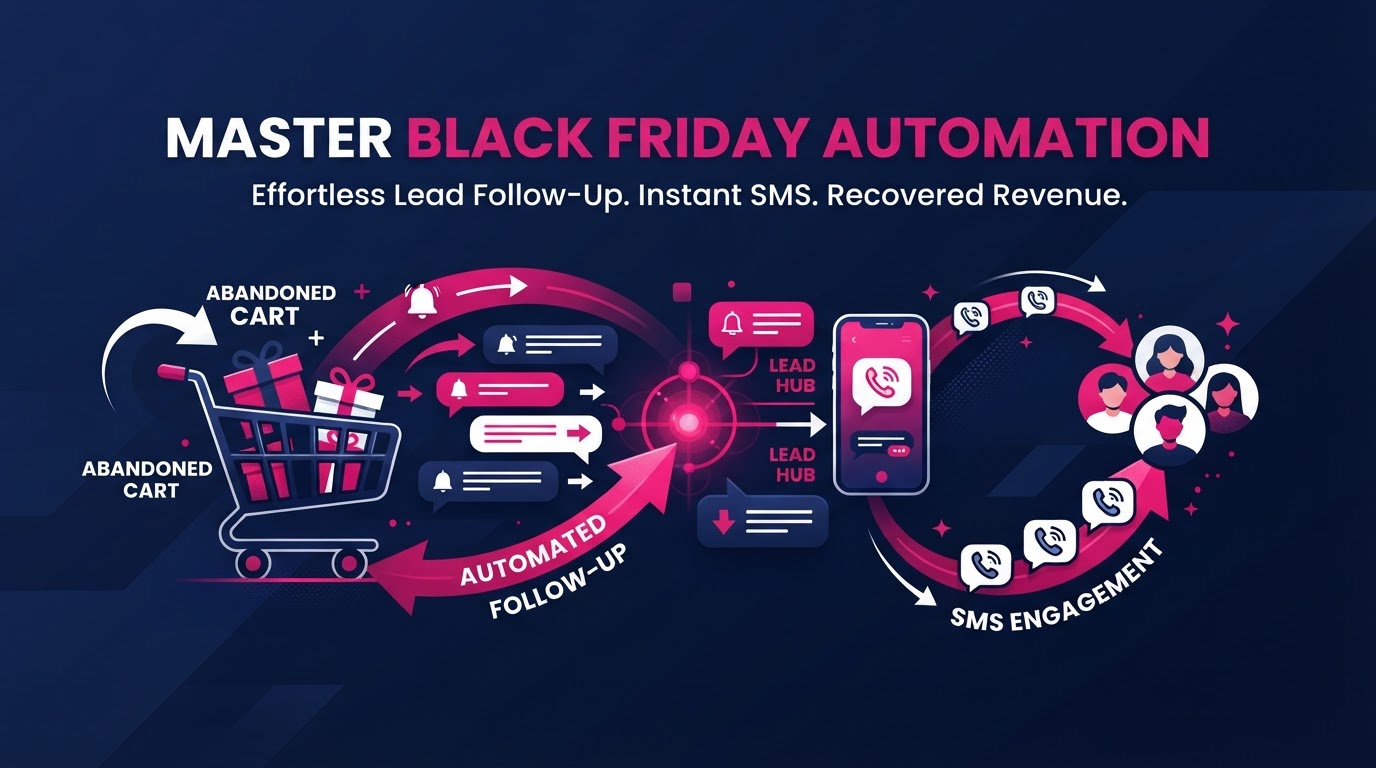
Of all the automations a small business can deploy for Black Friday, three generate the vast majority of recovered revenue: lead follow-up, SMS campaigns, and abandoned-cart recovery. This deep-dive guide covers the architecture, sequences, and benchmarks for each — the specific implementation details that determine whether the automation captures revenue or just sends messages. If you're deploying Black Friday automations, these three are the non-negotiables. Get them right, and the day pays for your entire automation stack for the year.
01The Three Highest-ROI Black Friday Automations
Not all Black Friday automations are created equal. Here's how the three highest-ROI automations compare:
| Automation | What It Recovers | Typical Recovery Rate | Monthly Cost |
|---|---|---|---|
| Lead follow-up | Un-responded inquiries | 20–30% conversion lift | $50–$200 |
| SMS campaigns | Email-ignored customers | 98% open rate vs. 21% email | $50–$300 |
| Abandoned cart recovery | Incomplete purchases | 10–15% of abandoned carts | $30–$150 |
Together, these three automations often recover more revenue than the rest of the Black Friday stack combined. According to Baymard Institute, the average cart abandonment rate is 70% — meaning for every 100 customers who start a purchase, 70 leave without completing. A 12% recovery rate (typical for a well-configured sequence) means 8 of those 70 are recaptured — significant recovered revenue, especially on Black Friday when cart values and volumes are high.
The principle: these three automations address the three points where Black Friday revenue leaks. Lead follow-up addresses inquiries that go unanswered. SMS addresses customers who ignore email. Abandoned cart recovery addresses purchases that don't complete. Plug all three leaks, and the day's revenue jumps dramatically. Our lead response time automation guide covers the lead follow-up architecture; this guide covers all three in the Black Friday context.
02Black Friday Lead Follow-Up Architecture
Black Friday generates a surge of inquiries — questions about deals, stock, shipping, returns — that manual response can't keep up with. The lead follow-up architecture ensures every inquiry gets an instant response and a human follow-up within the window that maximizes conversion.
The instant response (under 30 seconds). When an inquiry arrives (form submission, chatbot conversation, email), an automated response fires immediately: 'Thanks for reaching out! We're getting a lot of Black Friday questions — here's a quick answer to [common question], and we'll follow up personally within [timeframe].' The instant response acknowledges the inquiry, provides immediate value, and sets expectations — preventing the customer from bouncing to a competitor while they wait.
The human follow-up (within 1 hour). A human follows up personally within 1 hour, with the full context of the inquiry and the automated response. Because the automation has already acknowledged and engaged the lead, the human follow-up is a warm continuation — not a cold outreach to someone who's already lost interest. Harvard Business Review found that response within an hour makes a firm 7x more likely to qualify the lead — on Black Friday, when customers are making rapid decisions, the window is even shorter.
The nurture sequence (for unconverted leads). If the lead doesn't convert after the human follow-up, an automated nurture sequence keeps them engaged: relevant content, additional offers, and reminders. The sequence adapts based on behavior — a lead who clicks a product link gets a different next message than one who goes quiet. This captures leads who weren't ready to buy on Black Friday but are still in the market. Our business processes to automate guide covers nurture sequence architecture.
03Black Friday SMS Campaign Architecture
SMS is the highest-impact Black Friday outreach channel because it cuts through the email noise. Customers receive dozens of Black Friday emails; they receive few SMS — and SMS has a 98% open rate vs. 21% for email, according to Gartner's mobile marketing research. Here's the SMS campaign architecture:
The teaser (3 days before): 'Black Friday is coming — [Business] subscribers get early access to our deals. Watch your phone Thursday night.' This builds anticipation and confirms the customer is opted in to SMS (critical for compliance — see our TCPA and AI texting compliance guide).
The launch (Black Friday morning): 'Black Friday is live! [Top deal] — 50% off today only. Shop at [link].' This is the main campaign message — clear, urgent, and easy to act on. The link should go directly to the deal, not a generic homepage.
The reminder (mid-day): 'Black Friday deals end at midnight — [specific deal] is almost gone. Last chance at [link].' This creates urgency and captures customers who saw the morning message but didn't act. Reference specific deals and scarcity (stock levels, time remaining) to drive action.
The last chance (evening): 'Final hours — Black Friday ends at midnight. Don't miss [deal] at [link].' The final push. Keep it brief and urgent. After this message, stop sending — over-sending drives opt-outs and erodes the channel for future campaigns.
04Abandoned-Cart Recovery Architecture
Abandoned-cart recovery is the single highest-ROI Black Friday automation. Here's the detailed architecture:
The trigger (30 minutes after abandonment). When a customer adds an item to their cart (or starts a booking) but doesn't complete within 30 minutes, the recovery sequence triggers. The trigger captures the customer's identity (email and/or phone, if entered) and the cart contents. For anonymous carts (no email/phone captured), use browser cookies to display recovery messages when the customer returns to the site.
Touchpoint 1 (30 minutes): Gentle reminder. 'You left [item] in your cart — still interested? Complete your purchase at [link].' Tone is helpful, not pushy. The customer may have been distracted, not disinterested — a gentle reminder is often enough. Include the cart contents and a direct link to resume checkout.
Touchpoint 2 (6 hours): Incentive. 'Your cart is still waiting — here's 10% off to help you decide: [code].' The incentive overcomes the second most common abandonment reason (price hesitation). The discount should be genuine and easy to apply — the customer enters the code at checkout, no hoops.
Touchpoint 3 (24 hours): Final notice. 'Last chance — your Black Friday cart expires soon. Complete your purchase at [link].' The final push creates urgency. After this touchpoint, stop the sequence — further messages feel desperate and drive unsubscribes.
For service businesses: adapt to 'abandoned bookings' — when a customer starts the booking process but doesn't complete. The same 3-touchpoint sequence applies, adapted to bookings: 'You started booking [service] — still interested? Complete your booking at [link].' This recovers appointments that would otherwise be lost, which is especially valuable during Black Friday booking surges. Our appointment and calendar automation service builds these recovery sequences.
05Recovery Rate Benchmarks and ROI Calculation
Here's what to expect from each automation, with ROI calculations:
| Automation | Benchmark | Black Friday Example (100 carts/inquiries) | Recovered Revenue (avg. $50/cart) |
|---|---|---|---|
| Lead follow-up | 20–30% conversion lift | 25 additional conversions | $1,250 |
| SMS campaign | 98% open, 15–25% click | 20 additional purchases | $1,000 |
| Abandoned cart recovery | 10–15% recovery | 12 recovered carts | $600 |
| Total recovered revenue | $2,850 |
For a business with 100 abandoned carts and 100 inquiries on Black Friday, the three automations recover roughly $2,850 in otherwise-lost revenue — from a monthly automation cost of $130–$650. The ROI is decisive: the automations pay for themselves many times over on a single day, and continue delivering value throughout the year.
The compounding effect: customers recovered through these automations aren't just one-time sales — they're customers who can be nurtured into repeat buyers through the post-sale follow-up sequence. The lifetime value of a recovered customer is 5–10x the initial Black Friday purchase, which makes the ROI calculation even more favorable. Our funnel conversion checklist guide covers the full-funnel instrumentation that tracks this compounding value.
06Failure Cases and Limitations
The most common failure is broken triggers. The abandoned-cart recovery sequence is set up, but the trigger doesn't fire — carts are abandoned, but no recovery message sends. The cause is usually a misconfigured trigger (wrong event, wrong timing) or a broken integration between the cart and the automation platform. The fix: test the full sequence before Black Friday — abandon a test cart, verify the trigger fires, verify the message sends, verify the link works. A broken trigger means zero recovery, which means zero ROI.
The second failure is SMS compliance violations. A business sends Black Friday SMS to customers who didn't opt in to SMS marketing — which violates TCPA regulations and can result in significant fines. The fix: only send SMS to customers who have explicitly opted in to SMS marketing, and include opt-out instructions in every message ('Reply STOP to unsubscribe'). Our TCPA and AI texting compliance guide covers the compliance requirements in detail.
A limitation to acknowledge: these automations recover revenue from customers who were already interested enough to inquire or start a purchase — they don't generate new demand. If your Black Friday offers aren't compelling, no amount of automation will save the day. The automations maximize the conversion of existing interest; they don't create interest that isn't there. Pair them with strong offers and effective marketing for the full effect.
07An Anonymized Example from Our Work
A small online retailer selling home goods had 400 abandoned carts on Black Friday the previous year — at an average cart value of $65, that was $26,000 in abandoned revenue. They'd done nothing to recover it. The owner wanted to capture that revenue this year.
We deployed all three automations: lead follow-up (instant response + human follow-up within 1 hour + nurture sequence), a 4-touchpoint SMS campaign (teaser, launch, reminder, last chance), and abandoned-cart recovery (3-touchpoint sequence over 48 hours with a 10% incentive at touchpoint 2). On Black Friday, the lead follow-up lifted inquiry conversion 24%, the SMS campaign drove 85 additional purchases (from the 98% open rate cutting through email noise), and the abandoned-cart recovery recaptured 52 of the 400 abandoned carts — $3,380 in recovered revenue at a 13% recovery rate. Total recovered revenue across the three automations: $8,900, from a monthly automation cost of $380. The ROI was 23x in a single day — and the recovered customers, nurtured through post-sale follow-up, generated an additional $4,200 in repeat purchases over the following 60 days. The owner called it the best Black Friday she'd ever had — not because of the deals, but because of the systems that captured the revenue the deals generated.
08The Three Automations That Pay for the Year
Lead follow-up, SMS campaigns, and abandoned-cart recovery are the three highest-ROI Black Friday automations — together, they often recover more revenue than the rest of the stack combined, and the recovered revenue can pay for the entire automation stack for the year. The architectures above are the implementation details that determine whether the automations capture revenue or just send messages: instant response + human follow-up for leads, a 4-touchpoint SMS sequence for outreach, and a 3-touchpoint recovery sequence for abandoned carts. If you're deploying Black Friday automations, these three are the non-negotiables. If you're looking to build them, the automation audit and consulting service maps your business to these architectures. Because on the biggest sales day of the year, the businesses that win are the ones that plug the leaks — and these three automations plug the biggest ones.
Key Takeaways
- The three highest-ROI Black Friday automations: lead follow-up (20–30% conversion lift), SMS campaigns (98% open rate), and abandoned-cart recovery (10–15% recovery).
- Lead follow-up: instant response (30 seconds) + human follow-up (1 hour) + nurture sequence — 7x qualification likelihood within an hour.
- SMS campaign: 4 touchpoints (teaser, launch, reminder, last chance) — cuts through email noise, but requires explicit SMS opt-in for TCPA compliance.
- Abandoned-cart recovery: 3 touchpoints over 48 hours (reminder, 10% incentive, final notice) — recaptures 10–15% of the 70% who abandon.
- Together, these three often recover $2,850+ per 100 carts/inquiries — paying for the entire automation stack for the year in a single day.

Written by Moise
Founder & Lead Automation ArchitectMoise is the founder and lead automation architect at Wootomatic. With over a decade of hands-on experience designing, implementing, and maintaining high-throughput business automations, CRM pipelines, and custom AI agents, he has architected mission-critical workflows for hundreds of appointment-based and field-service businesses. His focus is on resilient, monitored systems that produce measurable ROI without fragile software bloat.
Ready to Put This Into Action?
Tell us about your workflow and we'll scope a custom automation within 24 hours.