On This Page
Appointment Booking Automation for Auto Repair Shops in Stockton
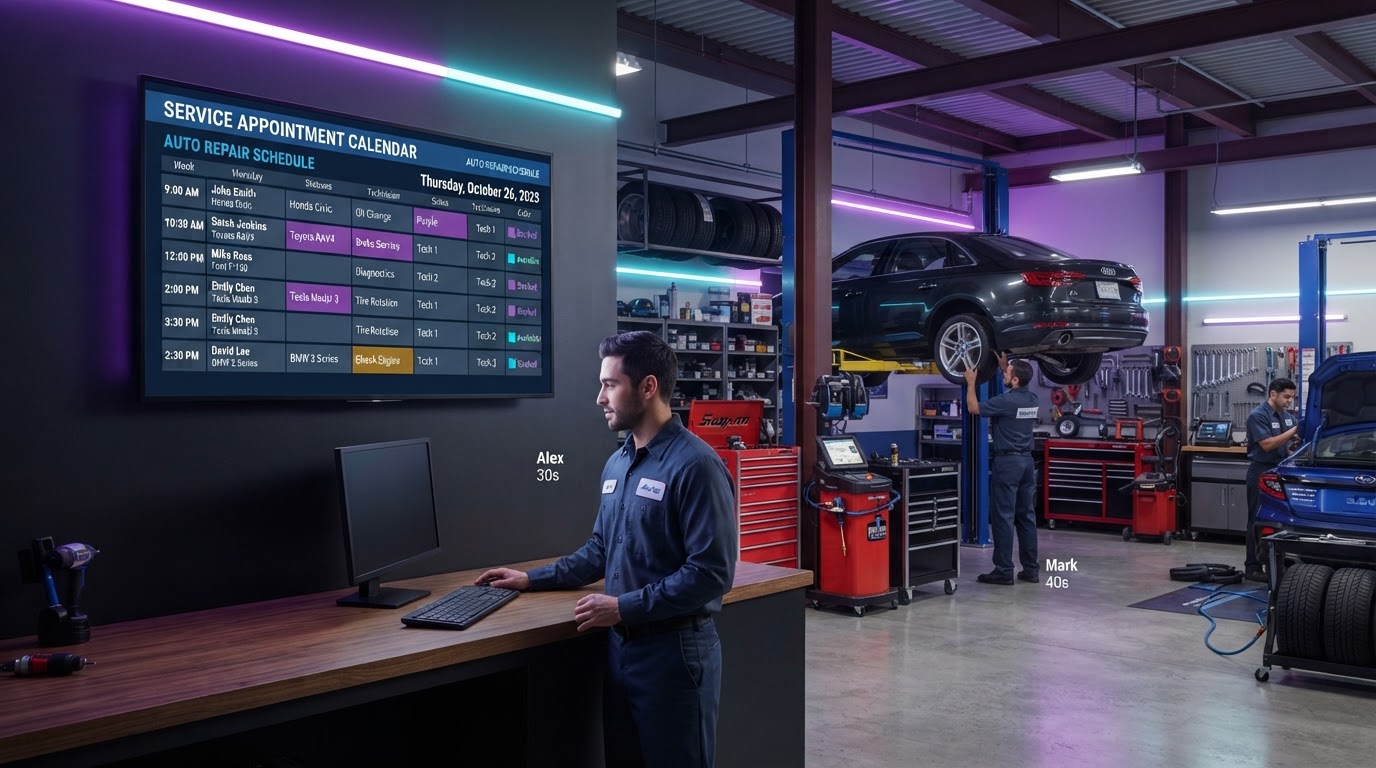
An auto repair shop's revenue is bounded by bay capacity — you can only bill for the hours your bays are full. Yet most Stockton shops run with 15–25% of their schedule empty because of a problem that's entirely fixable: phone-tag booking, missed calls, and no-shows. After automating appointment booking for auto shops across the Central Valley, we've seen the same pattern: automated booking, reminders, and no-show recovery typically fill 10–20% more bay hours within the first month. This guide shows exactly how Stockton auto repair shops can do it.
01The Numbers Behind an Empty Bay
A shop with 4 bays billing an average of $180 per service at 60% utilization is leaving significant revenue on the table. Pushing utilization to 75% — still well below capacity — adds roughly $4,000–$6,000 in monthly revenue with zero additional fixed cost. The bays, the lifts, and the tools are already paid for; the only thing missing is a full schedule.
Three leaks keep that schedule from filling. Missed calls: when mechanics are under cars and the service advisor is juggling phones, 30–50% of inbound calls go unanswered, and most of those callers book elsewhere. Phone-tag booking: back-and-forth voicemails to find a time that works cost both the shop and the customer time, and many customers give up. No-shows: industry data shows 20–30% no-show rates for shops without reminders, and an empty bay from a no-show is revenue that is gone forever.
Each of these is an automation problem, not a staffing problem. Our appointment and calendar automation service addresses all three.
02The Three Connected Pieces
The system has three connected pieces — booking, reminders, and recovery — each of which fills a specific leak in the schedule:
| Piece | What It Does | Impact |
|---|---|---|
| 24/7 self-serve booking | Customer picks a service and time slot online; system checks bay availability and confirms | Eliminates phone-tag, captures after-hours bookings |
| Automated reminders | SMS 24h and 1h before the appointment | Cuts no-shows 30–50% |
| No-show recovery | Auto-message within 30 min of a missed appointment with a rebook link | Recovers 40–60% of no-shows |
| Missed-call text-back | SMS within seconds of an unanswered call | Recovers the lead while they're still holding their phone |
The missed-call text-back is the highest-impact, fastest-deploying piece. When a call goes unanswered, the caller almost never leaves a voicemail — they call the next shop. An automated SMS within seconds recovers that lead while they're still holding their phone. Read our missed-call text-back guide for the full architecture.
03Stockton's Auto Repair Market
Stockton's auto repair market has characteristics that make appointment automation especially valuable. The city has a large commuter population driving high mileage, a significant logistics and warehousing sector with fleet vehicles needing service, and a competitive repair market where speed of response wins jobs.
Local factors that shape a Stockton shop's automation strategy: commuter volume (residents commute to the Bay Area and Sacramento, meaning many need before/after-work and weekend slots — exactly when phone-only booking fails), fleet accounts (local logistics businesses need predictable, scheduled service for multiple vehicles, and automated booking handles the volume a phone line cannot), competitive density (a Stockton driver searching 'brake repair near me' sees a dozen shops, and the one that answers and books instantly wins), and a bilingual customer base (a significant share of Stockton's customers are bilingual, and automated booking in both languages captures both audiences).
For the local context, see our Stockton service area page and our appointment automation for Stockton businesses.
Fill Your Stockton Shop's Bay Schedule
We'll wire online booking, SMS reminders, no-show recovery, and missed-call text-back to your calendar and CRM — so every call becomes a booked job instead of an empty bay.
04Cost and Break-Even
An appointment automation stack for an auto shop is one of the fastest-ROI deployments we do:
| Component | Monthly Cost | What It Does |
|---|---|---|
| Online booking + calendar sync | $100–$250 | 24/7 self-serve booking, bay availability |
| SMS reminders + no-show recovery | $50–$150 | Cuts no-shows, recovers missed appointments |
| Missed-call text-back | $30–$80 | Recovers unanswered-call leads |
| CRM logging | Included | Tracks every booking, no-show, and recovery |
| Total | ~$180–$480/mo | vs. one missed job = ~$180 lost |
The break-even is roughly 2–3 recovered jobs per month — most shops recover far more than that in the first week from missed-call text-back alone. A shop recovering 8 missed-call leads a month at $180 average ticket adds $1,440 in monthly revenue from a $200/month automation. See our pricing page for the managed subscription model.
05Deployment Checklist
Auto shop appointment automation deploys faster than most because the workflows are well-defined. Here is the checklist we work through:
- Map your services, bay availability, and time slots into the booking system and connect your calendar so availability is real-time
- Configure reminder timing (24h and 1h before) and the no-show recovery sequence (message at 30 min, rebook link, follow-up next day)
- Wire the missed-call text-back SMS response to unanswered calls and test with internal calls
- Open to all customers and review no-show rate and recovery rate weekly; adjust reminder timing if no-shows persist
The tuning matters: if no-shows stay high after reminders, the reminder copy or timing needs adjustment, not more reminders. Our workflow and integration automation service includes this ongoing monitoring.
06A Stockton Shop's Before and After
A two-location auto repair shop in Stockton was missing calls during peak hours — when mechanics were under cars and the single service advisor was juggling phones, walk-ins, and estimates. Missed calls went to voicemail, and 70% of those callers booked elsewhere. Their average lead response time was 3 hours, and their no-show rate was 28%.
We deployed a hybrid: an AI voice agent answered every call instantly, handled FAQs, booked appointments directly into the shop's calendar, and escalated complex or urgent cases to the service advisor via SMS with a call summary. We added SMS reminders and a no-show recovery sequence. The bot handled 65% of calls autonomously; the advisor handled the 35% that needed expertise — with full context. Missed-call rate dropped to near zero, after-hours booking increased 35%, and no-show rate fell to 11%.
The advisor's stress dropped because they handled meaningful conversations instead of answering 'what are your hours' forty times a day. For shops running seasonal service promotions, our promotions hub shows how to align offers with active campaigns.
07What Stays Human
Automation books and reminds; humans diagnose and build trust. Diagnostics — a customer describing a noise or a symptom needs a human to ask the right questions, not a bot guessing. Estimate conversations — pricing a complex repair requires judgment about parts, labor, and the customer's situation. Trust-building — repeat customers come back because of their relationship with the advisor, not because of a booking system. Upsells — a human who sees a worn belt during an oil change and mentions it builds revenue and trust simultaneously, a moment a bot cannot replicate.
The automation handles the scheduling friction so the advisor is available for these high-value conversations instead of playing phone-tag. For the full hybrid framework, read our customer service automation guide.
Key Takeaways
- Pushing bay utilization from 60% to 75% adds $4,000–$6,000/month with zero new fixed cost.
- Missed calls, phone-tag booking, and no-shows are the three schedule leaks — each is an automation problem.
- Missed-call text-back is the highest-impact, fastest-deploying piece.
- Break-even is roughly 2–3 recovered jobs per month; most shops recover far more in the first week.
Frequently Asked Questions

Written by Moise
Founder & Lead Automation ArchitectMoise is the founder and lead automation architect at Wootomatic. With over a decade of hands-on experience designing, implementing, and maintaining high-throughput business automations, CRM pipelines, and custom AI agents, he has architected mission-critical workflows for hundreds of appointment-based and field-service businesses. His focus is on resilient, monitored systems that produce measurable ROI without fragile software bloat.
Put This Into Practice
We build and manage these automations for service businesses on a flexible monthly subscription. Explore the related service to see how it works: