On This Page
Customer Service Automation: Improve Response Times Without Losing the Human Touch
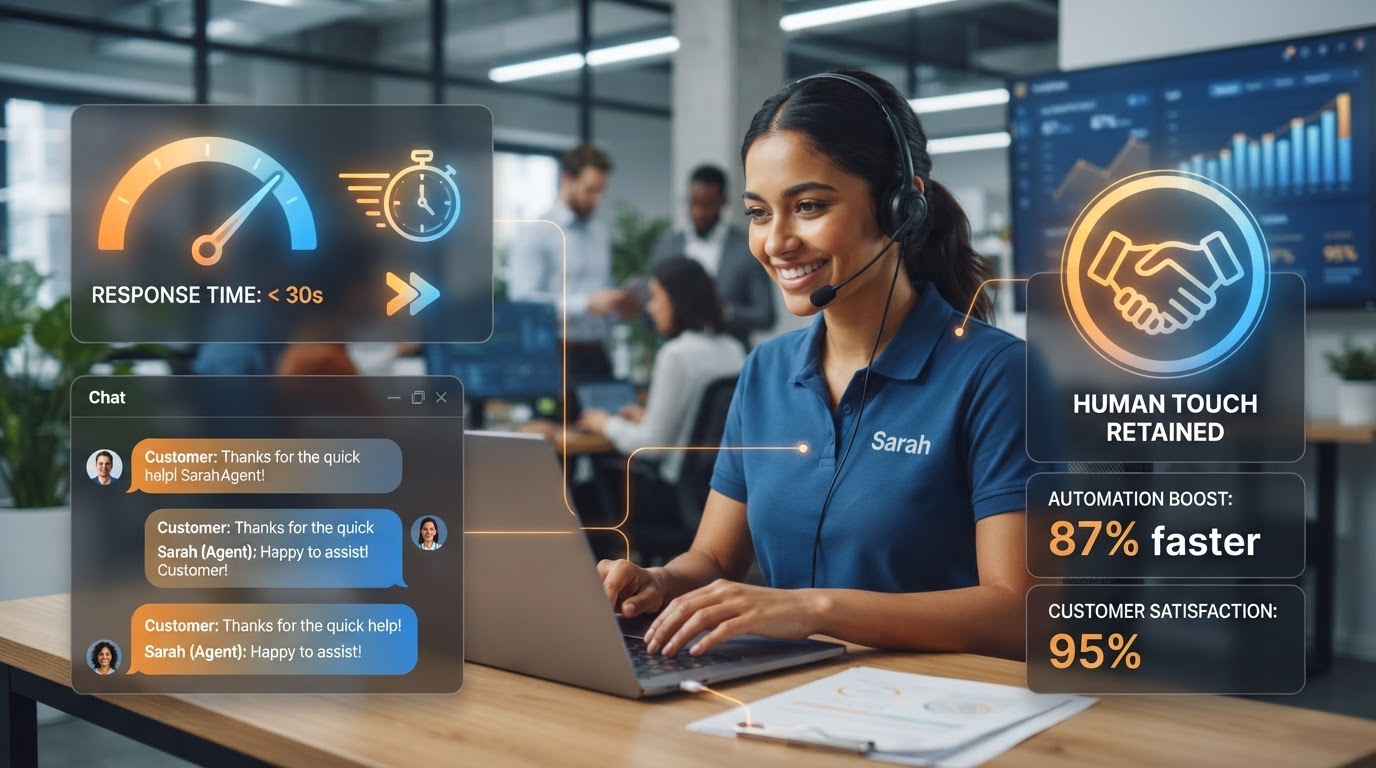
Customer Service Week is a reminder that great service is built by people — but the systems supporting those people determine whether they can actually deliver. The tension every service business faces: customers want instant responses, but instant human responses don't scale without burning out your team. Automation is the bridge, but only if it's deployed to augment humans, not replace them. This guide shows how to cut response times from hours to seconds while preserving the empathy and judgment that build long-term loyalty — the hybrid model we deploy for every client.
01The Response Time Problem
Response time is the single biggest predictor of customer satisfaction. According to Salesforce's State of Service report, 83% of customers expect an immediate response when they have a question — yet the average small business takes 4–12 hours to reply to an inbound inquiry. That gap is where customers are lost, reviews go negative, and competitors win.
The problem isn't that businesses don't care — it's that human-only service doesn't scale to the speed customers expect. A receptionist handling 50 inquiries a day can't respond to all of them in under a minute. A support rep juggling live chat, email, and phone can't give each channel instant attention. Speed and coverage require automation; quality and empathy require humans. The answer is a system where each does what it's best at.
This is the core insight of Customer Service Week: celebrate the people, but equip them with smarter systems. A rep supported by an AI that handles the repetitive 60% and escalates the complex 40% with full context can deliver better service than a team twice the size working manually. Our AI chatbots and voice assistants service is built around exactly this hybrid model.
02The Hybrid Service Model
The hybrid model has three layers, each with a clear role. Get the boundaries right and the system compounds; blur them and customers fall through the gaps.
| Layer | Handles | Response Time | Human Involvement |
|---|---|---|---|
| AI front line | FAQs, routing, lead capture, booking | Under 2 seconds | None |
| Automated workflows | Reminders, follow-ups, status updates | Instant (triggered) | None |
| Human team | Complex issues, escalations, empathy cases | Under 5 minutes (pre-qualified) | Full |
The AI front line handles the volume: 'what are your hours,' 'do you serve my area,' 'how much does it cost,' 'can I book an appointment.' These questions are repetitive, predictable, and don't require judgment. An AI trained on your knowledge base answers them instantly, 24/7, with consistent accuracy. This alone eliminates 60–70% of the inbound load on your human team.
Automated workflows handle the follow-up: confirmation emails, appointment reminders, status updates, satisfaction surveys. These aren't conversations — they're triggered communications that keep customers informed without requiring a human to remember to send them. Our missed-call text-back automation guide covers one of the highest-impact workflows in this layer.
The human team handles the value: complex problems, emotional situations, escalations, and relationship-building conversations. Because the AI has already filtered and pre-qualified, humans only touch the conversations that genuinely need them — and they start with full context, not from scratch. This is where the 'human touch' lives, and automation makes it more available, not less.
03Preserving the Human Touch: Escalation Rules
The hybrid model fails if escalation rules are wrong. Too aggressive, and customers feel bounced to a human for trivial issues. Too lax, and the AI frustrates people on complex problems it can't handle. The right rules are based on intent, sentiment, and value — not just topic.
Escalate immediately when: the customer expresses frustration or anger (sentiment detection), mentions 'cancel,' 'refund,' 'complaint,' or 'manager,' the issue involves payment disputes or sensitive personal data, or the AI has attempted to answer twice without resolution. These signals mean the customer needs a human, and delaying erodes trust.
Keep with the AI when: the question is factual (hours, pricing, services), the request is transactional (booking, rescheduling, status check), or the customer is early in the buying journey and gathering information. These are the AI's sweet spot — instant, accurate, consistent. The AI chatbot human handoff guide covers the full escalation framework, including how to hand off context so the human doesn't start cold.
The handoff itself is critical. When the AI escalates, it should pass the full conversation history, a summary of what was discussed, the customer's sentiment, and the specific issue — so the human picks up exactly where the AI left off. A customer who has to repeat their story to a human after already explaining it to a bot is a customer who feels disrespected, not served.
04Cost Ranges and Deployment Plan
A hybrid service system is affordable for most small businesses. Here's what the components typically cost:
| Component | Monthly Cost | What It Does |
|---|---|---|
| AI chatbot (trained on your KB) | $50–$200 | Handles FAQs, lead capture, booking 24/7 |
| CRM with automation | $150–$300 | Logs conversations, triggers workflows |
| SMS/reminder automation | $30–$100 | Appointment reminders, follow-ups |
| Human rep (escalations only) | $40k–$60k/yr | Handles complex cases, builds relationships |
| Total (vs. full human team) | ~$500/mo + 1 rep | vs. $80k–$180k/yr for 2–3 reps |
The deployment plan we use: Week 1 — ingest your top 50 support articles, FAQ, and pricing into the AI's knowledge base; define escalation rules. Week 2 — deploy the AI on your website and connect it to your CRM; test with internal queries. Week 3 — soft launch to a subset of traffic; monitor escalation logs and tune the AI's answers. Week 4 — full launch; begin the weekly tuning loop where you review escalations and teach the AI to handle questions it's currently escalating.
The weekly tuning loop is what separates a hybrid that converts from one that frustrates. Every escalation is a signal: either the AI couldn't answer a question it should have (add it to the knowledge base), or the escalation rule is wrong (adjust it). Within 8 weeks, most hybrid systems reach a steady state where the AI handles 65–75% of inquiries autonomously and the human team handles the rest with full context.
05Failure Cases and Limitations
The most common failure is deploying AI-only and walking away. A business installs a chatbot, sees it handle 70% of inquiries, and assumes the job is done. But the 30% that escalate get slower human response because the team was reduced, and the AI's answers drift as the business changes (new services, new pricing, new policies) without anyone updating the knowledge base. Within months, the bot gives outdated answers and customers lose trust. The fix: keep the human team at full strength initially, and maintain a weekly knowledge-base update cadence.
The second failure is poor escalation context. The AI escalates to a human, but passes only a notification — not the conversation. The human asks 'how can I help you?' and the customer, who just spent five minutes explaining their issue to the bot, is furious. The fix is technical but essential: wire the full conversation transcript and AI summary into the escalation notification. This is a standard part of our workflow and integration automation builds.
A limitation to be honest about: the hybrid model works best for service businesses with predictable, repetitive inquiry patterns — clinics, law firms, contractors, med spas. For businesses with highly consultative or emotional sales cycles (high-end B2B, therapy services), the AI should be limited to scheduling and basic info, with humans handling all substantive conversations. Know where your business sits on that spectrum before deciding how much to automate.
06An Anonymized Example from Our Work
A med spa with three locations was losing reviews because inquiries went unanswered after hours. Their two receptionists handled calls and chats during business hours, but anything that came in after 6pm or on weekends sat until Monday — and by then, the prospect had booked with a competitor. Their average response time was 14 hours.
We deployed a hybrid system: an AI chatbot on their website and a voice agent for after-hours calls, both connected to their CRM and calendar. The AI handled FAQs ('what treatments do you offer,' 'how much is a consultation'), captured leads, and booked appointments directly into the calendar 24/7. Complex or sensitive inquiries (medical questions, pricing negotiations) escalated to a human via SMS with full context. Average response time dropped from 14 hours to under 30 seconds. After-hours lead capture increased 40%, and the receptionists — freed from repetitive questions — focused on in-person patient experience. Their review velocity improved because no inquiry went unanswered, and the human team reported higher job satisfaction because they handled meaningful conversations, not 'what are your hours' for the fortieth time.
07Service That Scales Without Losing Soul
Customer Service Week celebrates the people who create exceptional experiences. The best way to honor them is to give them systems that handle the repetitive work so they can focus on the human work. The hybrid model — AI for speed and volume, humans for empathy and complexity — is how service businesses scale without burning out their team or disappointing their customers. If you're ready to build it, the AI chatbots and voice assistants service deploys the full hybrid stack, from knowledge-base training to escalation design.
Key Takeaways
- Response time is the biggest satisfaction predictor — 83% of customers expect immediate replies, but most businesses take 4–12 hours.
- The hybrid model: AI handles 60–70% of volume instantly, automated workflows handle follow-up, humans handle complexity with full context.
- Escalation rules should be based on intent, sentiment, and value — not just topic — and always pass full conversation context to the human.
- A hybrid system costs ~$500/month plus one rep, versus $80k–$180k/year for a full human-only team with worse coverage.
- Maintain a weekly tuning loop — every escalation is a signal to improve the AI or adjust the rules. AI-only deployments drift and fail within months.

Written by Moise
Founder & Lead Automation ArchitectMoise is the founder and lead automation architect at Wootomatic. With over a decade of hands-on experience designing, implementing, and maintaining high-throughput business automations, CRM pipelines, and custom AI agents, he has architected mission-critical workflows for hundreds of appointment-based and field-service businesses. His focus is on resilient, monitored systems that produce measurable ROI without fragile software bloat.
Ready to Put This Into Action?
Tell us about your workflow and we'll scope a custom automation within 24 hours.