On This Page
AI Chatbot vs. Live Agent: Which Customer Service Model Works Best?
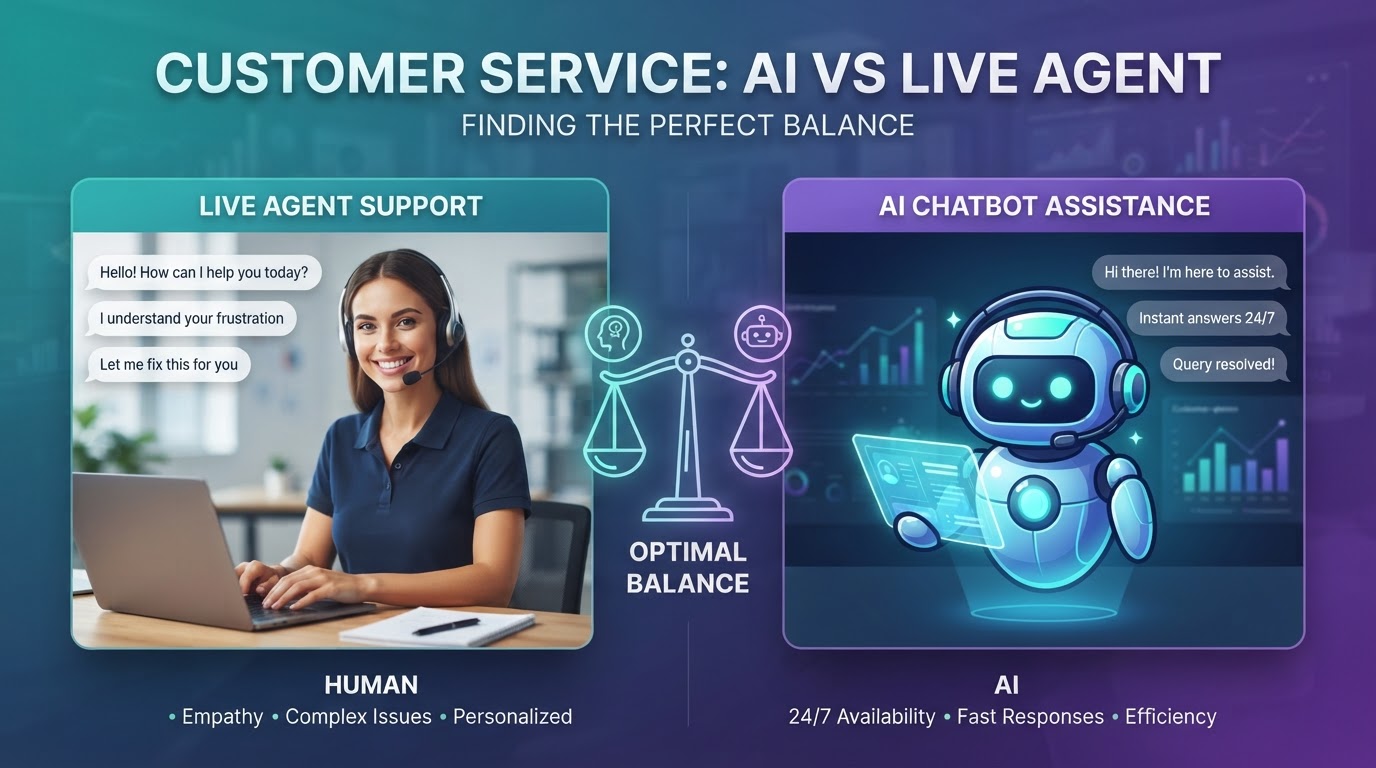
The debate between AI chatbots and live agents is usually framed as a choice — but the data shows it's a collaboration. Bots win on speed, cost, and coverage; humans win on empathy, complexity, and high-value conversations. Neither alone is optimal. This comparison breaks down the real numbers across the metrics that matter, shows where each model excels and fails, and gives you a decision framework for which conversations to automate and which to keep human. The answer, for almost every service business, is a hybrid that uses each for its strengths.
01Head-to-Head: The Numbers That Matter
Let's start with the data, not the opinions. These are the benchmarks we've measured across dozens of client deployments in 2026:
| Metric | AI Chatbot | Live Agent | Winner |
|---|---|---|---|
| First response time | Under 2 seconds | 30–90 seconds | Chatbot |
| Availability | 24/7/365 | Business hours (unless staffed) | Chatbot |
| Cost per conversation | $0.10–$0.50 | $4–$12 | Chatbot |
| Complex issue resolution | 20–30% | 85–95% | Live agent |
| Empathy / emotional cases | Low | High | Live agent |
| Consistency of answers | Perfect (if trained well) | Variable | Chatbot |
| Conversation volume capacity | Unlimited | 2–3 concurrent | Chatbot |
The pattern is clear: bots win on operational metrics, humans win on quality metrics. A business that deploys only a bot loses the high-value conversations. A business that deploys only humans loses the volume and speed. The optimal setup isn't a choice between them — it's a system where the bot handles the volume and the human handles the value. According to Gartner's customer service research, organizations using AI-assisted human models see 20–30% higher satisfaction than either AI-only or human-only setups.
The cost difference is decisive at scale. A business handling 1,000 conversations per month with live agents alone needs 2–3 reps ($80k–$180k/year). The same volume with an AI front line needs 1 rep for escalations ($40k–$60k) plus the bot ($50–$200/month). Same coverage, roughly half the cost — and the bot never has a bad day, takes a vacation, or quits.
02Where AI Chatbots Excel
Bots are unmatched at high-volume, repetitive, predictable interactions. Their sweet spot: FAQs ('what are your hours,' 'do you take my insurance'), lead capture (collecting name, email, and reason for inquiry), scheduling (checking calendar availability and booking), and status checks ('where is my order,' 'when is my appointment'). These conversations follow predictable patterns and don't require judgment or empathy.
Consistency is an underrated bot strength. A bot gives the same accurate answer to the same question every time. A human, at the end of a long shift, might give a slightly different answer, forget to mention a detail, or sound tired. For factual information, consistency builds trust — customers know they'll get a reliable answer regardless of when they ask.
Coverage is the other decisive advantage. 30% of B2C inquiries arrive outside business hours — evenings, weekends, holidays. A live-agent-only setup has zero coverage during those hours. A bot captures every one of those inquiries, books appointments, and queues complex cases for human follow-up. For a service business, that after-hours coverage directly recovers revenue that would otherwise go to a competitor who answers first. Our customer support bots use case documents this architecture in detail.
03Where Live Agents Still Win
Honesty matters in this comparison: bots are not better at everything, and pretending otherwise leads to bad deployment decisions. Live agents decisively outperform bots on: complex problem-solving (multi-step issues requiring reasoning across systems), emotional or sensitive conversations (a frustrated customer, a complaint, a cancellation), high-value sales conversations (negotiation, relationship-building, consultative selling), and anything requiring discretion or judgment that can't be reduced to rules.
Empathy is not automatable in a way that builds trust. A bot can say 'I understand your frustration' — but customers can tell the difference between a scripted empathy phrase and a human who genuinely engages with their situation. For a customer whose appointment was double-booked and who's now late for work, a bot's apology feels dismissive; a human's genuine acknowledgment and immediate fix builds loyalty. The AI chatbot human handoff guide covers exactly when to route these conversations to humans.
The mistake businesses make is deploying a bot-only model and losing the high-value conversations. A frustrated enterprise customer who gets a bot loop instead of a human doesn't just churn — they leave a negative review that costs future business. The bot's job is to handle the volume so humans are available for the value; when the bot replaces the human entirely, quality collapses on exactly the conversations that matter most.
04The Decision Framework: What to Automate
Use this framework to decide which conversations to route to the bot and which to keep human. The principle: automate the predictable, humanize the complex.
| Conversation Type | Route To | Reasoning |
|---|---|---|
| FAQ (hours, services, pricing) | Bot | Factual, repetitive, no judgment needed |
| Lead capture & qualification | Bot | Structured data collection, instant response |
| Appointment booking & rescheduling | Bot | Transactional, calendar integration |
| Order/appointment status | Bot | System lookup, instant answer |
| Complex support issue | Human | Multi-step reasoning, system access |
| Complaint or frustration | Human | Empathy required, trust at stake |
| Cancellation / retention | Human | Relationship, negotiation |
| High-value sales consultation | Human | Consultative, relationship-building |
The boundary isn't fixed — it evolves as the bot improves. Start conservative: automate only FAQs and booking, escalate everything else. As the bot proves reliable on simple cases, gradually expand its scope. Review escalation logs weekly: if the bot is escalating questions it could answer (add them to the knowledge base), or answering questions it shouldn't (tighten the escalation rules). This tuning loop is what separates a hybrid that works from one that frustrates.
05The Hybrid Model That Outperforms Either Alone
The hybrid model is simple in concept and precise in execution: the bot is the front line for every conversation, and humans handle escalations with full context. The bot captures, qualifies, and handles the predictable 60–70%; humans handle the complex 30–40% — but they start with the conversation history, a summary, and a sentiment score, so they're not starting cold.
This model outperforms either alone on every metric. Compared to bot-only: higher satisfaction (complex cases get human attention), higher conversion (high-value leads get consultative handling), lower churn (complaints get empathy). Compared to human-only: faster response (instant for the 70%), lower cost (one rep instead of three), 24/7 coverage. The hybrid doesn't compromise between speed and quality — it gets both.
The implementation requires three pieces working together: a bot trained on your knowledge base with clear guardrails, routing rules that score and direct conversations based on intent and sentiment, and a CRM integration that logs every conversation and passes context on escalation. Miss any of the three and the hybrid degrades. Our AI chatbots and voice assistants service builds all three as an integrated stack, and our customer service automation guide covers the deployment plan in detail.
06Failure Cases and Limitations
The most common failure is the bot-only trap. A business deploys a chatbot, sees cost savings, and reduces the human team. Initially, metrics look good — response time drops, cost drops. But over months, complex cases get bot loops instead of human resolution, reviews decline, and high-value leads churn because they didn't get the consultative conversation they needed. The cost savings were real; the revenue loss was larger and slower to surface. Never reduce the human team below the level needed for complex case volume — the bot should augment, not replace.
The second failure is context-free escalation. The bot escalates to a human, but the human receives only a notification, not the conversation. The customer repeats their story, feels disrespected, and the 'seamless' hybrid reveals itself as two disconnected systems. The fix is technical and non-negotiable: wire the full transcript and AI summary into every escalation. This is a standard deliverable in our workflow and integration automation builds.
A limitation to acknowledge: the hybrid model requires ongoing maintenance. The bot's knowledge base needs updating as your business changes; escalation rules need tuning as conversation patterns shift. A hybrid that's launched and never maintained will degrade within 3–6 months. Budget for a weekly 30-minute review — it's the difference between a system that compounds in value and one that decays.
07An Anonymized Example from Our Work
An auto repair shop with two locations was missing calls during peak hours — when mechanics were under cars and the single service advisor was juggling phones, walk-ins, and estimates. Missed calls went to voicemail, and 70% of those callers booked elsewhere. Their average lead response time was 3 hours.
We deployed a hybrid: an AI voice agent answered every call instantly, handled FAQs ('what are your hours,' 'do you do brake jobs,' 'how much for an oil change'), booked appointments directly into the shop's calendar, and escalated complex or urgent cases ('my check engine light is on and the car is shaking') to the service advisor via SMS with a call summary. The bot handled 65% of calls autonomously; the advisor handled the 35% that needed expertise — with full context, so they never asked a customer to repeat themselves. Missed-call rate dropped to near zero, after-hours booking increased 35%, and the advisor's stress dropped because they handled meaningful conversations instead of answering 'what are your hours' forty times a day.
08Choosing the Right Model for Your Business
The answer to 'chatbot or live agent' is 'both, deployed where each is strongest.' The hybrid model gives you the speed and cost-efficiency of AI with the empathy and judgment of humans — and it's the only model that scales without sacrificing quality. If you're evaluating which conversations to automate, start with the decision framework above and expand gradually as the bot proves reliable. The AI chatbots and voice assistants service deploys the full hybrid stack with the tuning loop built in.
Key Takeaways
- Bots win on speed (2s vs 45s), cost ($0.10–$0.50 vs $4–$12/conversation), and 24/7 coverage; humans win on complex resolution, empathy, and high-value sales.
- The optimal model is hybrid: bot handles 60–70% of volume, humans handle 30–40% with full conversation context on escalation.
- Use the decision framework: automate FAQs, lead capture, booking, and status checks; humanize complex support, complaints, cancellations, and consultative sales.
- Never reduce the human team below complex-case volume — the bot augments, it doesn't replace. Bot-only deployments lose high-value conversations.
- Budget for weekly maintenance — a hybrid that's launched and never tuned degrades within 3–6 months as your business changes.

Written by Moise
Founder & Lead Automation ArchitectMoise is the founder and lead automation architect at Wootomatic. With over a decade of hands-on experience designing, implementing, and maintaining high-throughput business automations, CRM pipelines, and custom AI agents, he has architected mission-critical workflows for hundreds of appointment-based and field-service businesses. His focus is on resilient, monitored systems that produce measurable ROI without fragile software bloat.
Ready to Put This Into Action?
Tell us about your workflow and we'll scope a custom automation within 24 hours.