On This Page
How Entrepreneurs Can Reduce Administrative Overhead and Avoid Burnout
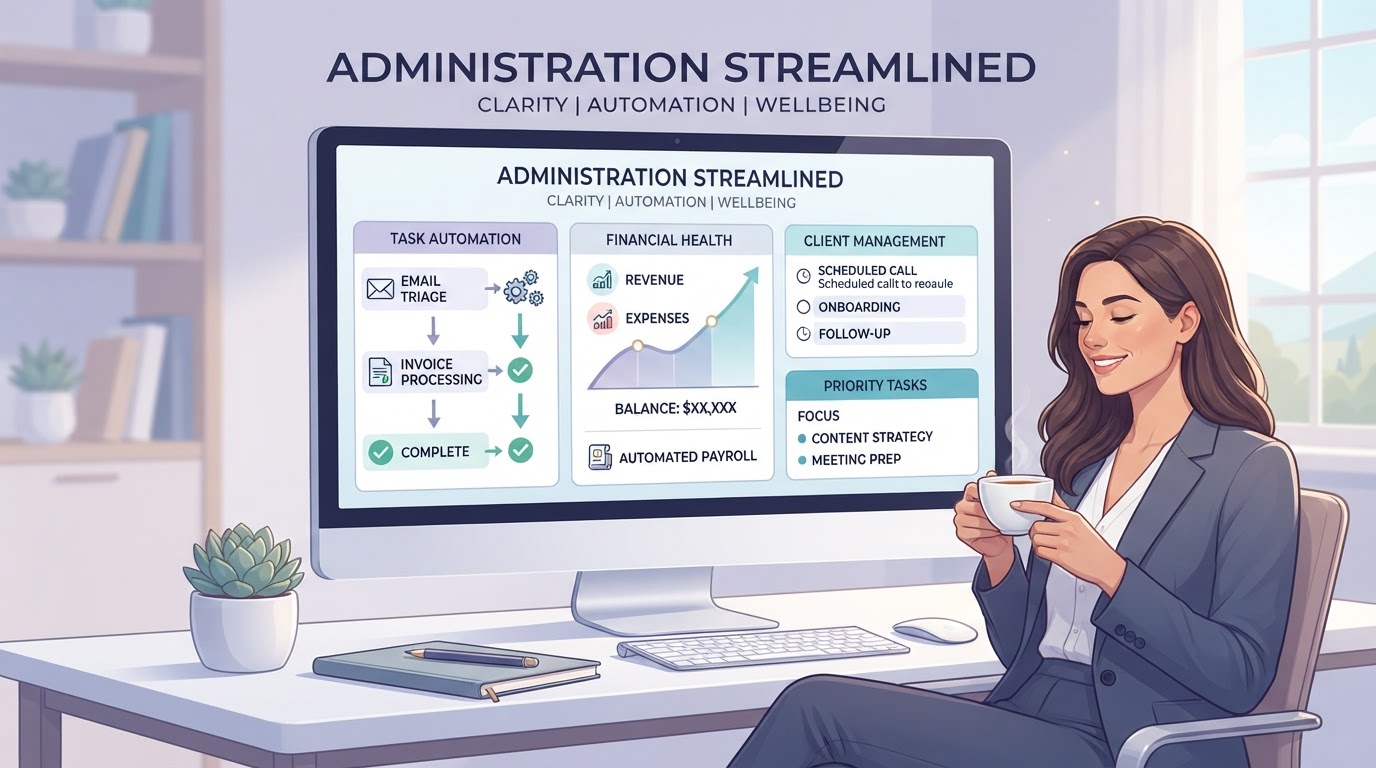
Entrepreneurial burnout doesn't usually come from the big strategic work — it comes from the death-by-a-thousand-cuts of administrative overhead. The daily grind of intake, scheduling, follow-up, invoicing, and reporting drains the energy that should go to growth, creativity, and relationships. International Men's Day, which recognizes men's health and positive leadership, is the right time to address this honestly: administrative overload is a health issue, not just an efficiency issue. This guide shows how to reduce administrative overhead through automation, reclaim 15–25 hours per week, and protect the personal time that prevents burnout.
01The Real Cost of Administrative Overload
Administrative overhead isn't just a time cost — it's an energy and health cost. Every hour spent on repetitive admin work is an hour of mental bandwidth consumed by low-value tasks, leaving less energy for the strategic work that actually grows the business and the personal time that sustains the entrepreneur. According to Gallup's entrepreneur wellbeing research, entrepreneurs report some of the highest stress and burnout rates of any professional group — and administrative overload is a primary contributor.
The pattern is familiar: the entrepreneur starts the day with strategic intentions, gets pulled into admin fires (a lead that wasn't followed up, an invoice that wasn't sent, a report that's overdue), and ends the day having done nothing strategic — just kept the business running. Repeat for months, and the result is burnout: exhaustion, cynicism, and reduced effectiveness. The root cause isn't a lack of discipline or resilience; it's a structural problem — the entrepreneur is doing work that should be automated.
The fix is structural, not motivational. You can't out-discipline a broken system. Our small business automation guide covers the general framework; this guide focuses specifically on the administrative overhead that drives burnout, and how to eliminate it.
02Identifying Your Highest-Friction Admin Tasks
Start by identifying the admin tasks that consume the most time and energy. Keep a simple log for one week: every time you switch from strategic work to handle an administrative task, note what it was and how long it took. At the end of the week, sort by frequency and time. The top items are your automation targets.
Here are the admin tasks that most commonly drive entrepreneurial overload:
| Admin Task | Typical Weekly Hours | Automation Difficulty | Burnout Impact |
|---|---|---|---|
| Lead intake & data entry | 5–8 | Low | High (interruption-driven) |
| Scheduling & rescheduling | 4–6 | Low | High (constant context-switching) |
| Follow-up & reminders | 3–5 | Low | Medium (easy to neglect) |
| Invoicing & payment tracking | 2–4 | Low | Medium (causes cash flow stress) |
| Reporting & data assembly | 3–5 | Medium | High (feels like wasted time) |
| Customer onboarding | 2–4 | Medium | Medium (repetitive) |
| Email management | 5–10 | Medium | High (never-ending) |
The highest-friction tasks are the interruption-driven ones — lead intake and scheduling — because they pull you out of strategic work mid-flow. Every interruption costs not just the time of the task itself, but the time to refocus afterward (research suggests 15–25 minutes to fully refocus after an interruption). Automating these tasks eliminates the interruptions, which compounds the time savings beyond the raw task hours.
03The Phased Automation Plan
Build the automation in phases, prioritizing the highest-friction tasks first:
Phase 1 (Weeks 1–2): Eliminate intake interruptions. Deploy automated lead capture, instant response, and missed-call text-back. These are the highest-friction tasks because they're interruption-driven — automating them eliminates the constant context-switching that drains energy. Cost: $50–$200/month.
Phase 2 (Weeks 3–4): Eliminate scheduling friction. Deploy self-serve booking and automated reminders. Scheduling is the second-biggest source of admin overhead — automating it eliminates the back-and-forth that consumes hours weekly. Cost: $45–$150/month.
Phase 3 (Weeks 5–6): Automate follow-up and invoicing. Deploy nurture sequences, automated invoicing, and payment reminders. These are the tasks that are easy to neglect (causing stress when they pile up) — automating them ensures they're handled consistently without your daily attention. Cost: $30–$125/month.
Phase 4 (Weeks 7–8): Automate reporting. Deploy an automated reporting dashboard that aggregates your key metrics without manual assembly. This eliminates the weekly reporting time sink and gives you visibility without effort. Cost: $0–$50/month.
Total: 8 weeks, $125–$525/month. The result: 15–25 hours per week reclaimed, the interruption-driven tasks eliminated, and the admin overhead that drives burnout structurally removed. The automation audit and consulting service maps your specific tasks to this phased plan.
04Protecting Personal Time to Prevent Burnout
Automation reclaims time, but preventing burnout requires using that reclaimed time intentionally — not just filling it with more work. Here's the framework for protecting personal time:
Set boundaries on availability. Automation provides 24/7 lead capture and response, which means you don't need to be available 24/7. Set clear business hours, and let the automation handle inquiries outside those hours. The instant reply acknowledges the lead; you follow up during your business hours. This is the structural fix for the 'always-on' burnout pattern — the business captures leads around the clock, but you don't have to be around the clock.
Protect strategic time blocks. Use the reclaimed hours for dedicated strategic work — not more admin. Block 2–3 hours per day for deep work (strategy, product, relationships) and protect those blocks ruthlessly. The automation handles the admin; the protected blocks handle the growth. Without this discipline, the reclaimed time gets absorbed by more busywork, and burnout returns.
Protect personal time. This is the health dimension that International Men's Day highlights. Use the reclaimed hours for personal time — family, exercise, rest, hobbies. Burnout isn't prevented by working more efficiently; it's prevented by working less on low-value tasks and more on what matters, including personal wellbeing. The entrepreneur who automates admin and uses the reclaimed time for rest and relationships is more effective, not less — because sustained performance requires recovery.
05Failure Cases and Limitations
The most common failure is reclaiming time and filling it with more work. An entrepreneur automates the admin overhead, reclaims 20 hours per week, and immediately fills those hours with more tasks — more projects, more clients, more commitments. The burnout returns, because the root cause (no recovery time) wasn't addressed. The fix: use the reclaimed time intentionally — for strategic work AND for personal time. Automation creates the opportunity; discipline determines whether it prevents burnout.
The second failure is automating without maintaining. The entrepreneur deploys the automation stack, sees the time savings, and assumes the job is done. But automations drift — data changes, APIs update, business conditions shift. Without maintenance, the systems degrade, the admin overhead returns, and the burnout follows. The fix: schedule a monthly maintenance review, per our automation monitoring best practices guide. The systems need ongoing attention to keep delivering the time savings that prevent burnout.
A limitation to acknowledge: automation can't eliminate all admin overhead. Some tasks require human judgment — complex customer issues, strategic decisions, relationship management. The goal isn't zero admin; it's eliminating the repetitive, low-value admin that drains energy, so the remaining admin (the high-value kind) gets the attention it deserves without causing burnout.
06An Anonymized Example from Our Work
A solo entrepreneur running a digital marketing consultancy was working 65-hour weeks and showing clear signs of burnout — exhaustion, cynicism, declining work quality. His admin overhead was consuming 25 hours per week: lead intake, scheduling, follow-up, invoicing, and reporting. He was considering quitting the business entirely because the grind felt unsustainable.
We deployed the phased automation plan over 8 weeks. By the end, his admin overhead had dropped from 25 hours to 5 hours per week (the remaining 5 hours were high-value admin that required his judgment). He reclaimed 20 hours per week — and, critically, he used them intentionally: 10 hours for strategic work (which grew his revenue 30% in the following quarter), and 10 hours for personal time (family, exercise, rest). His workweek dropped from 65 to 45 hours, his revenue increased, and his burnout symptoms resolved within 2 months. The automation stack cost $350/month — a fraction of the value of the reclaimed time and the prevented burnout. The structural fix worked because he used the reclaimed time for recovery, not just for more work.
07Administrative Overhead Is a Health Issue
International Men's Day recognizes men's health, positive leadership, and mentorship — and administrative overload is a men's health issue for entrepreneurs. The death-by-a-thousand-cuts of repetitive admin work drains energy, eliminates recovery time, and drives burnout. The structural fix is automation: eliminate the low-value admin, reclaim 15–25 hours per week, and use that time for strategic work and personal recovery. If you're an entrepreneur feeling the weight of administrative overhead, the automation audit and consulting service maps your tasks to a phased automation plan. Because a business that runs on systems, not on the entrepreneur's exhaustion, is a business built to last — and an entrepreneur who protects their health is a leader who can sustain the journey.
Key Takeaways
- Administrative overhead is a health issue, not just an efficiency issue — it drains energy and eliminates recovery time, driving burnout.
- The highest-friction tasks are interruption-driven (intake, scheduling) — automating them eliminates context-switching that compounds the time cost.
- Deploy in 4 phases over 8 weeks ($125–$525/month) to reclaim 15–25 hours per week.
- Use reclaimed time intentionally: strategic work AND personal time — filling it with more work just returns the burnout.
- Set availability boundaries (automation handles 24/7, you don't) and protect strategic and personal time blocks.

Written by Moise
Founder & Lead Automation ArchitectMoise is the founder and lead automation architect at Wootomatic. With over a decade of hands-on experience designing, implementing, and maintaining high-throughput business automations, CRM pipelines, and custom AI agents, he has architected mission-critical workflows for hundreds of appointment-based and field-service businesses. His focus is on resilient, monitored systems that produce measurable ROI without fragile software bloat.
Ready to Put This Into Action?
Tell us about your workflow and we'll scope a custom automation within 24 hours.