On This Page
How Military Family-Owned Businesses Can Build Portable, Automated Operations
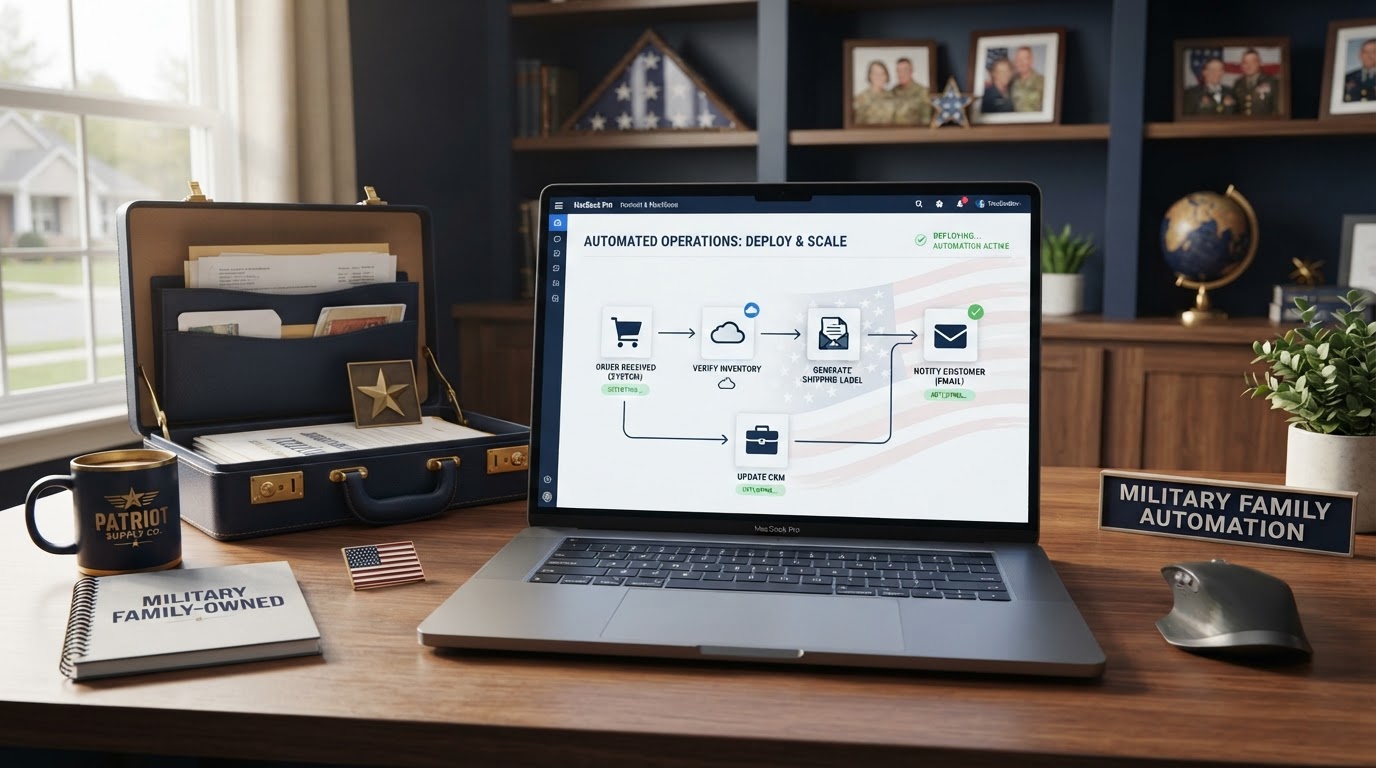
Military family-owned businesses face a unique operational challenge: building systems that are robust enough to survive frequent relocations, deployments, and schedule disruptions — while still delivering consistent service to customers who may be anywhere. The businesses that succeed aren't the ones with the most willpower; they're the ones with the most portable, automated operations. This framework is the complete guide to building a military family business that runs through transitions, scales without adding local headcount, and thrives regardless of where the military sends you. It's our tribute to Military Family Month — practical systems that make the sacrifice sustainable.
01The Portable Operations Framework
A portable operation has four layers, each designed to function independently of location and to run with minimal entrepreneur involvement. Build them in order — each layer depends on the one below.
| Layer | Purpose | Key Systems | Portability Test |
|---|---|---|---|
| 1. Foundation | Cloud infrastructure | CRM, storage, phone, payments | Accessible from any device |
| 2. Capture | Never miss a lead | Forms, chatbot, phone routing | Runs 24/7 unattended |
| 3. Delivery | Serve customers anywhere | Scheduling, automation, virtual delivery | Location-independent |
| 4. Growth | Scale without local presence | Follow-up, reviews, re-engagement | Automated and remote |
Layer 1: Foundation is the cloud infrastructure that everything runs on. Every system — CRM, document storage, phone, payments, communication — must be cloud-based and accessible from any device with an internet connection. The portability test: can you run the business from a laptop in a hotel room during a PCS move? If any system requires a local computer, local server, or physical presence, it fails the test. According to SCORE's small business technology guide, cloud-based operations are the single biggest factor in business resilience during disruptions — and for military families, disruptions are the norm, not the exception.
Layer 2: Capture ensures no lead is ever missed, regardless of the entrepreneur's availability. Automated forms, an AI chatbot, and virtual phone routing capture every inquiry 24/7 — during moves, deployments, trainings, and family emergencies. The business never goes dark; it always captures. This is the layer that prevents the revenue loss that typically accompanies military life disruptions.
02Layer 3: Portable Service Delivery
Layer 3 is where most military family businesses fail — because their service delivery is tied to a location. A consultant who only meets clients in person, a trainer who only works at a local gym, a service provider who only serves one metro area — these businesses break during a PCS move. The fix: build location-independent delivery options before you need them.
Virtual delivery is the primary portability strategy. If your service can be delivered virtually — consulting, coaching, training, design, writing, strategy — build the virtual delivery infrastructure from day one. Automated booking for virtual sessions, automated delivery of digital materials, automated follow-up after virtual meetings. The business serves customers anywhere, from anywhere. Our small business automation guide covers the virtual delivery architecture.
Hybrid delivery works for services that have both in-person and virtual components. A fitness trainer might offer in-person sessions in their current location and virtual programming for remote clients. A consultant might offer in-person strategy sessions locally and virtual implementation support remotely. The automation supports both: scheduling differentiates in-person and virtual appointments, follow-up sequences adapt to the delivery mode, and the business maintains revenue from both local and remote clients.
Partner networks extend delivery to new locations after a move. Before a PCS, identify potential partners in the new location — complementary service providers who can deliver your service locally while you manage the relationship remotely. Automate the referral and revenue-sharing workflow so the partnership is seamless. The business retains the customer relationship; the partner delivers the local service. This is how national service businesses scale — and it's how a military family business can maintain a national footprint despite relocations.
03Layer 4: Automated Growth and Retention
Layer 4 is the growth engine that runs without the entrepreneur's daily involvement — critical during deployments and moves when capacity is constrained. These automations maintain and grow the customer base remotely:
Automated follow-up sequences keep customers engaged across the relationship lifecycle. A new customer gets a welcome sequence; an active customer gets regular check-ins; a dormant customer gets a re-engagement offer. These sequences run automatically, maintaining relationships even when the entrepreneur can't personally reach out. During a 9-month deployment, this is the difference between customers who stay and customers who drift to competitors.
Automated review requests build online reputation without the entrepreneur's involvement. After each completed service, an SMS triggers with a review link. Reviews accumulate passively, strengthening the business's online presence — which is especially important for a business that needs to establish credibility in a new location after a move. Businesses that automate review requests see 3–5x more reviews, and reviews are a top factor in local search visibility.
Automated re-engagement recovers dormant customers. The system identifies customers who haven't booked in 60 or 90 days and sends a targeted re-engagement message with an incentive to return. This recovers revenue that most businesses never actively pursue — and for a military family business operating with limited capacity, recovering dormant customers is far more efficient than acquiring new ones. The business processes to automate guide covers this as process #14.
04The Implementation Plan
Building portable operations isn't a weekend project — it's a phased implementation that builds resilience over time. Here's the plan we use with military family business clients:
Phase 1 (Weeks 1–2): Foundation. Migrate to cloud-based systems: CRM, document storage, virtual phone, cloud payments. Test accessibility from multiple devices. This is the prerequisite — everything else depends on cloud infrastructure. Cost: $50–$150/month in tooling.
Phase 2 (Weeks 3–4): Capture. Deploy automated lead capture: website forms connected to CRM, AI chatbot for 24/7 inquiry handling, virtual phone routing. Every inquiry is now captured automatically. Cost: $50–$200/month.
Phase 3 (Weeks 5–6): Delivery. Build or enhance virtual delivery options: self-serve scheduling for virtual sessions, automated delivery of digital materials, automated follow-up. If the business is currently in-person only, develop at least one virtual service offering. Cost: $15–$100/month.
Phase 4 (Weeks 7–8): Growth. Deploy automated follow-up sequences, review requests, and re-engagement workflows. The growth engine now runs without daily involvement. Cost: $30–$100/month.
Total investment: ~$150–$550/month, deployed over 8 weeks. The result: a business that captures every lead, delivers service anywhere, maintains customer relationships automatically, and grows without requiring the entrepreneur's constant availability. For a military family facing a deployment or PCS move, this is the difference between a business that survives and a business that thrives. The automation audit and consulting service maps your specific business to this framework and builds the phased roadmap.
05Failure Cases and Limitations
The most common failure is waiting until a move or deployment to build portability. A military family business operates fine in a stable period, so the entrepreneur doesn't invest in automation and portability — until a PCS or deployment is announced, and then there's no time to build systems before the disruption hits. The business goes dark during the transition, loses customers, and may not recover. The fix: build portable operations during stable periods, not during crises. The best time to build resilience is when you don't need it yet.
The second failure is building automations that are too complex to maintain during constrained periods. A military spouse deploys a sophisticated automation stack, then during a deployment can't maintain it — the systems drift, break, and become worse than manual processes. The fix: build simple, robust automations with monitoring and alerts (per our automation monitoring best practices guide). The systems should run reliably with minimal maintenance — because during a deployment, minimal maintenance is all you'll have time for.
A limitation to acknowledge: portable operations don't eliminate the need for the entrepreneur's involvement — they reduce it. A military family business still requires the entrepreneur's strategy, expertise, and relationship-building. Automation handles the operational work so the entrepreneur's limited time goes to the work that can't be automated. The goal is a business that runs through disruptions, not a business that runs without the entrepreneur.
06An Anonymized Example from Our Work
A military family-owned property management business operated in a single metro area. When the service member received PCS orders to a base 2,000 miles away, they faced a choice: sell the business (losing years of built equity) or try to manage properties remotely from across the country. They chose remote management — but their operations were entirely manual and local: in-person property inspections, hand-delivered notices, local contractor coordination.
We built portable operations over 6 weeks: cloud-based property management CRM, virtual phone system (same number for tenants and owners), automated rent collection and late-fee workflows, automated maintenance request intake with photo documentation, and a partner network of local contractors in the original market coordinated through an automated dispatch system. The business now manages the same portfolio remotely — the entrepreneur handles strategy and owner relationships from the new location, and the automated systems handle tenant communication, rent collection, maintenance coordination, and reporting. The business didn't just survive the PCS — it became more profitable, because the automations reduced the operational overhead that was consuming the entrepreneur's time. They're now considering expanding to the new market, using the same portable systems.
07Operations That Move With the Mission
Military family-owned businesses don't have the luxury of building operations that depend on staying put. The businesses that thrive — through PCS moves, deployments, and the unpredictability of military life — are the ones with portable, automated operations that run regardless of location or availability. The four-layer framework above is the blueprint: cloud foundation, automated capture, portable delivery, and automated growth. Build it during stable periods, so it's ready when disruption comes. If you're a military family business owner looking to build operations that move with the mission, the automation audit and consulting service maps your business to this framework and builds the phased implementation plan. Military Family Month is a fitting time to build systems that make the family's sacrifice sustainable — because a business built to move is a business built to last.
Key Takeaways
- Portable operations have four layers: cloud foundation, automated capture, portable delivery, and automated growth — build in order, each depends on the one below.
- Layer 1 (foundation): every system cloud-based and accessible from any device — the portability test is running the business from a hotel room during a PCS move.
- Layer 3 (delivery) is where most military businesses fail — build virtual or hybrid delivery options before you need them, not during a move.
- Build portable operations during stable periods, not during crises — the best time to build resilience is when you don't need it yet.
- Total investment is ~$150–$550/month over 8 weeks — the result is a business that captures every lead, delivers anywhere, and grows without constant availability.

Written by Moise
Founder & Lead Automation ArchitectMoise is the founder and lead automation architect at Wootomatic. With over a decade of hands-on experience designing, implementing, and maintaining high-throughput business automations, CRM pipelines, and custom AI agents, he has architected mission-critical workflows for hundreds of appointment-based and field-service businesses. His focus is on resilient, monitored systems that produce measurable ROI without fragile software bloat.
Ready to Put This Into Action?
Tell us about your workflow and we'll scope a custom automation within 24 hours.