
On This Page
Hidden Manual Processes Costing Your Business Time, Money, and Leads
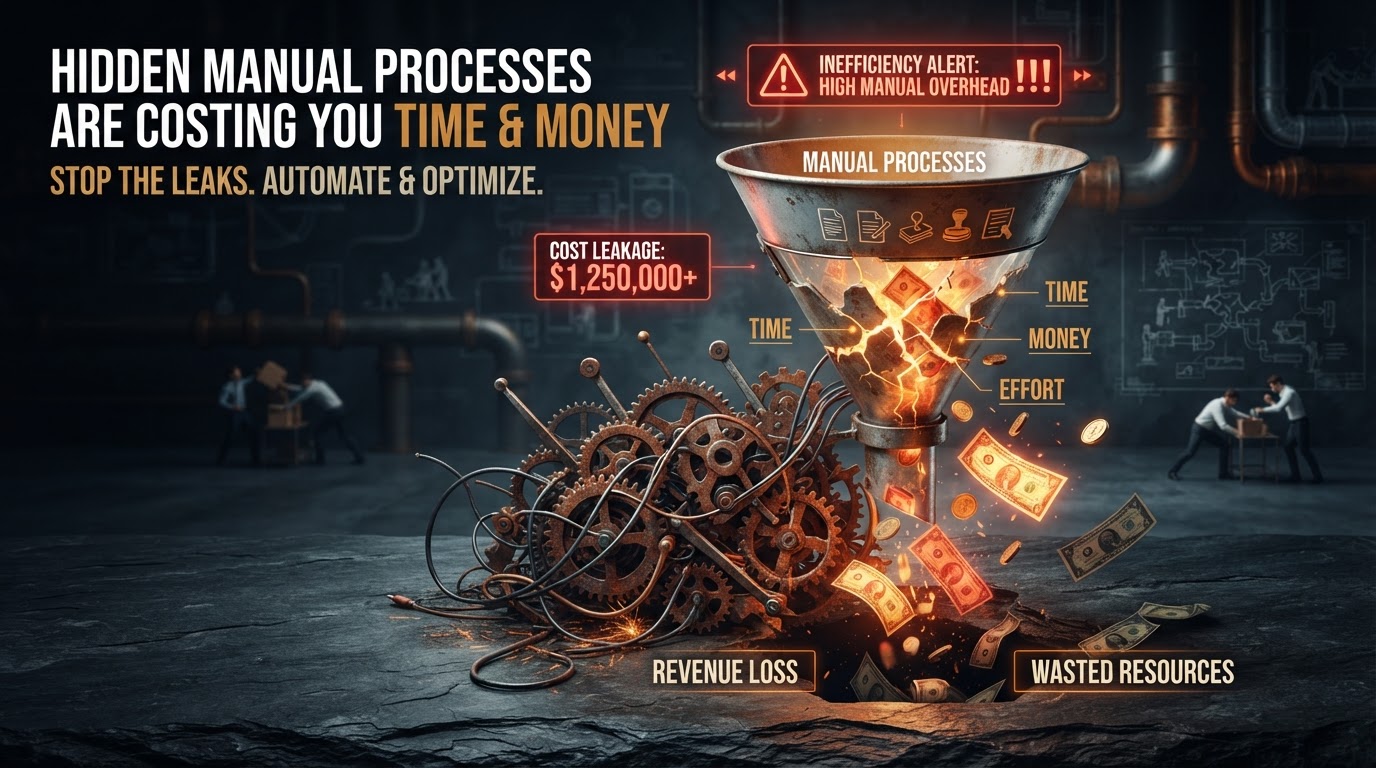
The scariest thing in your business isn't a broken automation — it's the manual processes you don't even realize are happening. They're invisible because they're embedded in 'just how we do things': the receptionist who copies form submissions into the CRM, the owner who manually sends appointment reminders, the sales rep who tracks follow-ups in a spreadsheet. These hidden processes cost time, lose leads, and create errors — and because nobody measures them, nobody fixes them. This guide shows you how to find the hidden manual processes in your business, quantify what they're actually costing you, and prioritize which to automate first.
03Quantifying the Cost: Time, Money, and Leads
Once you've found the hidden processes, quantify them. For each, calculate three costs: time cost (hours × blended hourly rate), error cost (errors per month × cost per error), and lead loss cost (leads lost per month × average customer value). The total is what the hidden process is actually costing you — and it's almost always larger than people expect.
Here's a real example from a client audit — a dental clinic with 3 staff members:
| Hidden Process | Time Cost/mo | Error Cost/mo | Lead Loss/mo | Total Cost/mo |
|---|---|---|---|---|
| Manual lead CRM entry | $520 | $0 | $1,200 (4 lost leads) | $1,720 |
| Manual appointment reminders | $380 | $0 | $3,500 (14 no-shows) | $3,880 |
| Manual daily reporting | $720 | $0 | $0 | $720 |
| Manual follow-up tracking | $240 | $180 | $2,000 (5 cold leads) | $2,420 |
| Total | $1,860 | $180 | $6,700 | $8,740/mo |
$8,740 per month in hidden costs — over $100,000 annually — from processes the clinic didn't realize were happening. And this is a small clinic with 3 staff. The lead loss component ($6,700/month) is the most striking: these aren't efficiency costs, they're revenue walking out the door because manual processes fail when people get busy. Automating these four processes would cost roughly $500/month in tooling — a 17x return on the first month alone. This is the math that makes automation an obvious decision once the hidden costs are visible.
05Failure Cases and Limitations
The most common failure in automating hidden processes is automating a broken process. A clinic's manual lead intake includes a step where the receptionist calls each lead to verify insurance — a step that adds 2 days to response time and loses 30% of leads. Automating that exact process (automated insurance verification calls) would codify the delay. The fix: before automating, redesign the process. In this case, verify insurance after the appointment is booked, not before — the lead gets instant response, and insurance is confirmed in the background. Automate the redesigned process, not the broken original.
The second failure is automating everything at once. A business finds 12 hidden processes and tries to automate all 12 simultaneously. The result: none are done well, the team is overwhelmed by changes, and the automation project stalls. The fix: prioritize by cost (highest total cost first), automate one process, measure for two weeks, then move to the next. Compounding wins beat big-bang projects — this is the principle in our business processes to automate guide.
A limitation to acknowledge: not every manual process should be automated. Processes requiring empathy, judgment, or relationship-building — sales negotiations, sensitive customer escalations, strategic decisions — should stay human. The goal isn't to automate everything; it's to automate the repetitive, rules-based work so humans can focus on the work that actually requires being human. The hidden process audit finds the automatable work; judgment determines what stays manual.
06An Anonymized Example from Our Work
A law firm was convinced they needed to hire a paralegal to handle their 'intake overload.' Before posting the job, they ran the hidden process audit. The finding: their intake process involved 7 manual steps — form submission, manual CRM entry, manual conflict check, manual scheduling call, manual confirmation email, manual follow-up tracking, and manual file creation. Each intake took 45 minutes of staff time, and 25% of leads went cold during the 2-day manual process.
We automated 5 of the 7 steps: form-to-CRM entry (instant), conflict check (automated database search), scheduling (self-serve booking), confirmation email (auto-triggered), and follow-up tracking (CRM nurture sequence). The two steps that stayed human: the initial consultation (requires legal judgment) and file creation (requires attorney review). Intake time dropped from 45 minutes to 8 minutes of human time. Lead cold rate dropped from 25% to 5%. The firm didn't hire the paralegal — they didn't need to. The hidden processes were consuming the equivalent of a full-time role, and automating them reclaimed that capacity without adding headcount.
Key Takeaways
- Hidden processes cost 15–25 hours per employee per week — invisible because they're distributed in small, seemingly trivial increments.
- Run a one-week audit: log every tool switch, every copy-paste, every 'should be automatic' task — sort by frequency × time to find your top targets.
- Quantify three costs per process: time, errors, and lead loss — the lead loss component is almost always the largest and most surprising.
- Automate the redesigned process, not the broken original — and prioritize by cost, one at a time, rather than automating everything simultaneously.
- Not every process should be automated — keep empathy, judgment, and relationship work human; automate the repetitive to free humans for the meaningful.

Written by Moise
Founder & Lead Automation ArchitectMoise is the founder and lead automation architect at Wootomatic. With over a decade of hands-on experience designing, implementing, and maintaining high-throughput business automations, CRM pipelines, and custom AI agents, he has architected mission-critical workflows for hundreds of appointment-based and field-service businesses. His focus is on resilient, monitored systems that produce measurable ROI without fragile software bloat.
Ready to Put This Into Action?
Tell us about your workflow and we'll scope a custom automation within 24 hours.