On This Page
CRM Pipeline Automation for Contractors in Bakersfield: Track Every Bid From Inquiry to Invoice
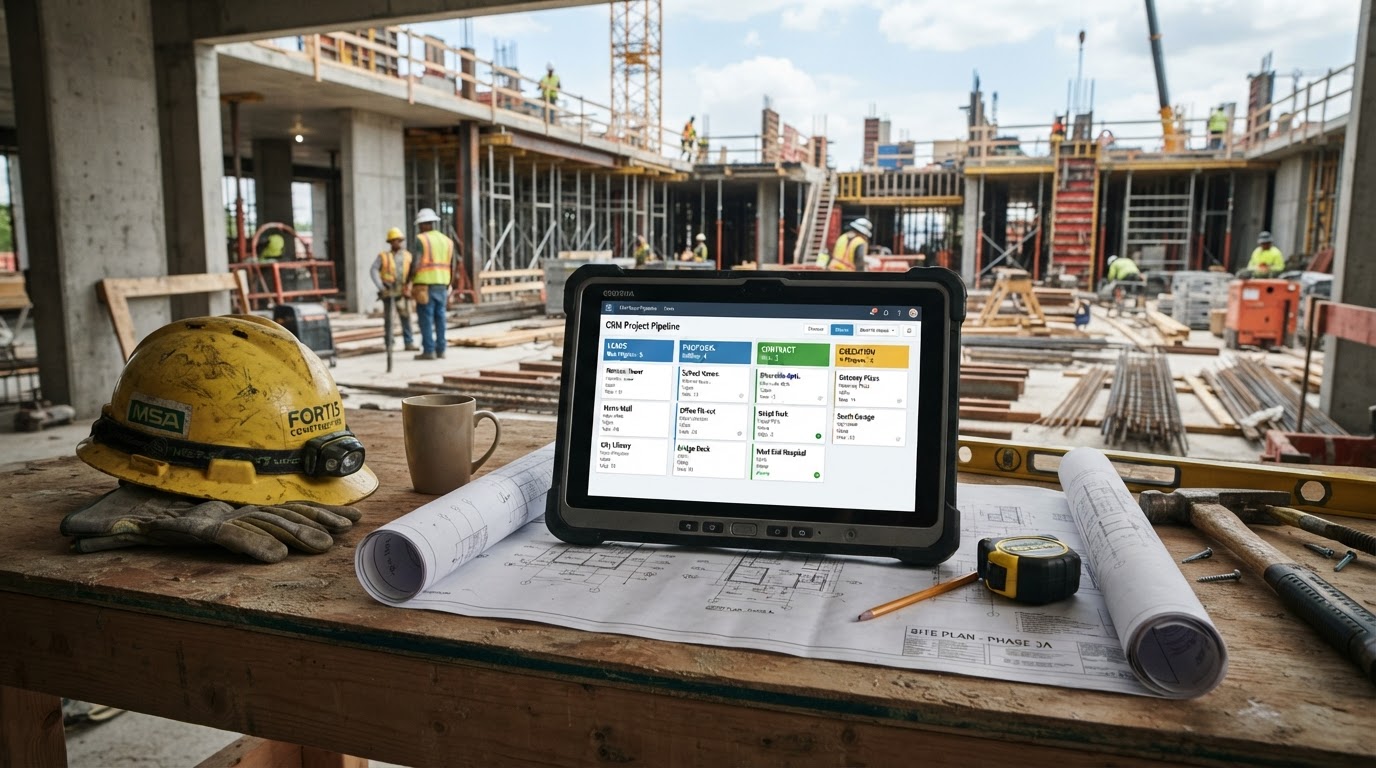
Contractors in Bakersfield win or lose jobs on organization as much as on price. A homeowner who requests a quote from three contractors hires the one who follows up — sends the quote on time, calls back, shows up when they said they would. The contractor who loses the quote email in a crowded inbox, forgets to follow up, or can't remember which bid is pending loses the job to the contractor who has a system. After automating CRM pipelines for contractors across the Central Valley, we've seen the same result: a CRM that tracks every bid and automates follow-up typically lifts bid-win rates 25–40% purely from jobs that would otherwise have been lost to disorganization.
01The Bid-Tracking Problem
Contractors handle a high volume of bids, each at a different stage, and the combination is where jobs are lost. A roofer might have 15 active bids out — some just quoted, some waiting on the homeowner, some won, some lost. Tracking all of them in a notebook or inbox means the follow-up calls do not happen, the 'just checking in' texts do not get sent, and the homeowner hires the contractor who stayed in touch.
Research from Harvard Business Review found that firms that contacted leads within an hour were 7x more likely to qualify them. For contractors, where a single job can be worth $5,000–$50,000, that follow-up gap is the difference between a full schedule and an empty one. And it is not just the first response — it is the consistent follow-up over the weeks a bid is pending.
02What the Pipeline Tracks
| Stage | Automated Action | Human Involvement |
|---|---|---|
| New inquiry captured | Instant acknowledgment + job details collection | — |
| Quote preparation | Automated job-detail questionnaire + estimate routing | Contractor prepares estimate |
| Quote sent | Automated follow-up sequence if no response | Contractor personalizes key touches |
| Bid won | Contract generation + scheduling + deposit request | Contractor reviews and signs |
| Job in progress | Automated status updates to homeowner | Contractor handles on-site work |
| Job complete | Automated invoice + review request | Contractor handles final walkthrough |
The follow-up sequence is the key. Once a quote is sent, the CRM triggers an automated sequence — a check-in after 3 days, another after a week, a final 'still interested?' after two weeks. These touches keep the bid alive without requiring the contractor to remember each one. Read our funnel conversion checklist for the full instrumentation.
03The Bakersfield Construction Market
Bakersfield's construction market has specific characteristics that make CRM pipeline automation especially valuable. The city has steady residential and commercial construction demand, a growing population driving new builds, and a competitive contractor market where organization wins jobs.
Bakersfield's growing population drives steady remodeling and new construction demand — high-value jobs where multiple contractors are quoted. The city's energy and agricultural economy generates commercial construction needs that require careful bid tracking. Contractors serve Bakersfield and surrounding Kern County communities, so tracking which bids are where matters. And a Bakersfield homeowner searching 'contractor near me' sees many options — the one who follows up consistently wins.
For the local context, see our Bakersfield service area page and our CRM automation for Bakersfield businesses.
04Cost and ROI
Contractor CRM automation has one of the clearest ROI cases because the value of a single won job is so high. A CRM with contractor pipeline ($200–$400/month) plus lead capture and quote workflow ($100–$250/month) totals roughly $300–$650/month — versus one lost job worth $5,000–$50,000 in revenue. The break-even is a single won job per year, and most contractors recover several in the first month from bids that would have gone cold. See our pricing page for the managed subscription model.
Build a Pipeline That Runs Itself
We'll map your lead flow, wire your CRM, and automate follow-up so no opportunity slips through the cracks.
05Deployment
Contractor CRM automation requires mapping your actual bid process before any automation is built. Week one is pipeline mapping: bid stages, fields, and follow-up timing. Week two is build and configure: the custom pipeline, automated stage transitions, and follow-up sequences. Week three is lead capture and quotes: connect lead capture from your website and lead sources, and build the job-detail questionnaire and estimate routing. Week four is launch and reporting: the dashboard showing bid-win rate by source, with weekly review.
Track which bids convert and which go cold, then adjust the follow-up timing. Our workflow and integration automation service includes this ongoing monitoring.
06A Bakersfield Contractor's Result
A Bakersfield remodeling contractor was tracking bids in a notebook and an inbox. He forgot to follow up on quotes, lost track of which bids were pending, and lost jobs to contractors who stayed in touch. His bid-win rate was 16%, and he estimated losing 6–10 jobs a year to disorganization. We deployed a CRM pipeline that captured every inquiry, tracked each bid's stage, and triggered automated follow-up sequences. Bid-win rate rose to 27% within three months — a 69% improvement — and he estimated recovering 8 additional jobs in that period.
For contractors running seasonal promotions, our promotions hub shows how to align offers with active campaigns.
07What Stays Human
A CRM automates tracking and follow-up; humans close jobs. Estimates and consultations — a homeowner needs a contractor's expertise to scope a project, not an automated email. On-site work — the actual construction is irreducibly human. Trust-building — homeowners hire contractors they trust, and a human's reassurance and presence is part of winning the job. Negotiation — pricing a complex job and negotiating scope requires human judgment. The CRM ensures no bid is forgotten; the contractor ensures the right bids are won.
08Why This Beats a Spreadsheet
The alternative to a CRM is a spreadsheet — and a spreadsheet does not follow up for you. It does not remind you when a bid has been pending too long, it does not send the 'just checking in' message, and it does not show you which lead sources actually convert. A CRM pipeline does all of that automatically, so the contractor spends time on estimates and on-site work instead of on administrative tracking. For the full framework, read our funnel conversion checklist.
Key Takeaways
- Contractors win or lose jobs on organization as much as price — the contractor who follows up consistently wins.
- A contractor CRM pipeline tracks every bid, its stage, and its next follow-up, automating the touches that keep bids alive.
- Bakersfield's residential growth, oil-and-agribusiness economy, and competitive density make CRM automation essential.
- Break-even is a single won job per year; most contractors recover several in the first month.
- Estimates, on-site work, and trust-building must stay human-led.
Frequently Asked Questions

Written by Moise
Founder & Lead Automation ArchitectMoise is the founder and lead automation architect at Wootomatic. With over a decade of hands-on experience designing, implementing, and maintaining high-throughput business automations, CRM pipelines, and custom AI agents, he has architected mission-critical workflows for hundreds of appointment-based and field-service businesses. His focus is on resilient, monitored systems that produce measurable ROI without fragile software bloat.
Put This Into Practice
We build and manage these automations for service businesses on a flexible monthly subscription. Explore the related service to see how it works: