On This Page
AI Automation Agency vs In-House Hire vs Freelancer: True Cost Comparison
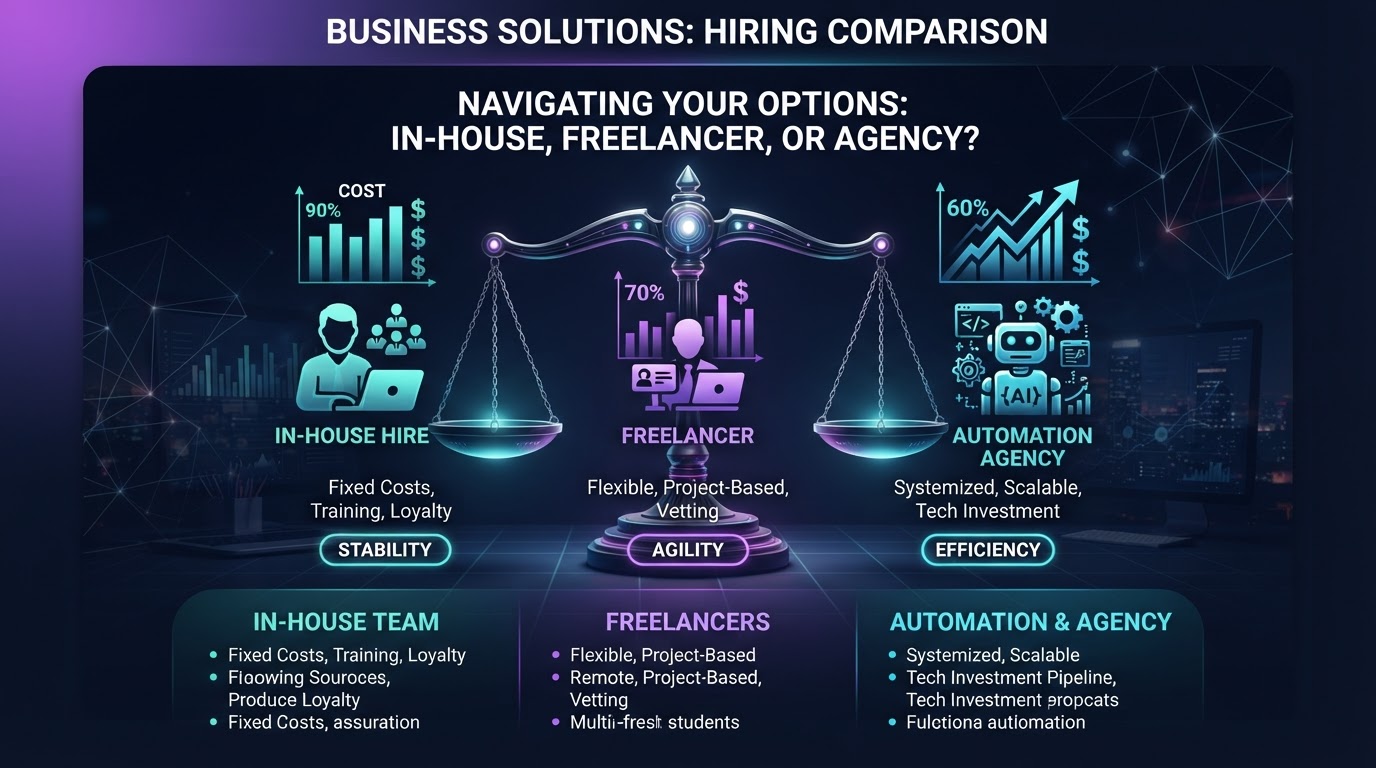
When a business decides to invest in automation, the first fork in the road is who builds it: an in-house hire, a freelancer, or an agency. Most owners make this decision based on gut feel or the first option that crosses their desk — and most end up regretting it within a year. After advising dozens of founders through this exact decision, the math is more lopsided than most expect, but the right answer depends on your stage, volume, and risk tolerance. This guide breaks down the true cost of each path — salary, benefits, ramp, tooling, and hidden risks — so you can decide on facts instead of guesses.
01The Three Options, Defined
The in-house hire is a full-time AI or automation engineer on your payroll. They work exclusively on your systems, sit in your meetings, and become a permanent part of your team. The appeal is control and dedicated capacity; the cost is salary, benefits, ramp time, and single-point-of-failure risk.
The freelancer is an independent contractor you engage per project or per hour. They bring specific expertise without the overhead of a full-time hire, and you can start and stop the engagement as needed. The trade-off is availability — they have other clients, their schedule isn't yours, and institutional knowledge walks out the door when the project ends.
The automation agency is a team you subscribe to on a monthly basis. You get a strategist, an engineer, a CRM specialist, and a workflow builder for a fraction of one hire's cost, with the ability to pause or cancel. The model is designed for businesses that need enterprise-grade capability without enterprise-grade headcount. Our deeper in-house AI hiring vs on-demand analysis covers the strategic logic in detail.
02True Cost of an In-House Hire
A mid-level AI engineer costs $140k–$180k fully loaded in 2026, according to Glassdoor salary data. But salary is just the start. Add recruiting fees (20–30% of first-year salary), benefits and payroll taxes (25–30% of salary), equipment and software licenses ($5,000–$15,000/year), and ramp time (3–6 months before productive output). The first-year fully-loaded cost is $200,000–$250,000 before the first workflow ships.
The hidden cost is the coverage gap. One engineer means no automation work happens when they're on vacation, sick, or stuck on a single hard problem. You've built a single point of failure into your operations — the exact thing automation is supposed to eliminate. We've seen businesses lose weeks of progress because their sole engineer left and nobody else understood the workflow architecture.
There's also a skills mismatch problem. AI engineering is broad — chatbot development, workflow automation, CRM architecture, and predictive modeling are different specialties. Hiring one person means they're strong in one area and mediocre in the rest. An agency brings specialists in each. The U.S. Bureau of Labor Statistics projects AI specialist roles will remain among the hardest to fill through 2030, which means retention risk is real and replacement costs are rising.
03True Cost of a Freelancer
A competent automation freelancer charges $75–$200 per hour, or $3,000–$15,000 per project depending on scope. The headline cost looks attractive compared to a full-time hire — and for a single, well-defined project, it often is. A freelancer building one Zapier workflow for $3,000 is a reasonable transaction if the scope is clear and the workflow is simple.
The costs emerge over time. First, availability: a good freelancer is booked weeks ahead, and urgent fixes wait in a queue. Second, knowledge transfer: when the project ends, the freelancer moves on, and your team is left maintaining a system they didn't build and don't fully understand. Third, scope creep: hourly freelancers have an incentive to expand scope, and project-based freelancers have an incentive to minimize it — either way, the alignment between your goals and theirs is imperfect.
The biggest hidden cost is lack of ongoing maintenance. Automations break — APIs change, data drifts, edge cases emerge. A freelancer who built your workflow 6 months ago may not be available to fix it when it breaks at 2am on a Friday. You're left with a broken automation and no one to call. For mission-critical workflows (lead routing, payment processing, compliance), this gap is a serious risk.
04True Cost of an Automation Agency
A managed automation agency subscription runs $2,000–$8,000/month, with most service businesses landing in the $3,000–$5,000 range. That buys sequential workflow delivery (one custom automation every 1–2 weeks), ongoing monitoring and maintenance, a multidisciplinary team, and the ability to pause or cancel anytime. The first-year cost is $36,000–$60,000 — a fraction of the in-house hire's $200,000+.
The value isn't just cost; it's coverage and capability. An agency has multiple engineers, so vacations and sick days don't stop your work. Because agencies build for many clients, they've already solved the edge cases you're about to hit — you benefit from pattern-matching that a single freelancer or in-house hire doesn't have. And the team approach means you get a strategist, an engineer, a CRM specialist, and a workflow builder, not one generalist who's mediocre at three of the four.
The trade-off is that you don't get a dedicated, full-time resource. An agency juggles multiple clients, and your requests are queued sequentially. For businesses that need 40+ hours/week of continuous automation work, an agency subscription may not provide enough throughput. But for the 90% of service businesses that need 5–15 hours/week of focused, high-quality automation work, the agency model is the most cost-effective path. The AI automation agency cost guide breaks down exactly what's included at each price tier.
05Side-by-Side Cost Comparison
Here's the first-year, fully-loaded cost comparison for a typical service business needing ~10 hours/week of automation work:
| Option | First-Year Cost | What You Get | Key Risk |
|---|---|---|---|
| In-house hire | $200,000–$250,000 | One dedicated engineer, full capacity | Single point of failure; 3–6 month ramp |
| Freelancer (hourly) | $39,000–$104,000 | Per-project builds, no headcount | No maintenance; no coverage; knowledge walks out |
| Freelancer (project) | $15,000–$60,000 | 3–6 scoped builds per year | Scope negotiation overhead; same gaps |
| Agency subscription | $36,000–$60,000 | Full team + maintenance + monitoring; pause anytime | Queue-based delivery — most service businesses' best fit |
The break-even analysis is decisive. An agency at $4,000/month ($48,000/year) costs 24% of an in-house hire's first-year cost, delivers work in 5–14 days instead of 3–6 months, and provides a full team instead of one person. The freelancer looks cheaper on paper but costs more in practice once you account for maintenance gaps and knowledge transfer. The automation ROI calculator framework helps you quantify the value each option delivers against these costs.
06When Each Option Actually Wins
In-house wins when: AI is your core product (you're building an AI SaaS), you're running hundreds of automations and annual agency spend exceeds $300k, or you need 40+ hours/week of dedicated, continuous automation work. At that scale, the economics flip and a dedicated team becomes cheaper. But that's a threshold most service businesses never reach.
Freelancer wins when: you have a single, well-defined, one-off project with clear scope and no ongoing maintenance needs. A freelancer building a one-time data migration or a simple, standalone workflow is a reasonable choice — as long as you accept that you'll own maintenance afterward. For anything recurring or mission-critical, the freelancer's gaps become liabilities.
Agency wins when: you need ongoing automation work (5–15 hours/week), want a full team's expertise without the headcount, value the ability to pause or cancel, and need mission-critical workflows maintained and monitored. This describes the vast majority of service businesses — clinics, law firms, contractors, med spas, agencies — that are serious about automation but not large enough to justify a full internal team.
07The Risk Profile of Each Option
Cost is only half the decision; risk is the other half. In-house risk: single point of failure, retention risk (one resignation cripples your operations), skills obsolescence (one person can't keep up with every new tool), and sunk cost if the hire doesn't work out. Freelancer risk: availability gaps, no maintenance coverage, knowledge transfer failures, and misaligned incentives on scope. Agency risk: less dedicated attention (you're one of several clients), queue-based delivery (not instant), and dependency on the agency's continued operation.
The lowest-risk option for most businesses is the agency with a pause/cancel clause. If the work isn't delivering, you stop — no severance, no unemployment, no recruiting cost to replace. The in-house hire carries the highest risk because the commitment is largest and the exit is hardest. The freelancer carries medium risk: lower commitment, but higher operational risk from coverage gaps.
The fairest way to evaluate risk: ask what happens if the relationship ends tomorrow. With an agency, you pause the subscription and your automations keep running (they're already built and deployed). With an in-house hire, you have a vacancy and a pile of work no one understands. With a freelancer, you have a finished project but no one to maintain it. The business processes to automate before hiring guide helps you identify which workflows are worth the risk of each model.
Key Takeaways
- An in-house AI engineer costs $200,000–$250,000 fully loaded in year one, with single-point-of-failure risk and a 3–6 month ramp.
- A freelancer looks cheap ($39k–$104k/year) but costs more in practice due to maintenance gaps, availability issues, and knowledge transfer failures.
- An agency subscription ($36k–$60k/year) delivers a full team, ongoing maintenance, and pause/cancel flexibility for 24% of an in-house hire's cost.
- In-house wins only when AI is your core product or you're running hundreds of automations (>$300k/year agency spend).
- Evaluate risk by asking what happens if the relationship ends tomorrow — an agency's built automations keep running; an in-house vacancy or freelancer exit leaves you stranded.

Written by Moise
Founder & Lead Automation ArchitectMoise is the founder and lead automation architect at Wootomatic. With over a decade of hands-on experience designing, implementing, and maintaining high-throughput business automations, CRM pipelines, and custom AI agents, he has architected mission-critical workflows for hundreds of appointment-based and field-service businesses. His focus is on resilient, monitored systems that produce measurable ROI without fragile software bloat.
Ready to Put This Into Action?
Tell us about your workflow and we'll scope a custom automation within 24 hours.
Start Your Automation Project