On This Page
AI Automation Agency Cost: Pricing Models, Project Ranges, and Hidden Fees
When a business owner searches 'AI automation agency cost,' they're usually trying to answer one question: can I afford this, and is it worth it? The frustrating reality is that most agency websites bury pricing behind a 'book a call' button, making comparison shopping nearly impossible. After building and managing automations for dozens of service businesses, we've seen every pricing model — the good, the bad, and the predatory. This guide breaks down what AI automation agencies actually charge in 2026, the three pricing models you'll encounter, the hidden fees that inflate invoices, and how to evaluate whether you're getting fair value for your investment.
01What an AI Automation Agency Actually Charges
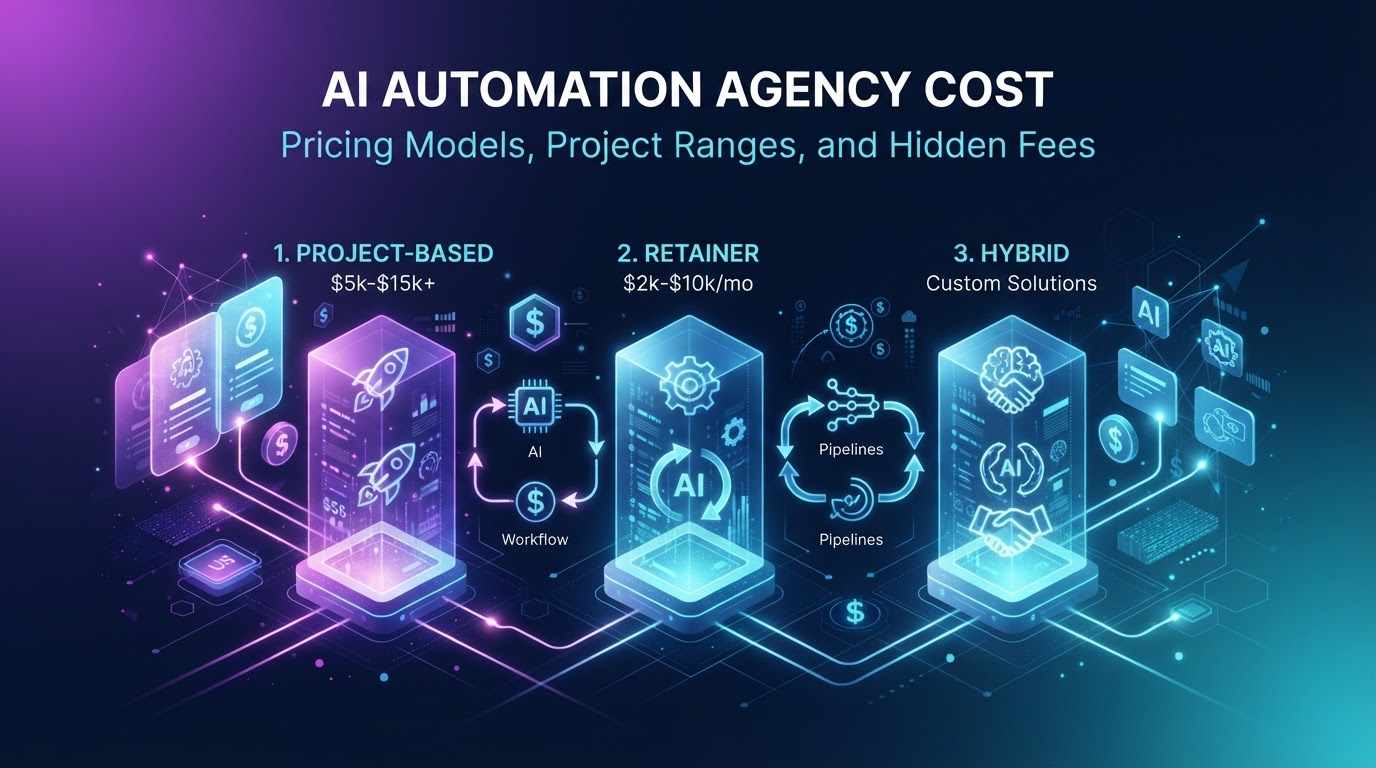
AI automation agency pricing in 2026 spans a wide range, largely because 'automation agency' covers everything from a freelancer configuring Zapier workflows to a full-stack team building custom AI voice agents. On the low end, a solo operator charging hourly might bill $75–$150 per hour for simple workflow setup. On the high end, enterprise-focused agencies quote $50,000–$200,000 for multi-phase custom AI development projects. The middle ground — where most service businesses should be shopping — runs $2,000–$8,000 per month for a managed subscription that delivers sequential workflow builds.
The key variable isn't the headline number; it's what's included. A $3,000/month subscription that delivers one custom automation every two weeks with monitoring and support is dramatically better value than a $15,000 project fee that delivers a single workflow with no ongoing maintenance. According to Clutch's agency pricing research, the average AI development project ranges from $10,000 to $49,000, but that figure conflates one-off builds with ongoing managed services — two very different purchases.
For service businesses — clinics, law firms, contractors, med spas — the relevant comparison isn't agency vs. agency. It's agency vs. in-house hire. A competent in-house AI developer costs $150,000+ annually before benefits, software licenses, and ramp time, as we break down in our in-house vs. on-demand comparison. A managed subscription at a fraction of that cost, with a full team instead of one person, is the value proposition most business owners should be evaluating.
02Pricing Models: Subscription vs. Project vs. Hourly
Most AI automation agencies use one of three pricing models. Understanding the trade-offs of each is essential before signing anything. The subscription model charges a fixed monthly rate for sequential workflow delivery — you submit requests, the agency builds them one at a time, and you can pause or cancel anytime. This is the model we use at Wootomatic because it aligns incentives: the agency benefits from keeping you long-term, so they deliver quality work that actually works rather than rushing to close a project invoice.
The project-based model charges a fixed fee for a defined scope — say, $15,000 for a lead-capture chatbot with CRM integration. This works for one-off builds with clear boundaries, but it creates a misaligned incentive: the agency profits by finishing fast and moving on, which means edge cases, testing, and post-launch tuning get shortchanged. Project pricing also doesn't account for the reality that automations need ongoing maintenance — APIs change, data drifts, and workflows that worked in month one break in month six.
The hourly model bills for time spent, typically $100–$250 per hour. This is the least predictable and most dangerous for the buyer. An agency billing hourly has no incentive to be efficient — every additional hour is revenue. We've seen businesses receive $8,000 invoices for work that should have taken a quarter of the time. If an agency only offers hourly billing, treat it as a red flag. For a structured alternative, our automation audit and consulting service provides a fixed-scope discovery engagement that maps your needs before you commit to any build.
04What You Get for Your Money: Deliverables Breakdown
A well-structured $3,000–$5,000/month managed automation subscription should deliver tangible, measurable work — not vague 'strategy sessions.' Here's what to expect: one to two custom workflow builds per month (each delivered in 5–14 days), ongoing monitoring and maintenance of existing automations, monthly performance reviews with actionable recommendations, and access to a multidisciplinary team (strategist, AI engineer, CRM specialist, workflow builder).
Concretely, in the first 90 days, a subscription at this level should deliver: a lead-capture automation with instant response, a missed-call text-back workflow, an appointment scheduling automation with reminders, an automated review request sequence, and a reporting dashboard. Each of these should be fully deployed, tested, and instrumented — not just 'configured' and left for you to debug. You can see examples of these deliverables in our portfolio of recent work.
The deliverables that matter most are the ones tied to revenue: lead response time reduction, no-show rate improvement, and review velocity. If your agency can't connect their work to these metrics, you're paying for activity rather than outcomes. The best agencies instrument every automation with tracking so you can see exactly how many leads were captured, how many appointments were booked, and how many reviews were generated — all attributable to the automation.
05How to Evaluate Whether the Price Is Right
The simplest evaluation framework: calculate the hours your team currently spends on the tasks being automated, multiply by blended hourly cost, and compare to the subscription price. If the automation saves 40 hours per week at $45/hour, that's $1,800/week or $7,800/month in reclaimed labor value — a $4,000/month subscription pays for itself nearly twice over before counting any revenue impact from faster lead response or reduced no-shows.
The second lens is revenue impact. A missed-call text-back automation that recovers even 5 leads per month, each worth $500 in lifetime value, generates $2,500/month in recovered revenue. An appointment reminder sequence that reduces no-shows by 15% on a business doing $30,000/month in booked appointments saves $4,500/month. These numbers should be part of the conversation from day one — if your agency can't or won't estimate ROI before building, they're selling software, not solutions.
Finally, evaluate the risk profile. A subscription you can pause anytime carries minimal risk — if the work isn't delivering, you stop. An annual contract or large upfront project fee carries significant risk with no recourse if the deliverable underwhelms. The fairest pricing model for both parties is one where the agency earns your continued business every month through visible results, not through contractual lock-in. If you're ready to scope your first automation and see exactly what it would cost, our contact page includes a prospect questionnaire that helps us provide a tailored recommendation within 24 hours.
Key Takeaways
- AI automation agencies charge $2,000–$8,000/month for managed subscriptions, $10,000–$49,000 for project builds, or $100–$250/hour — subscription models align incentives best.
- Always ask for total cost of ownership including third-party tool subscriptions, which can add 30–50% to the headline price.
- Watch for hidden fees: discovery charges, change-order premiums, and early-termination penalties are the three most common cost traps.
- A $3,000–$5,000/month subscription should deliver 1–2 custom workflow builds monthly, ongoing monitoring, and a multidisciplinary team — not vague strategy sessions.
- Evaluate price against reclaimed labor hours and revenue impact — if the agency can't estimate ROI before building, they're selling software, not solutions.

Written by Moise
Founder & Lead Automation ArchitectMoise is the founder and lead automation architect at Wootomatic. With over a decade of hands-on experience designing, implementing, and maintaining high-throughput business automations, CRM pipelines, and custom AI agents, he has architected mission-critical workflows for hundreds of appointment-based and field-service businesses. His focus is on resilient, monitored systems that produce measurable ROI without fragile software bloat.
Ready to Put This Into Action?
Tell us about your workflow and we'll scope a custom automation within 24 hours.
Start Your Automation Project