On This Page
Small Business Cybersecurity Checklist: Protect Your CRM, Customer Data, and Automations
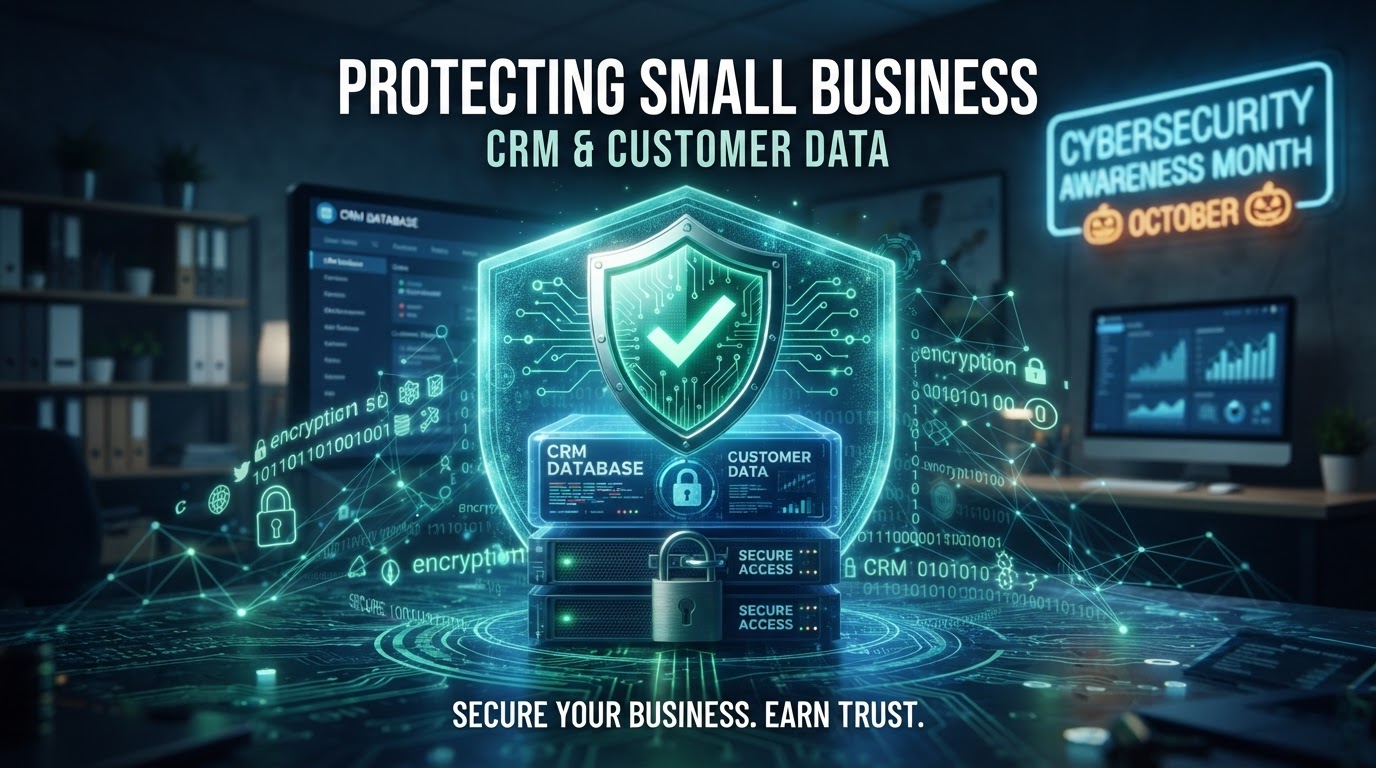
Most small businesses don't get hacked by sophisticated zero-day exploits — they get compromised because a CRM password was reused, an API key was committed to a public repo, or an automation was granted permissions it never needed. October is Cybersecurity Awareness Month, which makes it the right time to run a honest audit of how your customer data, CRM, and automations are actually protected. This checklist is the same one we run with every client before connecting AI or workflows to their systems. It's organized by priority: do the top items first, because they stop the most common and most damaging breaches for the least effort.
01Why Small Businesses Are the Target, Not the Exception
Small businesses assume they're too small to target. The data says the opposite. According to IBM's Cost of a Data Breach Report, the average breach cost for organizations under 500 employees is roughly $150,000–$200,000 — and 83% of breaches involve a human or credential element, not a novel technical exploit. Attackers target small businesses precisely because they typically lack dedicated security staff, formal access policies, and monitoring.
The automation angle makes this worse, not better. Every integration you add — a Zapier connection, a CRM API key, a chatbot with database access — is a new path to your customer data. An automation with overly broad permissions can exfiltrate your entire contact list in a single API call. Security isn't a separate concern from automation; it's a prerequisite for it. If you're connecting AI to your CRM, read our AI CRM security checklist for the specific risks that introduces.
The good news: the highest-impact security measures are inexpensive and mostly about configuration, not tooling. This checklist focuses on the 20% of actions that prevent 80% of breaches.
02The Prioritized Cybersecurity Checklist
Work through this list top to bottom. Each item includes the risk it addresses and the rough cost to remediate.
| Priority | Action | Risk Addressed | Cost to Remediate |
|---|---|---|---|
| 1 | Enable MFA on every CRM, email, and automation account | Credential theft | $0–$5/user/mo |
| 2 | Audit and remove unused integrations & API keys | Excess attack surface | $0 (1–2 hrs) |
| 3 | Apply least-privilege to every automation | Mass data exfiltration | $0 (config) |
| 4 | Rotate all API keys quarterly | Key compromise | $0 (process) |
| 5 | Encrypt customer data at rest (CRM setting) | Data theft on breach | $0–$20/mo |
| 6 | Implement automated offboarding for ex-employees | Insider access | $0 (process) |
| 7 | Back up CRM + automations weekly, test restores | Ransomware / data loss | $20–$100/mo |
| 8 | Train staff on phishing recognition | Social engineering | $0–$300/yr |
| 9 | Add error handling that never logs secrets | Secret leakage in logs | $0 (code review) |
| 10 | Document an incident response plan | Panic-driven mistakes | $0 (half-day) |
Items 1–3 are non-negotiable. If you do nothing else this month, enable multi-factor authentication everywhere, delete every integration you're not actively using, and restrict every automation to the minimum data it needs. These three actions alone prevent the majority of small-business breaches we see in the field.
03Securing Your CRM and Customer Data
Your CRM is the crown jewel — it holds every customer's name, contact info, purchase history, and often payment data. Start with access: every user should have role-based permissions, not blanket admin access. A sales rep doesn't need to export the full contact list; a marketer doesn't need to see payment fields. Most modern CRMs support granular roles — turn them on and audit who has what every quarter.
Data encryption is a setting, not a project. Confirm your CRM encrypts data at rest (most do by default in 2026, but legacy configurations sometimes disable it). For fields containing sensitive information — SSNs, health data, payment details — use field-level encryption if your CRM supports it. If you handle health data, our HIPAA-conscious patient intake automation guide covers the compliance-specific controls you need.
Backups are insurance you only value after you need them. A weekly automated export of your CRM data, stored in a separate cloud account (not the same provider), gives you a recovery path if the primary is compromised or corrupted. Test the restore at least once — an untested backup is an assumption, not a safeguard.
04Securing Your Automations and API Keys
Every automation is a credential holder. A Zapier workflow that syncs your CRM to your email tool holds API keys for both. If that workflow's account is compromised, the attacker has access to both systems. Treat every automation account as a privileged user: enable MFA, use a dedicated service account (not a personal email), and rotate keys quarterly.
Least-privilege is the single most important automation security principle. An automation that creates CRM records only needs create permissions — not read-all, not delete, not export. Most API platforms support scoped tokens or role-based API keys. Use them. A missed-call text-back automation should not be able to read your entire customer database. This is exactly the kind of scoping we apply in our workflow and integration automation builds.
Never commit API keys to code or logs. Store secrets in environment variables or a secrets manager, and ensure your error-handling code strips credentials before logging. We've audited automations where the full API key was logged on every error — a single log access would compromise the entire integration. Review your automation logs for any sensitive data leakage as part of this checklist.
05Failure Cases and Human Handoff
Security isn't set-and-forget. The most common failure we see is integration sprawl: a business adds 15 automations over two years, half become unused, but the API keys and permissions remain active. Every dormant integration is a live attack path. Schedule a quarterly integration audit — if an automation hasn't run in 30 days, disable it and revoke its keys.
The second failure is over-permissioned service accounts. A team creates one admin-level API key 'to make things easier' and uses it across five automations. When one automation is compromised, all five systems are exposed. Create separate scoped keys for each automation; the minor setup overhead is worth the blast-radius containment.
Human handoff matters for security too. Define what happens when an automation encounters an unexpected input or a potential security event. A chatbot that receives a request for sensitive customer data should escalate to a human, not attempt to fulfill it. Build escalation rules into every customer-facing automation — our AI chatbot human handoff guide covers the when and how of bot escalation, including security-sensitive scenarios.
06An Anonymized Example from Our Work
A property management client came to us after a former employee's credentials were used to export 4,000 tenant records from their CRM. The root cause wasn't sophisticated — the employee had left three months earlier, their account was never deactivated, and they had admin-level access. The breach cost the client roughly $35,000 in legal fees, notification costs, and lost business.
We implemented the checklist above in a single sprint: role-based access replaced blanket admin permissions, automated offboarding was wired into their HR process (when an employee is marked terminated, all access revokes within 60 seconds), MFA was enforced on every account, and a quarterly access audit was scheduled. Total cost: under $500/month in tooling and a half-day of configuration. The client's cyber liability insurer reduced their premium by 18% the following renewal — security investment pays in multiple directions.
07Building a Security-First Automation Practice
Security and automation aren't in tension — insecure automation is just fragile automation. A well-secured automation is more reliable, more auditable, and easier to maintain because least-privilege forces clear boundaries between what each workflow does. The checklist above is the foundation; the practice is running it quarterly, not once.
If you're connecting AI to customer systems or building workflows that touch sensitive data, the automation audit and consulting service includes a full security review as part of the discovery — we map every integration, every permission, and every key, then prioritize the fixes that close the biggest gaps first. October is a good prompt to start, but the work matters every month of the year.
Key Takeaways
- Small businesses are the primary target — 83% of breaches involve credentials or human error, not novel exploits.
- The top 3 actions — MFA everywhere, remove unused integrations, apply least-privilege — prevent the majority of breaches for under $5/user/month.
- Treat every automation as a privileged user: dedicated service accounts, scoped API keys, quarterly rotation.
- Never commit secrets to code or logs; review error-handling code for credential leakage.
- Run the full checklist quarterly, not once — integration sprawl and over-permissioned accounts are the most common drift failures.

Written by Moise
Founder & Lead Automation ArchitectMoise is the founder and lead automation architect at Wootomatic. With over a decade of hands-on experience designing, implementing, and maintaining high-throughput business automations, CRM pipelines, and custom AI agents, he has architected mission-critical workflows for hundreds of appointment-based and field-service businesses. His focus is on resilient, monitored systems that produce measurable ROI without fragile software bloat.
Ready to Put This Into Action?
Tell us about your workflow and we'll scope a custom automation within 24 hours.